Horizontal or vertical trading?
- DSGN open interest more than 200 times avg.
- Stock up more than 50% year to date
- Options part of longer-term spread strategy?
How does a stock trading below $20 on average daily volume of less than 500,000 shares get noticed in a market dominated by tech behemoths trading for hundreds or thousands of dollars per share?
Before answering that question, let’s introduce the stock—Design Therapeutics (DSGN), a company with fewer than 100 employees that in January pushed above $10 for the first time more than three years:
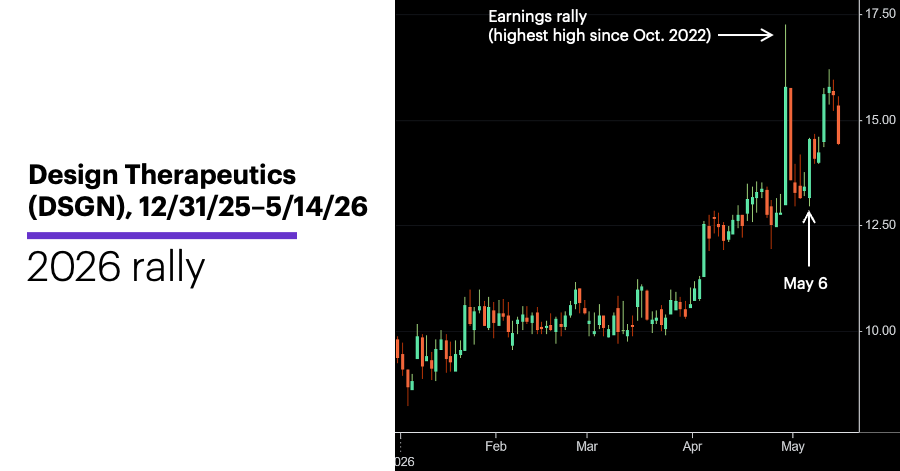
Source: Power E*TRADE. (For illustrative purposes. Not a recommendation.)
While DSGN is up more than 50% so far this year, it likely attracted more attention last week with some exceptionally high option volume totals, which remain exceptionally high open interest (OI). Barring a major liquidation, DGSN could be a mainstay on the LiveAction scan for unusual OI for a while. On Thursday, DSGN’s OI stood at 42,443—more than 200 times average, and roughly 10 times as much as any other stock on a relative basis.
Over the next six expirations, only a relative handful of DGSN contracts (outside the May options expiring today) have any open positions at all—and of those, only four have OI above 100. But for the purposes of this discussion, only two of those contracts matter: the December $10 and $25 calls, each with OI of approximately 20,000.
While the two positions could be unrelated, the fact that both contracts had volume of roughly 15,000 and 5,000 on May 6 and 7, respectively, suggests a potential connection. While a bullish large trader (or traders) may have bought both options or a bearish trader may have shorted them, it’s also possible the contracts were part of a long-short spread—perhaps a vertical (“bull”) call spread consisting of 20,000 long December $10 calls and 20,000 short December $25 calls.
This position could profit in the event DSGN continued to rally, but profits would also be capped at the higher (short) strike price, since any gains on the long options would be offset by losses on the short options at that point. But the spread’s maximum loss is limited to the cost of establishing the trade—which, using the average closing prices for the options on May 6 and 7 (around $6.80 and $2.55, respectively), would have been around $8.5 million. As large as that figure is, however, it’s much less than the $13.6 million that would have been required to buy the $10 calls outright.
By selling the higher-strike calls, the spread trader sacrifices the possibility of more substantial profits in return for a lower cost of entry. Also, the short option benefits from time decay, offsetting some of the long option’s drawback in this regard.
Today’s numbers include (all times ET): Empire State Manufacturing Index (8:30 a.m.), Industrial Production and Capacity Utilization ( 9:15 a.m.).
Today’s earnings include: Sony (SONY).
Click here to log on to your account or learn more about E*TRADE's trading platforms, or follow the Company on Twitter, @ETRADE, for useful trading and investing insights.