For (long) options, time is a tyrant
- NTNX call volume elevated early Wednesday
- Large call trade may have been a liquidation
- Stock rallied, but calls lost value over life of trade
Since falling to its lowest level since late 2023 in early February, software stock Nutanix (NTNX) has traded in a narrow consolidation between $35 and $43, down roughly 50% from the record high it hit last May.
While the stock’s congested trading may have made an afterthought for many traders, it did make an appearance on Wednesday’s LiveAction scan for unusual options volume. With the stock up more than 2% midday to around $40, the standout position was in the April $42.50 calls, which expire a week from Friday.
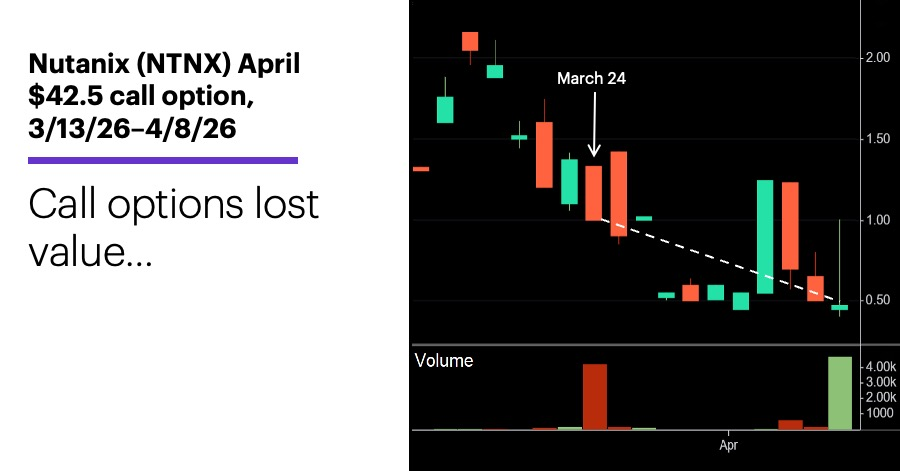
Given open interest (OI) in the contract was 4,900, it was impossible to know if traders were establishing new positions or closing out existing ones. The call’s price chart shows a similar-sized position was opened 10 trading days earlier, on March 24:
Source: Power E*TRADE. (For illustrative purposes. Not a recommendation.)
Since then, the option had fallen from $1.00 to below $0.50. While most people would likely assume this decline was triggered by a decline in the stock, NTNX was actually trading higher around midday Wednesday than it was on March 24:
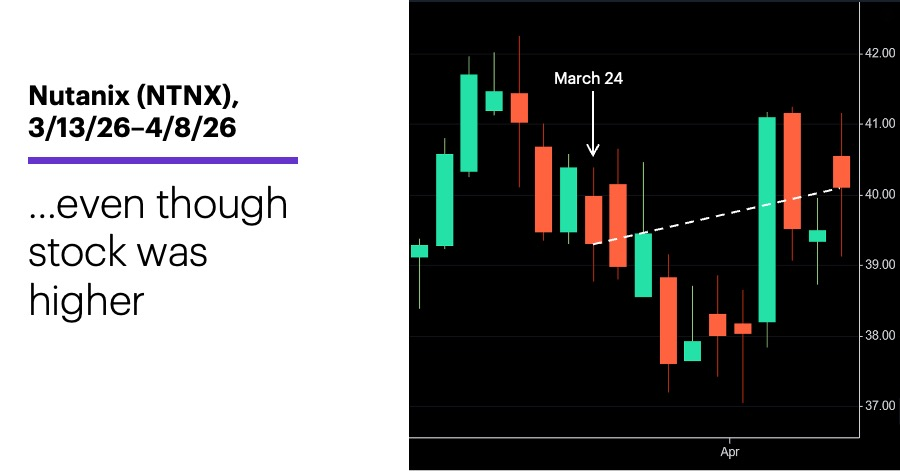
Source: Power E*TRADE. (For illustrative purposes. Not a recommendation.)
This apparent disconnect is a real-world illustration of time decay—the inevitable loss of value that all long options experience over their lifetimes, regardless of whether the underlying stock goes up or down, or volatility increases or decreases. The more time that passes, the lower the odds the stock will be able to make the move required to turn an out-of-the-money option like the NTNX call into a profitable, in-the-money option before expiration.
That’s why time decay becomes a bigger problem for options owners the closer expiration gets. Options lose time value at an accelerated rate as expiration approaches because one unit of time—say, a day—constantly becomes an increasingly large portion of the option’s life. For example, when an option has 60 days until expiration, one day represents just 1.7% of the contract’s lifetime. When that option has 10 days until expiration, one day represents 10% of its lifetime—that is, a bigger piece of its “time value.”
Tomorrow’s OI totals will show whether Wednesday’s NTNX call trades were new positions or liquidations. If they’re the latter, we’ll also know that the traders who shorted the calls on March 24 and were the ones who profited on their positions—not the option buyers who may have been correct about the stock’s direction, but wrong on timing.
Market Mover Update: Crude oil’s 16% drop on Wednesday after the announcement of a two-week US-Iran ceasefire was the market’s biggest one-day decline since 2020. May WTI crude oil futures (CLK6) fell more than 17% intraday to $91.05, but bounced to end the day above $94.
Today’s numbers include (all times ET): Personal Income and Spending (8:30 a.m.), PCE Price Index (8:30 a.m.), GDP (8:30 a.m.), Weekly Jobless Claims (8:30 a.m.), EIA Natural Gas Report (10:30 a.m.).
Today’s earnings include: Blackrock (BLK), WD-40 (WDFC).
Click here to log on to your account or learn more about E*TRADE's trading platforms, or follow the Company on Twitter, @ETRADE, for useful trading and investing insights.