Disruption vs. interruption
- Insurance stocks pull back on AI disruption
- AON down more than 9% on Monday
- A new version of the “Amazon Effect”?
While potential AI disruption of the software industry has been the focus of many traders and investors lately, the same theme has played out in another industry this week—although it hasn’t received the same level of attention.
Many insurance stocks—in the US on Monday and in Europe on Tuesday—sold off after reports of a new GenAI insurance app allowing users to receive personalized home insurance quotes (and, eventually, buy policies).
Among the harder hit insurers were Willis Towers Watson (WTW) and Arthur J. Gallagher (AJG), both of which dropped more than 10% on Monday, while Aon (AON) slid more than 9%—breaking below its 2025-2026 lows and tagging its lowest level in more than 18 months:
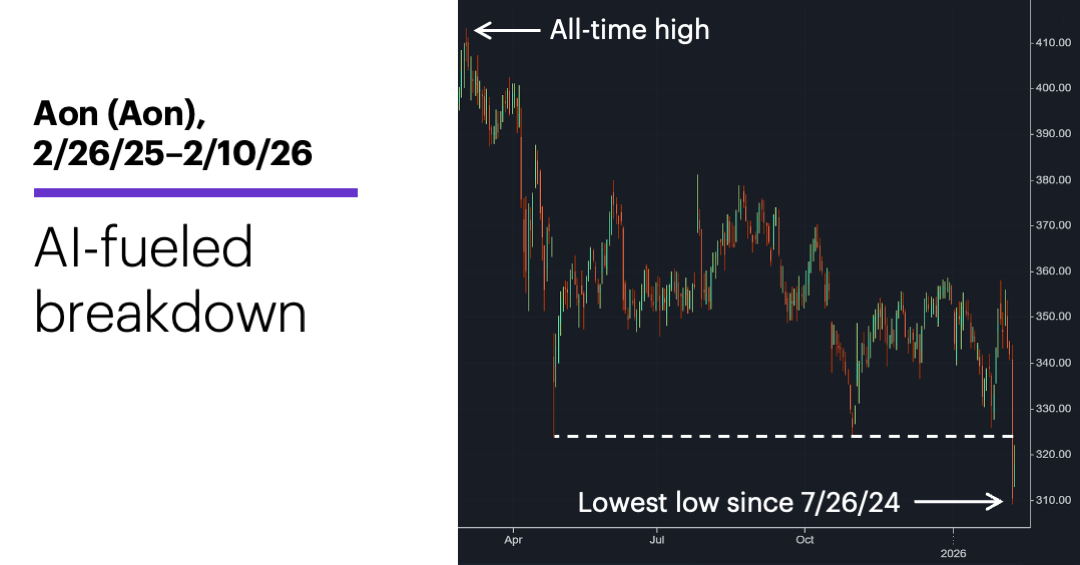
Source: Power E*TRADE. (For illustrative purposes. Not a recommendation.)
Unlike AJG and WTW, AON rebounded on Tuesday. But given AON has experienced only nine other 9%-or-larger down days over the past 25 years, Monday’s move wasn’t one to dismiss out of hand.
However, the uncertainty of exactly how AI may disrupt different industries—let alone specific stocks—over the long term makes it fair to wonder whether, in some case, immediate market reactions may be overdone.
In a way, these episodes may be analogous to what for many years was called the “Amazon Effect”—sharp sell-offs in various “legacy” businesses that were sometimes assumed to be doomed as soon as news broke that Amazon was extending its long, powerful arm into their businesses.
For example, in May 2017 CVS (CVS) and other pharmacy stocks sold off sharply on news that Amazon was planning to get into the prescription fulfillment business. The stock fell nearly 7% that month, ending it at $76.83. In the years since, CVS indeed fell as low as as $43.56—but not before it traded as high as $110.83. On Tuesday it was trading around $75—less than $2 below where it was at the end of May 2017.
As is the case in the software arena, AI may benefit certain insurance companies as much as disrupt them. It’s likely that in the coming year some insurance companies will flourish and others will flounder—just as they would if they hadn’t been “disrupted” by AI. Regardless, these are questions that won’t be answered anytime soon. In the meantime, traders and investors would be wise to cast an objective eye on short-term price action.
Market Mover Update: Some stocks that have suffered in the recent software sell-off continued to stabilize on Tuesday. Salesforce (CRM), Microsoft (MSFT), and Amdocs (DOX) all logged their third-straight up days, although the trio are still well below their January highs.
Today’s numbers include (all times ET): Employment Report (8:30 a.m.).
Today’s earnings include: Airbnb (ABNB), Albemarle (ALB), AppLovin (APP), GoDaddy (GDDY), Humana (HUM), Kraft Heinz (KHC), Shopify (SHOP), T-Mobile (TMUS).
Click here to log on to your account or learn more about E*TRADE's trading platforms, or follow the Company on Twitter, @ETRADE, for useful trading and investing insights.