A firmer case for software
- S&P 500 software industry down 17% this year
- GenAI “threat” only one part of the story
- Certain stocks testing notable technical levels
One day doesn’t make a trend, but traders and investors watching tech kick off the week by following through on its Friday surge may have noticed that software stocks were significant contributors to the rally.
Year-to-date, though, software was still the biggest drag on the tech sector—down more than 17%, more than any other S&P 500 industry group by a wide margin. A recent report from Morgan Stanley & Co. discusses several aspects of the group’s recent volatility, but notes one of the main fears is the idea that GenAI code-generation tools will allow more companies to develop software themselves, rather than relying on products and services from third-party companies.
While the analysts fully acknowledge this potential to disrupt the industry, as the report’s name suggests, AI is software. The question is not whether software will ultimately monetize GenAI, but which companies will effectively tap into its capabilities.1
The bear case, the analysts argue, doesn’t adequately reflect the ability of software vendors to benefit from—rather than by disrupted by—the GenAI innovation cycle. As they point out, software developer productivity has been improving for decades, making the new code-generation tools simply the “latest in a long line of innovations lowering the cost of software development.”
This could translate into potential long-term buying opportunities in some software stocks, although the analysts stress that recently discounted prices won’t, by themselves, necessarily reverse investor sentiment. To reverse that tide, companies will likely need to provide clear evidence that they’re embracing GenAI and showing improved overall revenue growth—a process, they note, that takes time.
That said, some of the stocks highlighted in the report have recently reached technical levels that may have grabbed the attention of traders. Microsoft (MSFT), which is down nearly 25% from its October record close, recently pulled back to test the bottom of the large up gap it formed (after releasing earnings) at the beginning of May 2025:
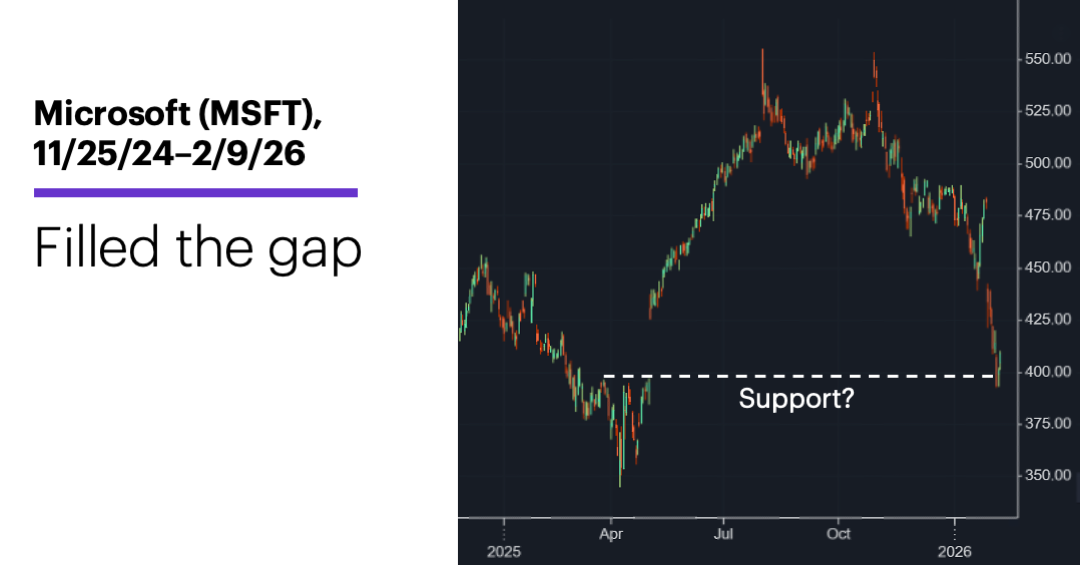
Source: Power E*TRADE. (For illustrative purposes. Not a recommendation.)
Another, Salesforce (CRM), is more than 45% below its December 2024 record high—a move that included a 15% sell-off in the past eight trading days after the stock broke down below its late-2025 and early 2026 lows (shorter dashed line):
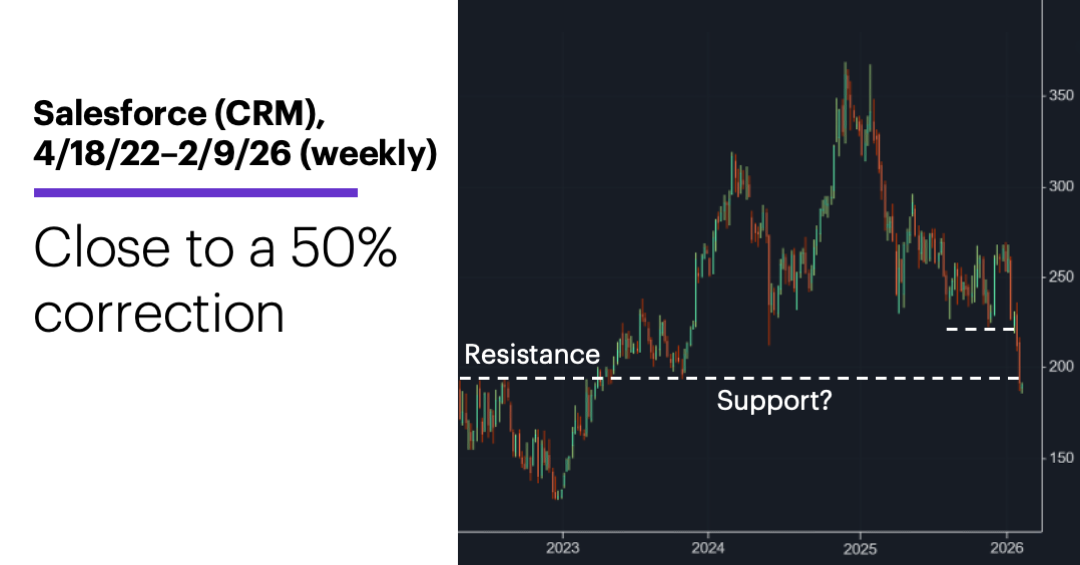
Source: Power E*TRADE. (For illustrative purposes. Not a recommendation.)
This sell-off dropped shares to a longer-term support-resistance level dating back to 2022 (roughly $190–$195). The stock broke out above its late-2022 highs in early 2023, pulled back to test that level in late 2023, then rallied to its eventual record high.
Whether these stocks find support near these or other levels remains to be seen—picking tops and bottoms is an impossible task, and there’s no way to know if software has exited this period of uncertainty and volatility. But as the report suggests, there are reasons to question some aspects of the bearish software argument and keep tabs on potential opportunities in the space.
Today’s numbers include (all times ET): NFIB Small Business Optimism Index (6 a.m.), Retail Sales (8:30 a.m.), Employment Cost Index (8:30 a.m.), Import and Export Prices (8:30 a.m.), Business Inventories (10 a.m.).
Today’s earnings include: Astera Labs (ALAB), CVS (CVS), Datadog (DDOG), Quest Diagnostics (DGX), Ford (F), Coca Cola (KO), Lattice Semiconductor (LSCC), Lyft (LYFT), Marriott International (MAR), Mattel (MAT), Spotify (SPOT), Teradata (TDC).
Click here to log on to your account or learn more about E*TRADE's trading platforms, or follow the Company on Twitter, @ETRADE, for useful trading and investing insights.
1 MorganStanley.com. Software Gut Check—AI IS Software. 2/9/26.