Early boost carries August for bulls
E*TRADE from Morgan Stanley
It was far from a month-long bullish celebration, but most stock investors will likely be happy to take the US market’s August gain—even though it appeared to get its biggest boost from hopes for a resolution to the US-Iran conflict that never materialized.
The S&P 500 (SPX) broke out of a roughly two-month trading range at the beginning of August as oil prices tumbled roughly 10% amid hopes the Strait of Hormuz stalemate was drawing to a close. However, after edging to new record highs around mid-month, the bullish momentum faded as long-term Treasury yields hit multi-decade highs, oil rebounded as the US and Iran exchanged airstrikes, and the Fed appeared to take a more hawkish stance on inflation:
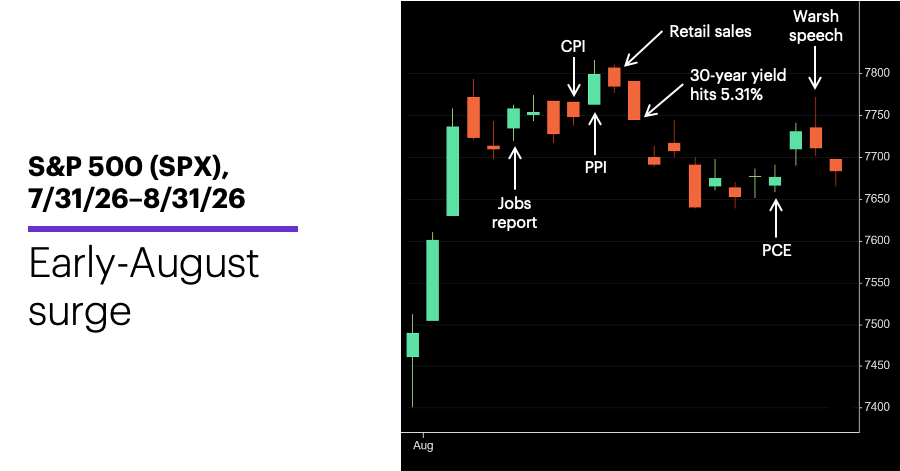
Source: Power E*TRADE. (For illustrative purposes. Not a recommendation. It is not possible to invest directly in an index.)
Energy was the S&P 500’s strongest sector last month, while utilities was its weakest. Tech and materials also posted strong gains. Six of the SPX’s 11 sectors were negative for the month.
Software was the S&P 500 tech sector’s strongest industry group. Despite tech’s relative strength, it was another choppy month for semiconductors. NVIDIA (NVDA) pulled back—along with most other semiconductor stocks—in the two weeks leading up to the AI chipmaker’s August 26 earnings announcement.
Volatile oil prices climbed amid a shifting Middle East narrative. Reversing the early-month sell-off, oil prices ended August slightly higher. As the dispute over the Strait of Hormuz dragged on, the US announced economic sanctions against Iran, and prices jumped as the two countries traded military strikes at the end August.
Long-term yields mostly ignored attempts to lower them. The US Treasury’s announcement that it planned to buy long-term Treasuries in order to lower their elevated yields haven’t, so far, had much of an effect. At the end of August, the 30-year yield was a little below the 19-year high of 5.31% it hit earlier in the month, while the benchmark 10-year yield closed at a 19-month high of 4.75%.
The US led developed markets last month, but lagged emerging markets. The MSCI Emerging Markets Index was a step ahead of the S&P 500 last month, while the MSCI Developed Markets Index was a step behind.
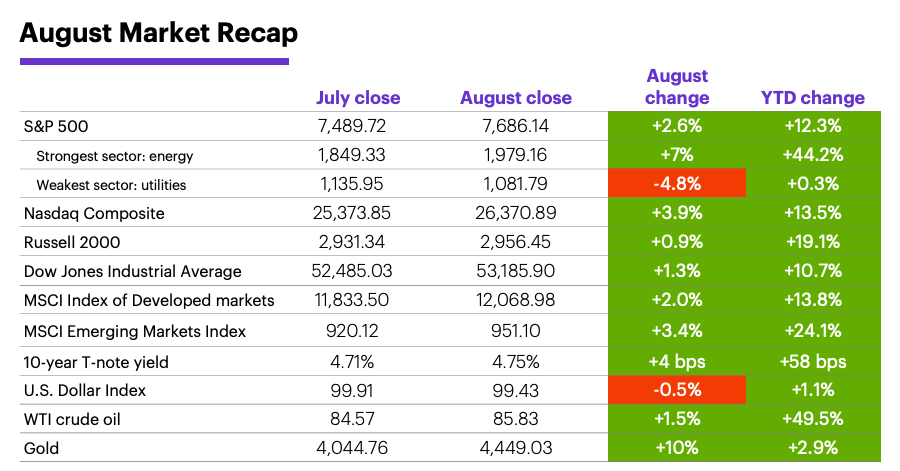
Data source: Power E*TRADE and FactSet. (For illustrative purposes. Not a recommendation. It is not possible to invest directly in an index.) Note: crude oil, gold, and U.S. Dollar Index data reflect spot-market prices. BPS (basis point) = 0.01%. MSCI Index of Developed Markets and MSCI Emerging Markets Index represent “total-return” performance (index change including dividend reinvestment). Past performance is not indicative of future results.
Most of last month’s economic data appeared to point to the Fed remaining on hold. In the first half of August, a soft jobs report, cooler-than-expected inflation data from the Consumer Price Index (CPI) and Producer Price Index (PPI), and soft retail sales appeared to ease concerns the Fed would hike interest rates.
Those concerns returned in late August as the Fed appeared to change its tone. At the Jackson Hole Economic Symposium on August 28 (two days after a warmer-than-expected PCE Price Index inflation print), Fed Chairman Kevin Warsh acknowledged inflation wasn’t meaningfully moving toward the Fed’s 2% target level. The CME FedWatch Tool’s probability of a September rate hike jumped from roughly 35% the day before the speech to 57.5% after it, ending August at 65.4%.
Despite the perceived hawkishness of the speech, Morgan Stanley & Co. economists aren’t convinced hikes are coming. While noting Chairman Warsh said, “inflation is the problem and rate hikes are the tool to fix it,” they don’t believe he intended those comments as guidance. While it’s “a closer call now,” they think the September 11 CPI release will provide further evidence of disinflation, and believe the Fed will likely remain on hold the remainder of the year.1
A stellar earnings season winds down. By August 28, 97% of S&P 500 companies had released Q2 earnings—86% reported positive earnings surprises, while 77% reported positive revenue surprises.2
The AI paradigm may be shifting from spending to results, according to Morgan Stanley & Co. strategists. While the AI buildout will likely continue (with bottlenecks around chips, power, and various “connectors”), they say the focus is shifting away from capex and toward companies being able to realize free-cash-flow generation, monetization, and return on investment. Rotation within AI will continue, they say, with positive signs from the AI adopters rather than the pure enablers.3
The US government will likely prioritize control over various aspects of AI as it becomes a source of national economic and geopolitical power.
Insight of the month: AI sovereignty. With AI becoming a critical source of national economic and geopolitical power, the US government will prioritize control over compute, data, energy, talent, models, and supply chains, according to Morgan Stanley & Co. strategists. The analysts believe this will extend the AI buildout and create opportunities across chips, data centers, networking, power, and the cloud. Their recent research includes a list of stocks with the “highest materiality” to this theme.4
Has small-cap relative strength run its course? The Russell 2000 (RUT) index has comfortably outperformed the S&P 500 so far this year, but Morgan Stanley Wealth Management strategists aren’t inclined to increase small-cap exposure. They highlight a few potential headwinds: Small-cap valuations are no longer as compelling relative to higher-quality large caps, forecasts for a jump in 2027 small-cap margins may be “ambitious,” and rate-hike risk continues.5
September market history. The S&P 500 has fallen in seven of the past 12 Septembers. Although last year brought the strongest September since 2010, it’s still the only month with a negative average S&P 500 return since 1957. And while September has been positive once more than negative since 1991, it remained the weakest month of the year. If September is positive this year, it will be just the fourth time in the past seven decades that it has been an up month three or more years in a row.6
Important September dates: Employment Report (9/4), US markets closed for Labor Day (9/7), PPI (9/10), CPI (9/11), Retail Sales (9/16), Fed interest rate decision (9/16), Housing Starts (9/17), PCE Price Index (9/30), Q2 GDP, final estimate (9/30).
Click here to log on to your account or learn more about E*TRADE's trading platforms, or follow the Company on X (Twitter), @ETRADE, for useful trading and investing insights.
1 MorganStanley.com.Jackson Hole Reaction: The Hike Not Taken. 8/28/26
2 FactSet. Earnings Insight. 8/28/26.
3 MorganStanley.com. What Are Companies Saying? 8/24/26.
4 MorganStanley.com. AI Sovereignty: Policy, Market, and Economic Implications. 8/19/26.
5 MorganStanley.com. The GIC Weekly: Revisiting Small Caps. 8/31/26.
6 Figures reflect S&P 500 (SPX) monthly closing prices, 1957–2025. Supporting document available upon request.
Because of their narrow focus, sector investments tend to be more volatile than investments that diversify across many sectors and companies. Technology stocks may be especially volatile. Risks applicable to companies in the energy and natural resources sectors include commodity pricing risk, supply and demand risk, depletion risk and exploration risk. Health care sector stocks are subject to government regulation, as well as government approval of products and services, which can significantly impact price and availability, and which can also be significantly affected by rapid obsolescence and patent expirations.
Yields are subject to change with economic conditions. Yield is only one factor that should be considered when making an investment decision.