Fed hold continues
To no one’s surprise, the Federal Reserve announced after its latest policy meeting that it was leaving its benchmark fed funds rate in a target range of 3.5%-3.75%:
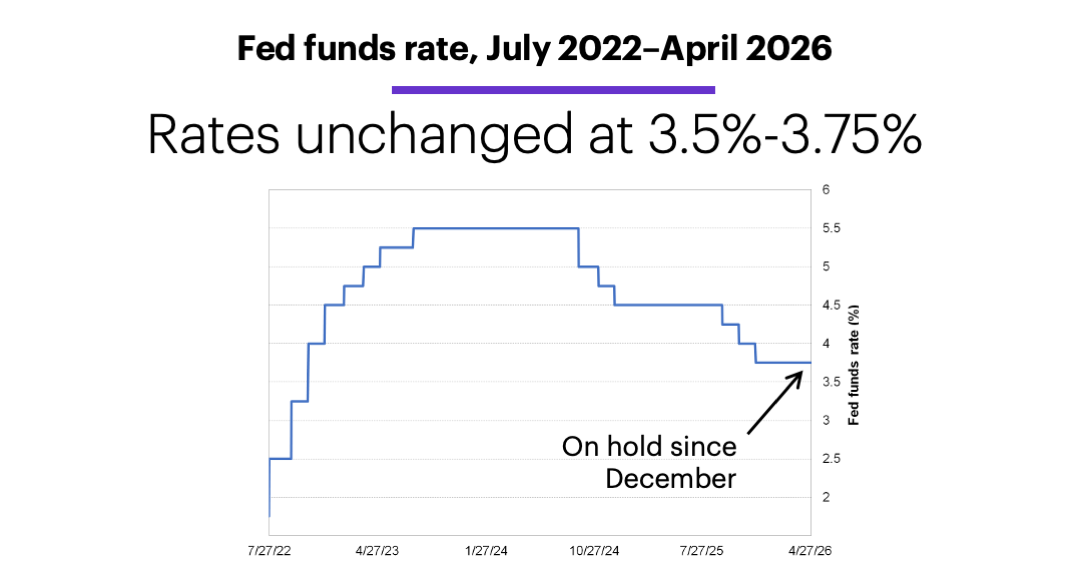
Source (data): Federal Reserve. Values represent upper end of Fed funds target range. (For illustrative purposes. Not a recommendation.)
The market-based probability of a rate cut immediately before the meeting was essentially zero, reflecting the uncertainties the Fed is currently confronting—most notably, the potential inflationary impact from high energy prices as a result of the Iran war.
Fed Chair Jerome Powell has been under enormous pressure from the White House to lower interest rates. When the Department of Justice last week dropped its investigation into his handling of the Fed headquarters renovation project, it appeared to clear the way for Trump nominee Kevin Warsh to be confirmed as the next chairman—possibly in time for the next policy meeting in June. However, it’s unlikely his tenure will result in an immediate pivot to rate cuts.
Ellen Zentner, Chief Economic Strategist for Morgan Stanley Wealth Management, points out that in his nomination hearing before the Senate Banking Committee last week, Warsh didn’t lay the groundwork for aggressive easing. She also notes that any policy shift would still require a consensus from the FOMC board, and the current economic backdrop of firm growth and sticky inflation doesn’t justify lower rates.
After the meeting, Morgan Stanley & Co. economists pushed back their expectations for the next Fed rate cuts from September and December 2026 to January and March 2027.1
Note: The Fed’s next policy meeting is scheduled for June 16-17, 2026.
1 MorganStanley.com. April FOMC Reaction Later Cuts and a Longer Hold. 4/30/26.