Options take flight as stock loses altitude
- UAL call volume 10 times average on Tuesday
- Matching trades in October OTM calls
- Stock fell 23% from June high to September 1 low
On Tuesday morning, with United Airlines (UAL) shares trading around $108.50 (on their way to an intraday low of $105.18), two large trades occurred in out-of-the-money (OTM) call options—more than 30,000 contracts in both the October $120 and $135 calls:
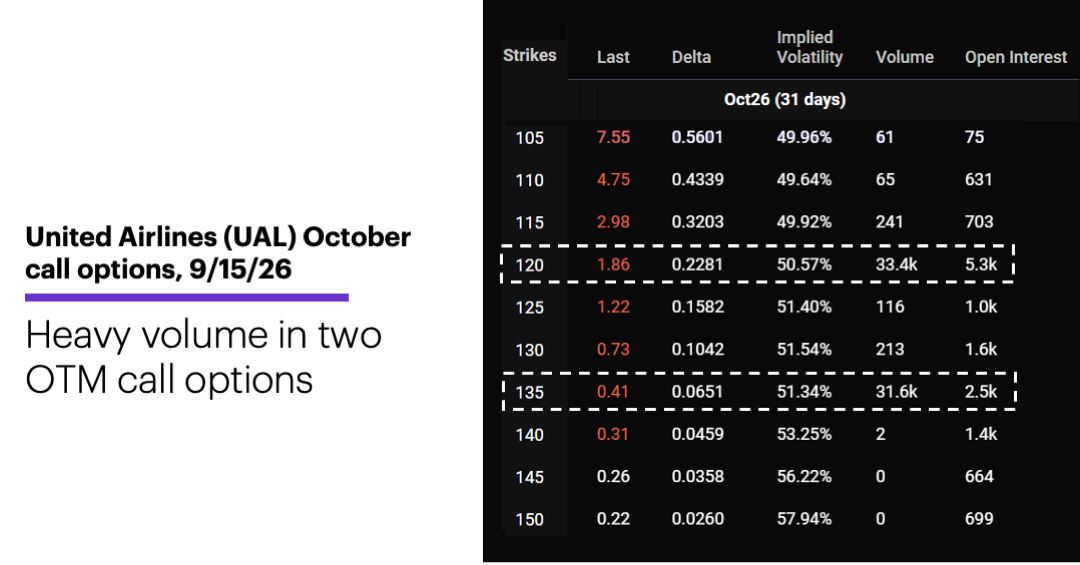
Source: Power E*TRADE. (For illustrative purposes. Not a recommendation.)
Despite the roughly 1,800-contract difference in their volume, intraday charts showed almost identical trades (of around 31,400 contracts) were executed in both options at the same time. So, although it’s possible the positions were unrelated, it appeared more likely they were connected.
One possibility is that a large trader established a bull call spread—purchasing the $120 calls and simultaneously selling the $135 calls. A big advantage of this position, relative to an outright long-call position, is that it’s less expensive: The premium collected from shorting the higher-strike calls offsets some of the premium paid for the (more expensive) lower-strike calls. For example, using the last trade prices shown above, instead of paying $1.86 per contract to establish a long position in the $120 calls, the trader could have spent $1.45 ($1.86–$0.41) to establish a bull call spread.
This cost advantage is balanced by the spread’s limited upside. While a long call can potentially continue to gain value as long as the stock rallies, the bull call spread’s profit is capped at the short call’s strike price—above that level, the short call’s losses cancel the long call’s gains. In this case, the spread’s maximum profit would occur if the stock closed at $135 or higher at expiration, in which case the short $135 call would expire worthless, and the trader would get to keep all the collected premium ($0.41 per contract), in addition to the profits from the long call.
UAL’s price chart may offer a possible explanation of why a trader would have wanted to establish such a position—if, in fact, Tuesday’s trade activity did represent a large call spread. After closing at a record high of $136.11 in June, UAL has (so far) sold off in two major waves, the second of which reached $104.63 on September 1—a 23% drop:
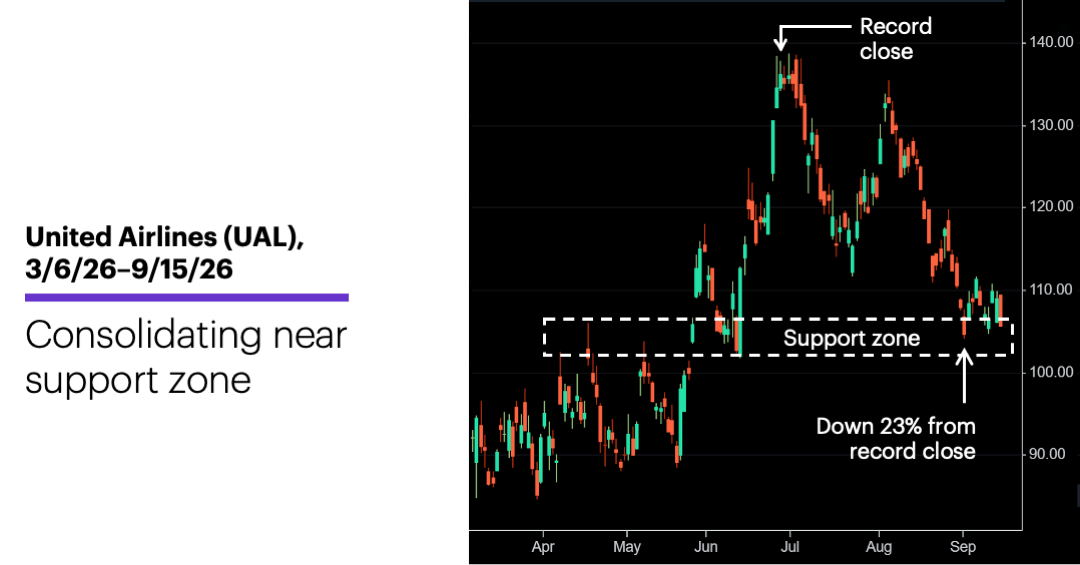
Source: Power E*TRADE Pro. (For illustrative purposes. Not a recommendation.)
This move dropped UAL to a potential support level—the zone from roughly $101.75 to $106, which contains the stock’s June pullback low, as well as its April and May swing highs. A trader who thought the stock would potentially rally from this level over the next few weeks could have been motivated to establish a bull call spread.
On the other hand, a trader who thought the stock had additional downside may have inverted the position—selling the $120 calls and buying the $135 calls. The maximum profit of this “bear call spread" is the net credit received when establishing the position. Unlike the bull call spread, losses aren’t capped, since the short call can continue to lose money if the stock keeps rallying.
While there has to be a seller for every buyer—representing the potentially opposite market outlook—one argument that could be made against the idea that a large trader initiated a bear call spread in this scenario is that the stock’s recent 23% decline could, conceivably, decrease the odds of significant additional downside during the options’ limited time window.
Market Mover Update: Interestingly, the U.S. Global Jets ETF (JETS) appeared on Tuesday’s LiveAction scan for unusual call volume, along with UAL.
The US 10-year Treasury yield closed at 5% on Tuesday—its highest level since 2007.
Oil prices continued to surge on Tuesday, with October WTI crude oil futures climbing more than 5% intraday to $106.75.
Signet Jewelers (SIG) closed below its September 9 close for the fourth day in a row (see “Gauging earnings momentum”).
Today’s numbers include (all times ET): mortgage applications (7 a.m.), Retail Sales (8:30 a.m.), Import and Export Prices (8:30 a.m.), Business Inventories (10 a.m.), Housing Market Index (10 a.m.), EIA Petroleum Status Report (10:30 a.m.), Fed interest rate announcement (2 p.m.).
Today’s earnings include: Lennar (LEN).
Click here to log on to your account or learn more about E*TRADE's trading platforms, or follow the Company on X (Twitter), @ETRADE, for useful trading and investing insights.