Aftermarket move overdone?
- Aerospace “aftermarket” stocks down on oil concerns
- Many stocks in group in correction territory
- Oil prices resetting at higher levels?
The ripple effects of the Iran war and elevated crude oil prices are evident in many corners of the market, but Morgan Stanley & Co. analysts recently noted their effect in an area many traders and investors may have overlooked—aerospace aftermarket companies, which provide components, spare parts, and maintenance and repair services for commerical aircraft.
They pointed out that the stocks they cover in this group were down nearly four times as much as the S&P 500 (roughly 15% vs. 4%) since the conflict in Iran started. With higher oil prices potentially impacting travel costs and demand, it makes sense that those concerns would extend to the companies that service aircraft.
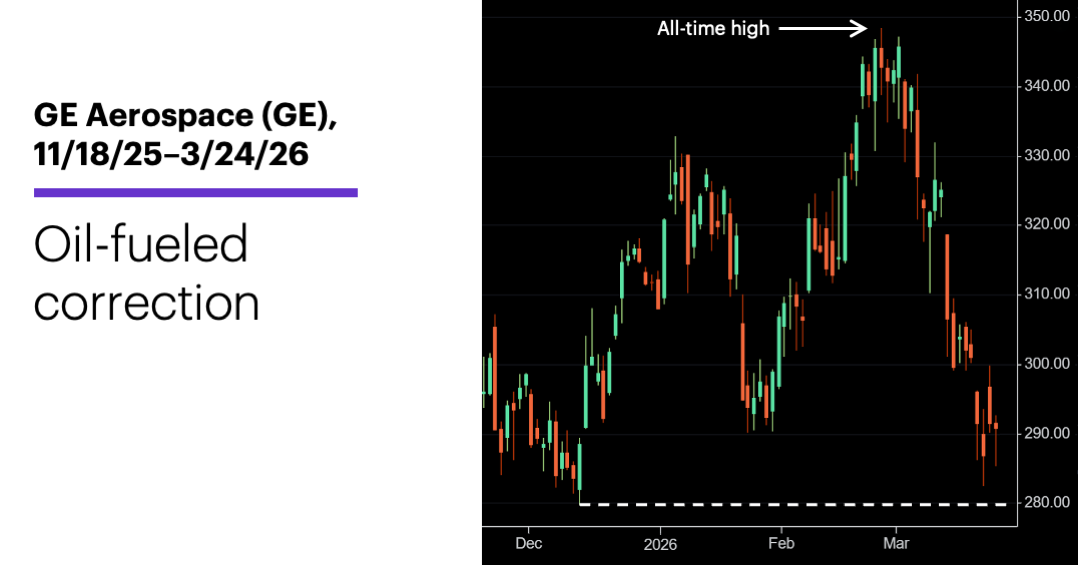
One of those stocks, GE Aerospace (GE), was trading near its December lows on Tuesday after pulling back as much as 16% in February:
Source: Power E*TRADE. (For illustrative purposes. Not a recommendation.)
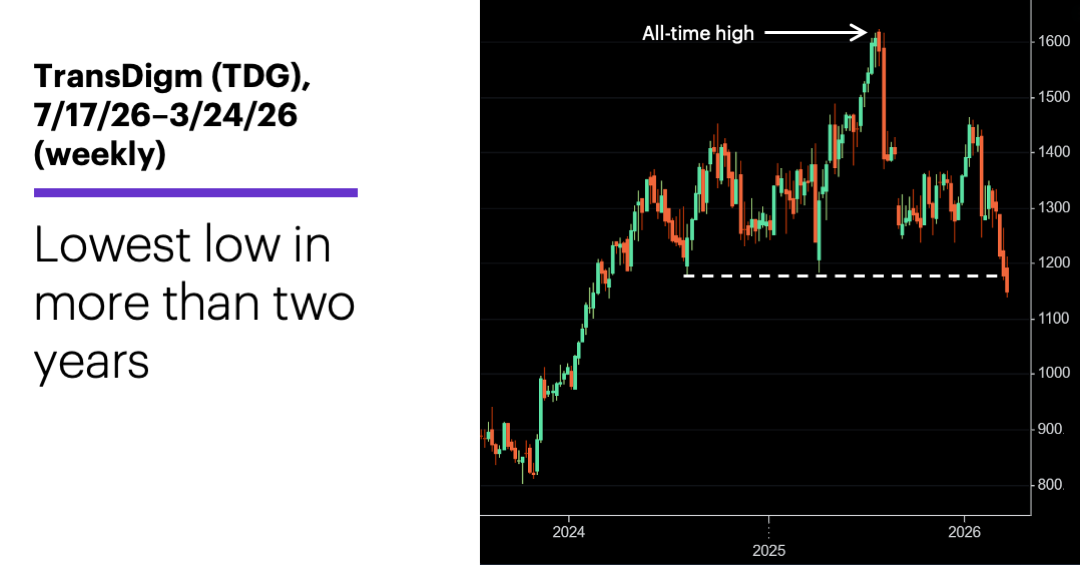
Another, TransDigm (TDG), broke below its August 2024 and April 2025 lows this week, extending the correction from its July 2025 record high to nearly 30%:
Source: Power E*TRADE. (For illustrative purposes. Not a recommendation.)
But the analysts argue that the group’s recent pullback may be overdone, given short-term cost pressures won’t change the fundamental realities of long-term aircraft maintenance. As they explain, because commercial aircraft have roughly 25-year useful lives, a few weeks (or even quarters) of cost disruption probably won’t materially impact demand for aftermarket services.
Although the analysts concede that maintenance patterns may shift modestly, “they cannot be avoided, particularly in an environment where aircraft use remains high, supply constraints for new aircraft delivery persist, and retirement levels remain low.”1
Market Mover Update: Oil prices followed Monday’s 10% sell-off with a signficant rebound on Tuesday. June WTI crude oil futures rallied nearly 5% (see “Looking for a signal in oil”).
On Tuesday, Morgan Stanley & Co. strategists outlined the possibility that oil prices may not quickly return to their levels before the US and Israeli attacks on Iran. The disruption in energy markets, they explain, has moved “beyond logistics to production,” implying higher energy prices (relative to their previous base-case scenario) even in the event of a de-escalation of hostilities. They see the $80-90 range as a 2026 price point in a de-escalation scenario, while continued constraints would likely drive oil prices near $100-110 for at least two to three months.2
Today’s numbers include (all times ET): mortgage applications (7 a.m.), Durable Goods Orders (8:30 a.m.), import and export prices (8:30 a.m.), current account (8:30 a.m.), advance retail and wholesale inventories (8:30 a.m.), EIA Petroleum Status Report (10:30 a.m.).
Today’s earnings include (all times ET): Paychex (PAYX), Winnebago (WGO), Worthington Enterprises (WOR).
Click here to log on to your account or learn more about E*TRADE's trading platforms, or follow the Company on Twitter, @ETRADE, for useful trading and investing insights.
1 MorganStanley.com. Aftermarket Pullback Creates Buying Opportunity Amid Oil-Driven Volatility. 3/24/26.
2 MorganStanley.com. Energy Shocks in the Economy & Markets II. 3/24/26.