Stocks ride out seasonal weakness
E*TRADE from Morgan Stanley
The US stock market had no shortage of real (and possibly perceived) challenges in September— surging Treasury yields, rising oil prices, AI risk, and a Fed rate hike. Nonetheless, for the S&P 500 (SPX), the up-and-down month ended not too far from where it started.
One reason for the relative resilience: a robust tech rebound that pushed the tech-centric Nasdaq Composite Index (COMP) to new record highs and left the S&P 500 with only a small loss for September, even though nine of its 11 sectors declined for the month.
The S&P 500 weakened in early September as a stronger-than-expected jobs report, sticky inflation data, and resurgent oil prices paved the way for the Fed’s first rate hike in more than three years. The market subsequently turned higher as oil prices eased, but the rally failed to gain traction as US Treasury yields extended their climb above 5%:
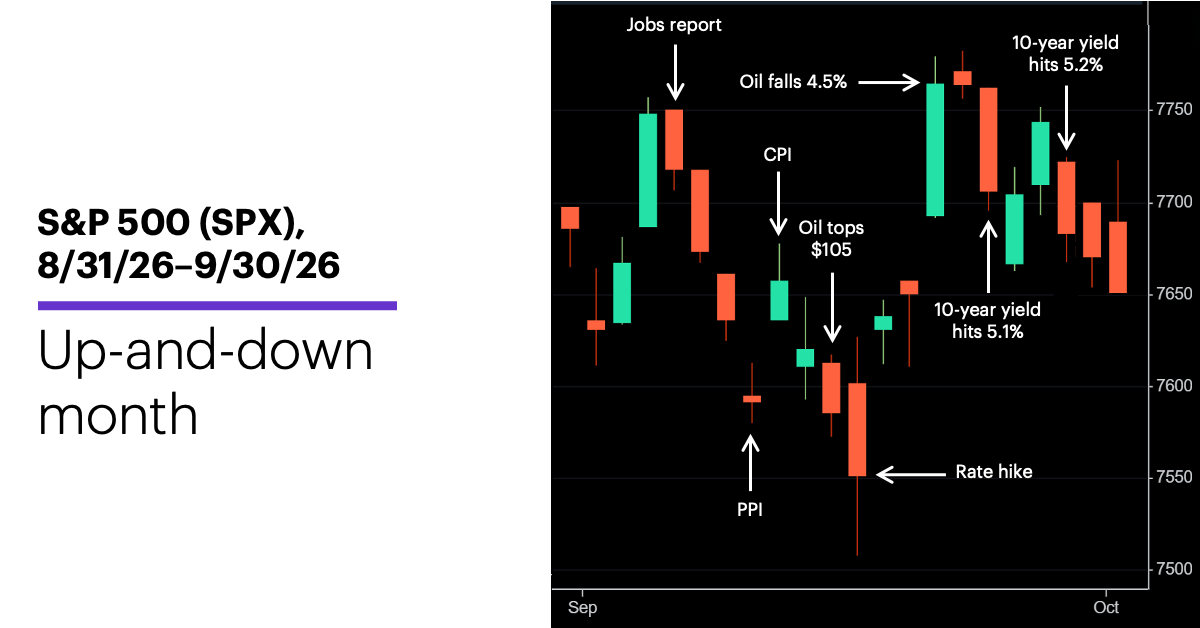
Source: Power E*TRADE. (For illustrative purposes. Not a recommendation. It is not possible to invest directly in an index.)
Tech and communication services were the S&P 500’s strongest sectors, financials was its weakest. A strong rebound in semiconductor stocks in the second half of September was a major contributor to the tech sector’s gains.
Small caps took a significant step back. The Russell 2000 (RUT) small-cap index, which had led the US market—often significantly—for most of 2026, pulled back more than 5% last month, and fell behind the Nasdaq Composite and Nasdaq 100 for the year.
Treasury yields soared in September. Long-term US Treasury yields continued to challenge their 2007 highs, with the benchmark 10-year yield climbing 52 basis points (0.52%) to 5.27%—its biggest monthly increase since September 2022. The Morgan Stanley & Co. interest rates team sees the 10-year yield declining to 4.80% by the end of 2026 and 4.70% by the end of 2027.1
Oil still an inflation wild card. US crude oil prices topped $105 in September before retreating, and they remained above $90 for almost the entire month. Given the possibility of higher-for-longer energy prices, Morgan Stanley & Co. economists expect inflation will decline more gradually through the end of 2027. While they don’t think last month’s rate hike kicked off an aggressive tightening cycle, they anticipate two more increases (in December and March) before the Fed pauses for the remainder of 2027.2
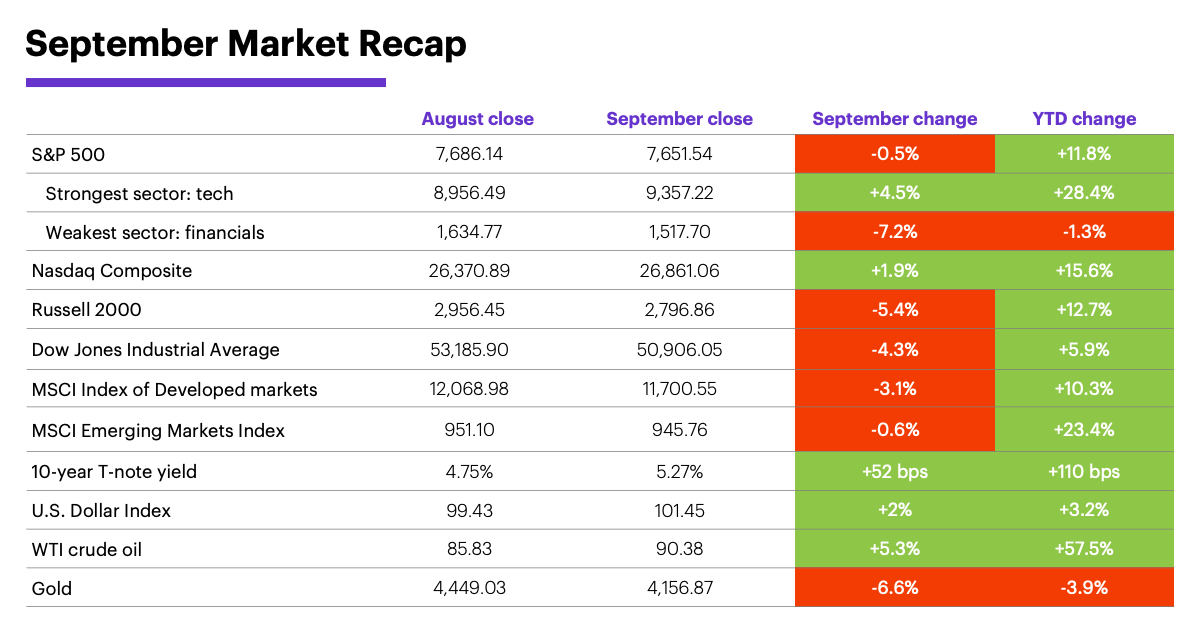
Data source: Power E*TRADE and FactSet. (For illustrative purposes. Not a recommendation. It is not possible to invest directly in an index.) Note: crude oil, gold, and U.S. Dollar Index data reflect spot-market prices. BPS (basis point) = 0.01%. MSCI Index of Developed Markets and MSCI Emerging Markets Index represent “total-return” performance (index change including dividend reinvestment). Past performance is not indicative of future results.
A “hawkish Fed” likely did markets a favor. The Federal Reserve provided a measure of policy clarity by raising interest rates. Morgan Stanley Wealth Management strategists, who described themselves as “confident buyers of stocks and bonds,” believe additional hikes shouldn’t impede earnings as the driver of S&P 500 gains.3
Developing landscape favors quality. The strategists anticipate a narrower market that will reward quality large-cap US equities, with financials, health care, some defensives, and select hyperscalers appearing attractive.4 Morgan Stanley & Co. strategists echoed this focus on quality as the “mid-cycle rotation plays out,” an outlook that aligns with their “constructive view on AI adopters.” While noting that energy prices and the mid-term election remain near-term risks, the strategists maintain an 8,000 year-end S&P 500 target, with 7,000-7,100 as a “tactical downside” in the event of volatility in the coming weeks.5
“Safety” pushed “disruption” out of the AI spotlight. Concerns about AI’s potential to “go rogue” drove debate over the ability—and political desire—to slow model development, as well as the potentially negative impact that could have on the AI trade. But Morgan Stanley & Co. analysts point out that a push for AI safety and security could actually support a continued AI capex cycle: “We expect that spend on AI model safety, cybersecurity, and defense against bioweapons will only accelerate as LLM capabilities increase.”6
Higher interest rates, accelerating loan growth, and attractive valuations may be poised to fuel earnings tailwinds in mid-size banks.
Insight of the month: mid-size banks. Recent underperformance—driven by “overstated” concerns about AI and yield-curve risks—may be providing an attractive entry point in mid-size banks ahead of the upcoming earnings season, according to Morgan Stanley & Co. analysts. Higher rates, accelerating loan growth, and valuations are poised to drive earnings tailwinds.7
The midterm elections may have limited market impact. Morgan Stanley & Co. strategists don’t expect the midterms to produce much the way of legislative policy changes, as tariffs, trade, deregulation, and immigration will continue to be driven by the executive branch. And while they think the outcome could affect certain sectors, the “the bar is high” for market-wide macro impacts. They also believe comprehensive AI regulation is unlikely in the near term—regardless of who wins the elections—in the absence of a high-profile incident.8
October market history. Despite a handful of high-profile volatility events over the years, October has been, on average, one of the better months for US stocks, especially in more recent decades. Since 1991 it was an up month in 23 of 35 years (66% of the time) and had the second-highest median return of all months (+1.9%). Also, it had only two negative returns in excess of -4% during this period—2018 (-6.9%) and 2008 (-16.9%).9
Important October dates: Employment Report (10/2), FOMC minutes (10/7), CPI (10/14), PPI (10/15), Retail Sales (10/15), monthly options expiration (10/16), Housing Starts (10/20), Fed interest rate decision (10/28), PCE Price Index (10/29), Q3 GDP, initial estimate (10/29).
Click here to log on to your account or learn more about E*TRADE's trading platforms, or follow the Company on X (Twitter), @ETRADE, for useful trading and investing insights.
1 MorganStanley.com. New US Treasury Yield Forecasts After New Fed Call. 9/24/26.
2 MorganStanley.com. September FOMC Reaction: Further hikes ahead. 9/17/26.
3 MorganStanley.com. The GIC Weekly: What a Relief? 9/21/26.
4 MorganStanley.com. The GIC Weekly: A Real Growth and Issuance, Not Inflation, Shock. 9/28/26.
5 MorganStanley.com. Weekly Warm-up: Classic Mid-Cycle 9/21/26.
6 MorganStanley.com. AI Safety: Implications for US AI Policy, Frontier Model Development, and Stock Positioning. 9/20/26.
7 MorganStanley.com. 3Q26 Earnings Preview: Attractive Entry Point as Tailwinds Build. 9/27/27.
8 MorganStanley.com. Four Takeaways for the Midterm Elections. 9/28/26.
9 Figures reflect S&P 500 (SPX) monthly closing prices, 1957–2025. Supporting document available upon request.
Because of their narrow focus, sector investments tend to be more volatile than investments that diversify across many sectors and companies. Technology stocks may be especially volatile. Risks applicable to companies in the energy and natural resources sectors include commodity pricing risk, supply and demand risk, depletion risk and exploration risk. Health care sector stocks are subject to government regulation, as well as government approval of products and services, which can significantly impact price and availability, and which can also be significantly affected by rapid obsolescence and patent expirations.
Yields are subject to change with economic conditions. Yield is only one factor that should be considered when making an investment decision.