Fed makes its move
The Federal Reserve hiked interest rates for the first time in more than three years, raising its benchmark fed funds rate to a target range of 3.75%-4%:
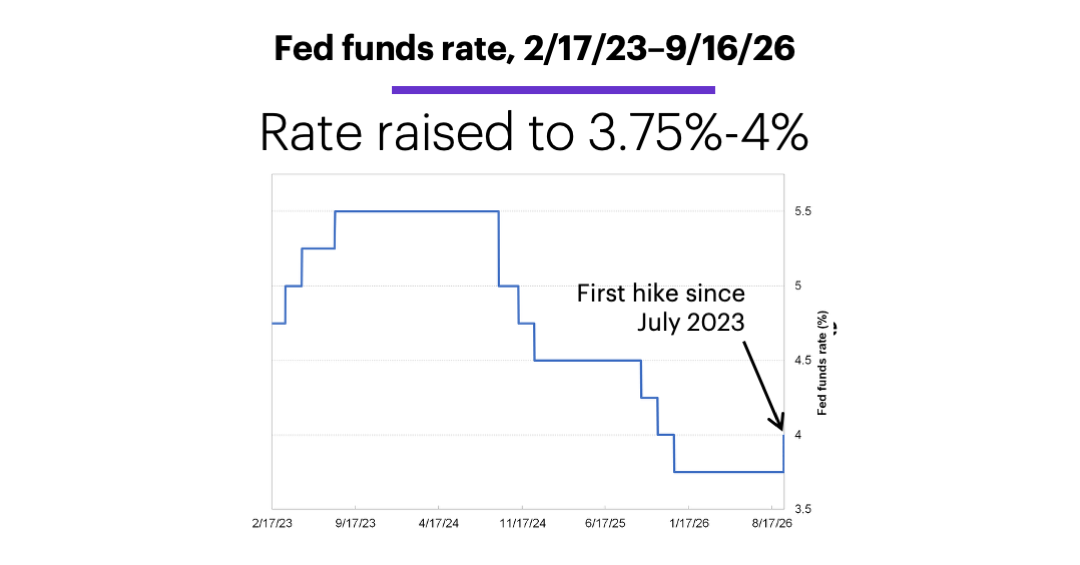
Source (data): Federal Reserve. Values represent upper end of Fed funds target range. (For illustrative purposes. Not a recommendation.)
The hike ended a five-meeting pause on rate changes, a run that spanned the end of Jerome Powell’s chairmanship and the beginning of Kevin Warsh’s. (The last adjustment was a cut in December 2025.) But in recent weeks, the economic backdrop shifted notably.
A June retreat in oil prices, followed by moderate (but still above-target) inflation readings, gave the Fed room to take a “wait-and-see” stance on interest rates. However, the latest surge in oil prices— accompanied by higher-than-expected inflation numbers, rising long-term US Treasury yields, and strong labor-market data—appeared to leave the Fed with little choice but to raise interest rates at this meeting.
The Warsh-led Fed has made a point of stressing the Fed’s inflation-fighting mission, and some regional Fed presidents had called for rate hikes at the Fed’s July policy meeting. Meanwhile, the White House has continued to lobby for rate cuts.
Earlier this week, Morgan Stanley & Co. economists noted that although inflation is decelerating, it isn’t doing so as quickly as the Fed would like, with upside surprises reflecting resurgent energy prices and continued demand strength tied to AI-related investment. As a result, they expected the Fed to hike rates by 0.25% hike at both the September and December policy meetings.1
While acknowledging the very real risks posed by higher oil prices and an unexpected inflation shock, among other factors, Morgan Stanley & Co. strategists described last week’s upside inflation surprises as “old news.” They argued that a September rate hike might support the Fed’s inflation-fighting credibility without “fostering a significant spike in the cost of capital.”
They also noted that quality stocks remain a valuable inflation hedge over the intermediate-term, and have tended to outperform around a first hike: The equal-weight Top 1,000 has typically recovered to +9% nine months after a first hike, while quality outperformed across every window around the move, including +3% over three months and +5% over the following year.2
Note: The Fed’s next policy meeting is scheduled for October 27-28, 2026.
Click here to log on to your account or learn more about E*TRADE's trading platforms, or follow the Company on X (Twitter), @ETRADE, for useful trading and investing insights.
1 MorganStanley.com. September FOMC Preview: Sticky Inflation Forces Rate Hikes. 9/15/26.
2 MorganStanley.com. Weekly Warm-up: The Inflation Data is Old News to the Markets. 9/14/26.