New Fed, familiar result
The start of the Kevin Warsh Era at the Federal Reserve felt very much like the end of the Jerome Powell Era, as the central bank announced it would leave its benchmark fed funds rate in a target range of 3.5%-3.75%:
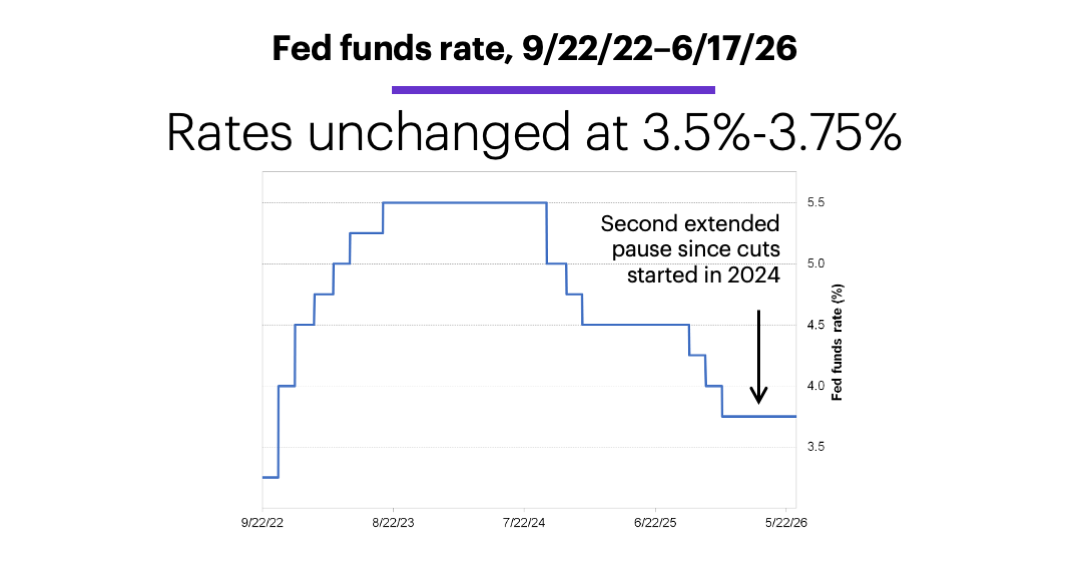
Source (data): Federal Reserve. Values represent upper end of Fed funds target range. (For illustrative purposes. Not a recommendation.)
While the Fed has long been under enormous pressure from the White House to lower interest rates, the inflationary threat posed by high energy prices as a result of the Iran war kept the Jerome Powell-led Fed on the sidelines. Despite the recent announcement that the US and Iran agreed to re-open the Strait of Hormuz on June 19—news that was followed by a sharp drop in crude oil prices—continued uncertainties may also keep the Warsh-led Fed in wait-and-see mode.
In discussing the realities of resuming “normal” oil production and transport, Morgan Stanley & Co. analysts estimated it could take “several weeks for tanker flow to be restored,” with 50% of production back by September, and 80% by December. But they also point to recent signs of weakness in physical oil markets. Overall, they see a “tight” summer for oil and a potential rebound from current levels into Q3, with the global Brent crude oil price (which is currently priced nearly $4 above US oil) anchored around $80 by Q4.1
On Tuesday, when US spot crude oil prices were trading between $77-$78, December WTI oil futures were trading between $73-$74—suggesting prices could decline another 5% by the end of the year, although they would still be more than 11% higher than they were immediately before the US-Iran conflict. Similarly, inflation could potentially remain sticky, even if it cools.
Morgan Stanley & Co. economists noted the Fed’s statement, forecasts, and press conference were hawkish, with new Chair Kevin Warsh focused on lowering inflation to 2% and showing little concern about labor-market strength. And although nine board members expect at least one hike in 2026, the economists continue to be more optimistic about easing inflation, forecasting the Fed will remain on hold the remainder of the year.2
Note: The Fed’s next policy meeting is scheduled for July 28-29, 2026.
1 MorganStanley.com. Let the Oil Flow. 6/15/26.
2 MorganStanley.com. June FOMC Reaction: Hawkish Today, Reforms Tomorrow. 6/18/26.