Options market flexes muscle
- PLNT call volume more than 230 times avg. on Thursday
- May represent a low-risk, limited-upside trade
- Stock in short-term pullback, but still near record high
On a relatively quiet day for the market, Planet Fitness (PLNT) was an outlier on Thursday—but not because of the way its stock was trading.
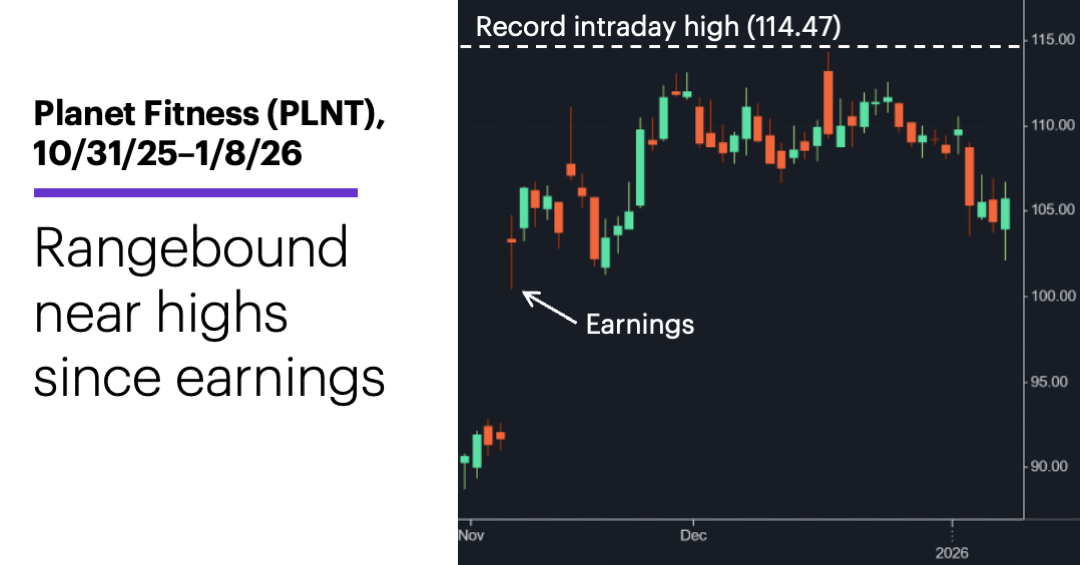
PLNT shares were modestly higher most of the day even though they tested their mid-November lows early in the session. Despite a recent pullback—and mostly sideways trading since the company’s last earnings announcement—the stock was still relatively close to its all-time high above $114:
Source (data): Power E*TRADE. (For illustrative purposes. Not a recommendation.)
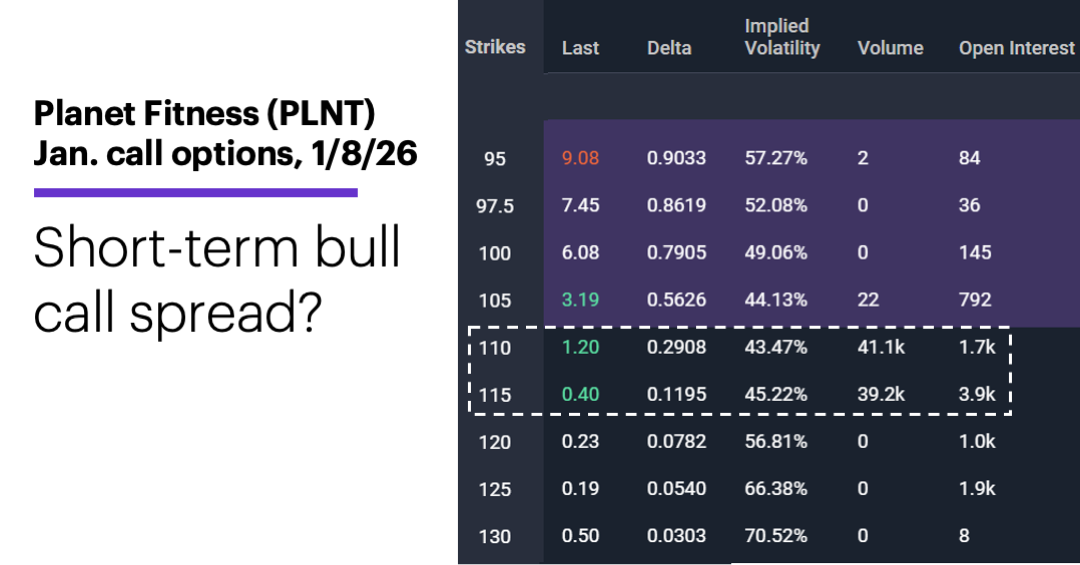
Things were much different in the options market. PLNT was conspicuous on multiple LiveAction scans by virtue of call options volume that was 218 times average. Calls outnumbered puts roughly 85 to one.
The volume in question was concentrated in two options expiring a week from today—the January $110 and $115 calls:
Source: Power E*TRADE. (For illustrative purposes. Not a recommendation.)
What can we surmise about these trades? Given their short-term nature, one could argue the buyers expected PLNT to make a fairly solid up move over the next six trading days. Meanwhile, the sellers could have been betting the stock wouldn’t reach either strike price by expiration, in which case they’d get to keep the premium they collected.
Two quick observations suggest a single large trader may have been buying and selling options simultaneously. First, these are significant positions. If we round the trades to 40,000 contracts, that means they represent eight million shares of stock. (PLNT’s average daily volume is around 1.4 million shares.)
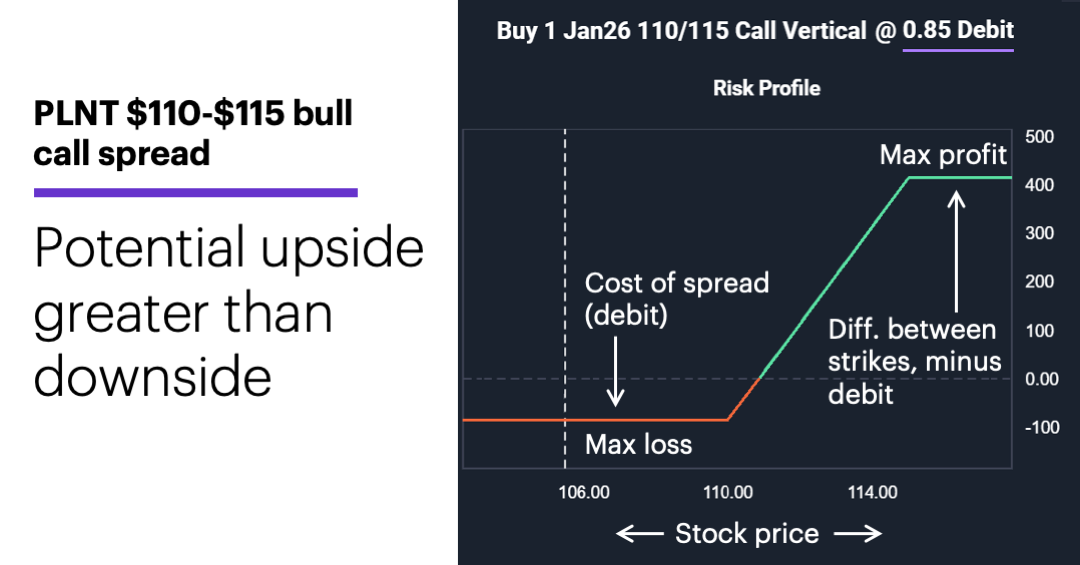
Second, the fact that almost all the activity in both options occurred simultaneously in two large trades (at 9:40 a.m. and 10 a.m. ET) suggests they could be part of a single “spread” trade—specifically, a vertical (bull) call spread. That would mean a trader bought the $110 calls while shorting the $115 calls at the same time. The following chart shows the reward-risk profile for this spread using the approximate trade prices from Thursday morning ($1.25 for the $110 call and $0.40 for the $115 call):
Source: Power E*TRADE. (For illustrative purposes. Not a recommendation.)
The long calls would provide upside exposure in the event the stock rallied, while the premium collected from the short calls effectively reduces the cost of that exposure—but also limits the trade’s upside. The position has the potential to profit (at expiration) if the stock is trading between the two strike prices.
Any bull call spread’s maximum risk is the cost of the spread (the “debit”), which in this case is $85 ($125–$40). No matter how far the stock falls, the spread can’t lose any more than that. A bull call spread’s maximum potential profit—which would be realized at expiration if the stock closed at the higher strike price—is the difference between the strike prices, minus the debt—in this case $415 ($500-$85). No matter how much more the stock rallies, the spread’s profit can’t increase.
If this was, in fact, a large bull call spread, the position’s reward-risk ratio was nearly five to one. That sounds promising, but the key word in the previous paragraph is “potential.” While the trade’s maximum profit is much greater than its maximum loss, that doesn’t mean the stock has a higher probability of rallying into the profit zone than it does of falling.
Today’s numbers include (all times ET): Employment Situation (8:30 a.m.), Housing Starts and Building Permits (8:30 a.m.), Housing Starts and Permits (8:30 a.m.), Consumer Sentiment (10 a.m.).
Click here to log on to your account or learn more about E*TRADE's trading platforms, or follow the Company on Twitter, @ETRADE, for useful trading and investing insights.