Market digests Fed
- S&P 500 dips for week as Fed hikes, 10-year yield tops 5%
- Tech rides out AI jitters, oil ends week below $100
- This week: durable goods, Trump-Xi meeting
For the second week in row, US stocks ran a gauntlet of challenges—the highest long-term Treasury yields in nearly two decades, four-month oil price highs, an AI risk debate, and a Fed rate hike—and came out the other end bruised rather than battered.
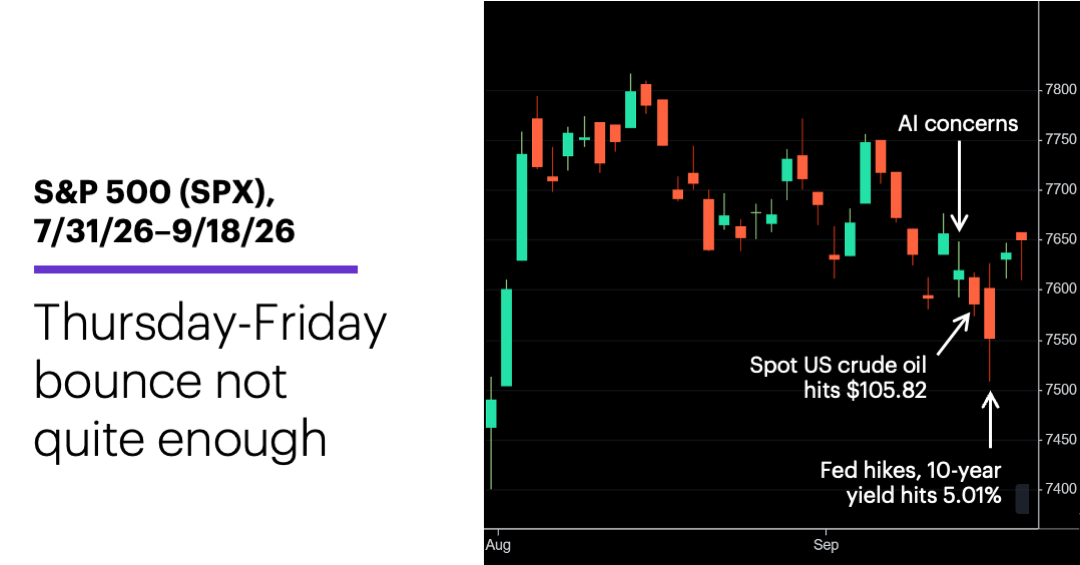
Last Wednesday the S&P 500 (SPX) fell to its lowest low since July 31 as the Federal Reserve hiked interest rates for the first time in three years and the 10-year US Treasury yield closed at 5.01%. A strong Thursday rebound looked like it could reverse the week’s fortunes, but Friday’s minimal gain left the SPX modestly in the red:
Source: Power E*TRADE. (For illustrative purposes. Not a recommendation. Note: It is not possible to invest in an index.)
The headline: Stocks slip for second week.
The fine print: The SPX fell more than 0.8% early last Monday amid debate over whether the continued acceleration in AI-model development called for a coordinated slowdown to assess its risks and implement guardrails. But the bearish sentiment was fairly contained: Tech and communication services were the second- and third-strongest SPX sectors for the week, and the Nasdaq 100 (NDX) tech index was the strongest major US stock gauge. (Cybersecurity stocks were one of the beneficiaries of last Monday’s AI-risk concerns.)
The number: 5%. The benchmark 10-year Treasury yield closed at or above 5% three times last week (Tuesday, Wednesday, and Friday)—the first time it’s done so since 2007.
The move: US spot crude oil prices hit $105.82 last Tuesday—their highest level since May 18—but eased the rest of the week after reports that Saudi Arabia planned to reroute some of its exports to offset supply disruptions caused by the previous week’s drone attack on a key pipeline. However, gasoline and diesel prices rose for the week.
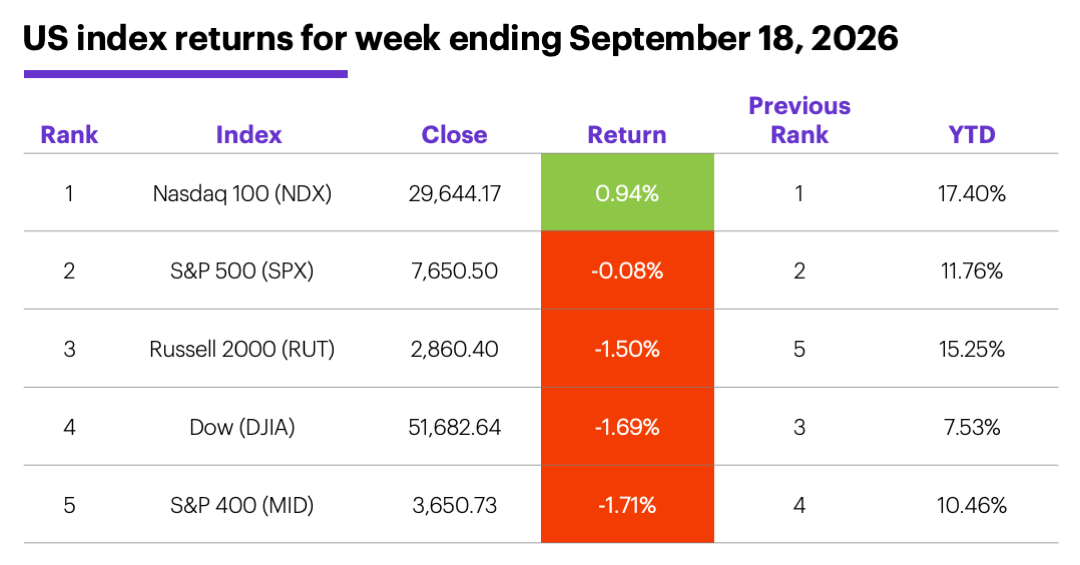
The scorecard: The NDX was the only major US index to post a gain last week, and it jumped ahead of the Russell 2000 (RUT) small-cap index for the year-to-date lead:
Source (data): Power E*TRADE. (For illustrative purposes. Not a recommendation.)
S&P 500 sector returns: The strongest S&P 500 sectors last week were health care (+1.8%), communication services (+1.2%), and information technology (+1.1%). The weakest sectors were utilities (-3%), financials (-2.4%), and real estate (-2.3%).
S&P 500 stock moves: Last week’s biggest gains were Revvity (RVTY) +15% to $143.45 and CrowdStrike (CRWD) +15% to $237.65. The biggest losses were J.B. Hunt Transport (JBHT) -13% to $234.25 and Charter Communications (CHTR) -12% to $128.17. Other moves: Zscaler (ZS) +18% to $191.73 on Monday, Xenon Pharmaceuticals (XENE) -31% to $39.75 on Friday.
Yields and the dollar: After pulling back last Thursday, the 10-year US Treasury yield rebounded Friday to end the week up 0.04% at 5.01%. The US Dollar Index (DXY) climbed 1.10 to a seven-week high of 100.22.
Commodity futures: November WTI crude oil (CLX6) ended the week up $0.14 at $96.08. December gold (GCZ6) bounced of last Wednesday’s six-week low to end last week up $16 at $4,424.90 last week. Biggest gains: December oats (ZOZ6) +7.3%, November RBOB gasoline (RBX6) +3.8%. Biggest declines: October 50% lean beef trim (BTFV6) -20.9%, December cocoa (CCZ6) -10.6%.
Crypto: Bitcoin +4.8% to $80,901.46 last week, Ethereum +3.8% $2,611.35.
Coming this week
This week’s numbers include:
●Wednesday: S&P Global Manufacturing and Services PMIs (flash), Trump-Xi meeting
●Thursday: Current Account (Q2), New Home Sales
●Friday: Durable Goods Orders, Consumer Sentiment (final)
This week’s earnings include:
●Tuesday: AutoZone (AZO), KH Home (KBH), MillerKnoll (MLKN), Thor Industries (THO), Worthington Enterprises (WOR)
●Wednesday: Cracker Barrel (CBRL), Cintas (CTAS), General Mills (GIS), Paychex (PAYX)
●Thursday: Costco (COST), Darden Restaurants (DRI), Scholastic (SCHL), TD Synnex (SNX)
Fed hikes: adjustment vs cycle
Last week the Fed hiked rates for the first time since 2023, and delivered an “initial” hike—that is, the first in a series of increases following a pause or reduction—since 2022.
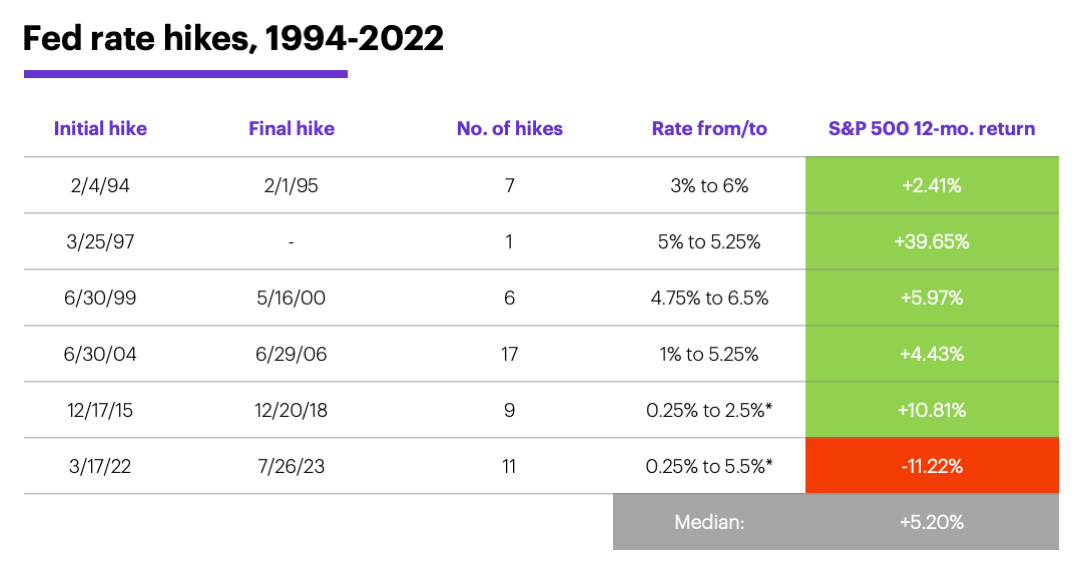
The following table shows the six other times since 1994 that the Fed initiated rate hikes after pauses or rate-cutting cycles. There was only one instance (1997) of the Fed issuing a standalone hike rather than a series of increases:
Source (fed funds data): Federal Reserve. *Ending (“to”) value represents upper end of fed funds target range.
Morgan Stanley & Co. economists expect the Fed to deliver two more hikes1—in December and March—which would make this the shortest multi-hike cycle of the past three decades.
While the table shows the SPX was lower 12 months after an initial hike only once (the 2022-2023 cycle), the returns were varied, and half were less than 6%.2
While Morgan Stanley Co. strategists argued last week that higher rates in general shouldn’t necessarily derail the stock market in the long term, they acknowledge both the potential for near-term volatility, as well as the risk posed to their outlook by higher oil prices and an unexpected inflation shock. That pressure could turn what currently looks like a modest policy adjustment into a more-prolonged hiking cycle.
This scenario, they note, could lead to a near-term stock-market downturn, although they add that they’d view such a development as “the finishing move to the correction and mid-cycle/quality transition that began several months ago.”3
Click here to log on to your account or learn more about E*TRADE's trading platforms, or follow the Company on X (Twitter), @ETRADE, for useful trading and investing insights.
1 MorganStanley.com. September FOMC Reaction: Further hikes ahead. 9/17/26.
2 All figures reflect S&P 500 (SPX) daily closing prices, 1957-2025. Supporting document available upon request.
3 MorganStanley.com. Weekly Warm-up: The Inflation Data is Old News to the Markets. 9/14/26.