Market slips on AI, oil, and inflation
- Tech, inflation spur volatility as earnings season starts
- Oil extends rally, Treasury yields pull back
- This week: aerospace-defense (and TSLA) earnings
Earnings season has gotten off to an eventful start, although earnings were mostly overshadowed last week by inflation, concerns about the AI trade, and another surge in energy prices.
The result was an extension of the US stock market’s consolidation—or series of consolidations—dating back to mid-year. Other than three-straight positive weeks ending August 14, the S&P 500 (SPX) hasn’t posted more than two-consecutive positive or negative weeks since May.
Last week’s selling started slowly but gained momentum after Wednesday’s hotter-than-expected Consumer Price Index (CPI) reading. Although more elevated inflation signals from the Producer Price Index (PPI) triggered sharp losses—especially in AI-related tech—early Thursday, the SPX reversed to close higher. But the market failed to capitalize on the pivot, retreating again on Friday as spot US crude oil jumped above $101:
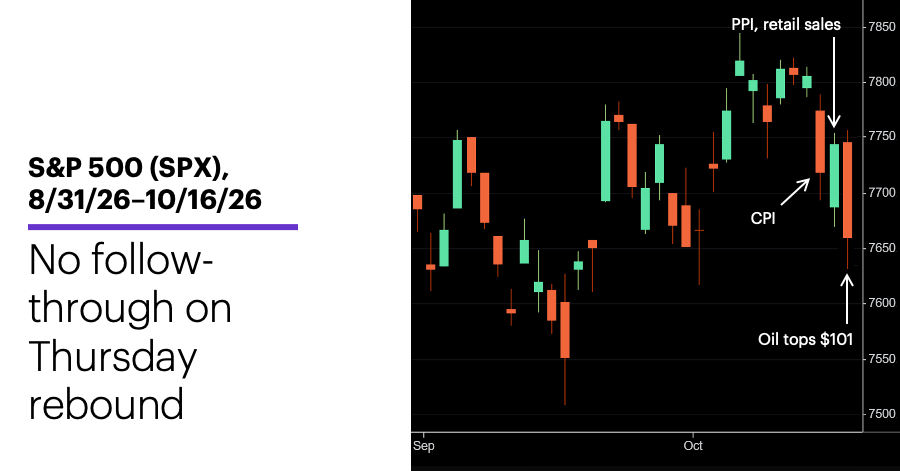
Source: Power E*TRADE. (For illustrative purposes. Not a recommendation. Note: It is not possible to invest in an index.)
The headline: Hot inflation, cold AI weigh on stocks.
The fine print: Broader bearish factors arguably played a role, but the post-earnings weakness exhibited by some of the large banks that reported last week—despite mostly strong numbers—may highlight a challenge of the current earnings season: outperforming high expectations.
The move: Although the benchmark 10-year Treasury yield jumped as high as 5.3% after last Wednesday’s CPI release, it ended the day lower at 5.19%—then dropped sharply (to 5.09%) on Thursday.
The number: 7 (out of 11)—the number of SPX sectors that closed higher last week, even though the index itself shed nearly 2%.
The scorecard: The Dow Jones Industrial Average (DJIA) is the weakest major US index this year, but it was the only one to gain ground last week. The Nasdaq 100 (NDX) posted its biggest weekly loss since April 2025:
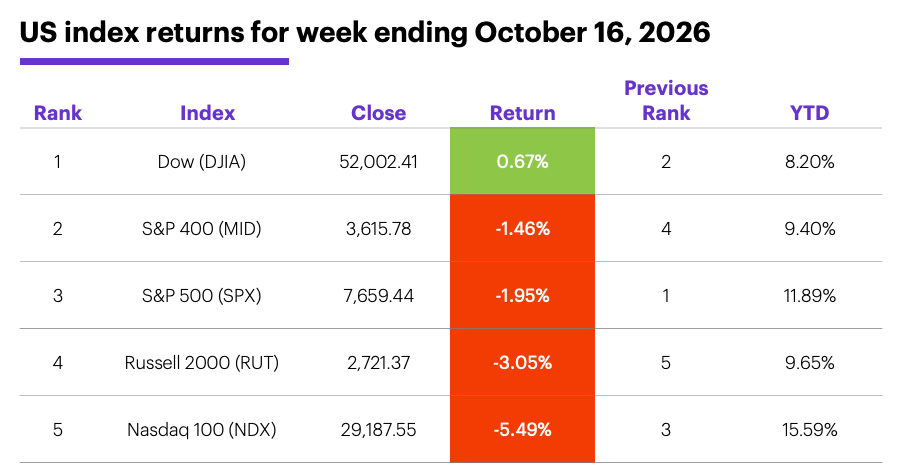
Source (data): Power E*TRADE. (For illustrative purposes. Not a recommendation.)
S&P 500 sector returns: The strongest S&P 500 sectors last week were energy (+5%), consumer staples (+4.9%), and health care (+3.3%). The weakest sectors were tech (-6.3%), consumer discretionary (-2%), and communication services (-1.8%).
S&P 500 stock movers: Last week’s biggest gains were Fair Isaac (FICO) +16% to $771.19, Cognizant Tech Solutions (CTSH) +12% to $66.03, and Equifax (EFX) +11% to $161.25. The biggest losses were Ciena (CIEN) -26% to $332.73, Coherent (COHR) -26% to $232.9, and Lumentum (LITE) -25% to $824.13. Other moves: Bending Spoons (BSP) +41% to $53.46 on Wednesday.
Yields and the dollar: The benchmark 10-year US Treasury yield fell 16 basis points (0.16%) to 5.08% last week. The US Dollar Index (DXY) fell 0.37 to 101.84.
Commodity futures: December WTI crude oil futures (CLZ6) jumped $8.01 to $99.02 last week amid renewed conflict in the Strait of Hormuz and a breakdown of the Ukraine-Russia “energy ceasefire.” December gold (GCZ6) fell $35.20 to $4,181.10. Biggest gains: December WTI crude oil (CLZ6) +8.8%, November cheese (CSCX6) +8%. Biggest declines: April Lithium (LTHJ7) -13.6%, December silver (SIZ6) -6.1%.
Crypto: Bitcoin -1.3% to $81,500.80 last week, Ether -2.6% to $2,419.77.
Coming this week
This week’s wide-ranging earnings calendar includes planes, trains, and one high-profile automobile (TSLA)—as well as a few chip-sector names. Some highlights:
●Monday: Fifth Third Bancorp (FITB), FNB (FNB)
●Tuesday: General Electric (GE), General Motors (GM), Halliburton (HAL), Hasbro (HAS), Keycorp (KEY), Netflix (NFLX), Northrop Grumman (NOC), Synchrony Financial (SYF), United Airlines (UAL), Viking Therapeutics (VKTX), Weatherford (WFRD)
●Wednesday: Abbott Laboratories (ABT), CME Group (CME), International Business Machines (IBM), IMAX (IMAX), Lam Research (LRCX), Southwest Airlines (LUV), AT&T (T), Tesla (TSLA), Texas Instruments (TXN), United Rentals (URI)
●Thursday: American Airlines (AAL), Quest Diagnostics (DGX), General Dynamics (GD), Honeywell (HON), Lockheed Martin (LMT), MaxLinear (MXL), Norfolk Southern (NSC), Procter & Gamble (PG), Spotify (SPOT), Union Pacific (UNP), Valero Energy (VLO), Verisign (VRSN), Western Digital (WDC)
●Friday: American Express (AXP), SLB (SLB)
This week’s numbers include:
●Monday: NAHB Housing Market Index
●Tuesday: Housing Starts and Building Permits, Pending Home Sales
●Thursday: Leading Economic Indicators Index
●Friday: S&P Global Manufacturing and Services PMIs (flash), Consumer Sentiment (final)
More than halfway through October
Friday marked the 12th trading day of October, and despite recent volatility, the SPX found itself in a familiar position, historically speaking—up for the month (if only by a small margin after Friday’s sell-off).
Over the past 69 years, the SPX had a positive October return as of day 12 in 46 years—twice as often as it was down for the month at this point.
The SPX also tended to be a little more bullish through the end of the month when it had a positive October return at day 12, posting a positive net return over the next 10 trading days 63% of the time with a 0.7% median return. By contrast, when October’s return was negative at day 12, those figures were 61%and 0.4%, respectively.1
Click here to log on to your account or learn more about E*TRADE's trading platforms, or follow the Company on X (Twitter), @ETRADE, for useful trading and investing insights.
1 All figures reflect S&P 500 (SPX) daily closing prices, 1957-2026. Supporting document available upon request.