Working around the memory crunch
- “Memory stocks” have led recent semiconductor pullback
- Memory shortage expected to be multi-year
- Different “workarounds” could benefit different stocks
Just as time waits for no man, it could be argued the AI industry will not wait for more DRAM.
DRAM, or Dynamic Random Access Memory, has been central to the recent chip-stock pullback, which on Tuesday reached its fifth day, led by memory stocks like Micron (MU) and SK Hynix (SKNY).
Yesterday, the PHLX Semiconductor Index (SOX) found itself more than 7% below the three-month high it hit on October 6, and more than 17% below its June record high. That said, it was still up more than 72% for the year, thanks to a 105% rally off its late-March low:
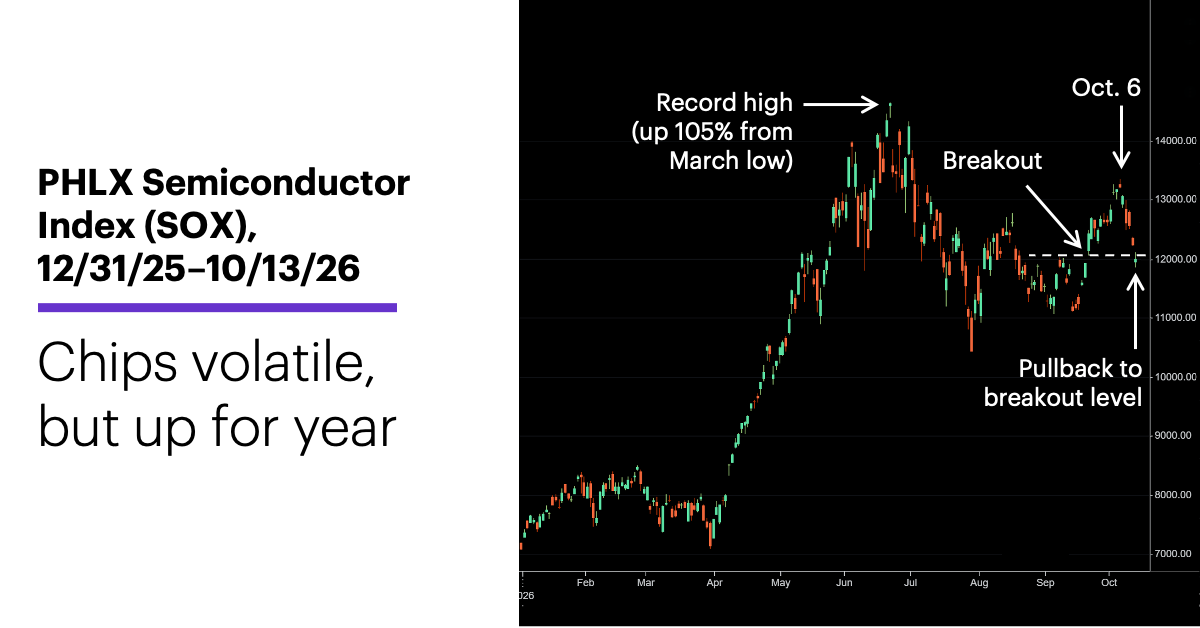
Source: Power E*TRADE. (For illustrative purposes. Not a recommendation. Note: It is not possible to invest directly in an index.)
There were several issues cited for last week’s retreat, beyond concerns about the general health of the AI trade. Morgan Stanley & Co. analysts recently explored one of them—the memory shortage, which is still in full force.
While AI-driven demand for memory underpinned the rallies in some chip stocks this year (e.g., MU and Sandisk), the analysts noted the shortage may slow the AI buildout and potentially create a negative feedback loop that could weigh on the valuations of these stocks.
But they also argued that the AI industry would likely implement workarounds to compensate for the crunch. If memory supply cannot keep pace with demand, they explain, the AI industry will need to become more memory efficient. The analysts lay out three possible paths:
1. “De-speccing,” or reducing an AI model’s memory requirements. First, the analysts note this approach would be deployed selectively, not universally. Second, although they don’t believe it would directly benefit any companies in the memory space, at the margin it could help certain “scale-up plays,” such as Astera Labs (ALAB) and Marvell Technology (MRVL).
2. “Disaggregation” of AI workloads. This approach reduces overall memory demand by breaking up AI tasks into memory-intensive and less-memory-intensive portions. Potential beneficiaries include Cerebras (CBRS) and NVIDIA (NVDA).
3. CXL “memory centralization.” CXL is a switched access to DRAM that facilitates centralized memory "pooling," allowing several processors to access the same memory. While the analysts note this has generally been considered a general-purpose compute technology, recent comments from chip suppliers suggest there could be large opportunities within AI as well. Potential beneficiaries include ALAB and MRVL.
The analysts also noted that they maintain Overweight ratings on MU and Sandisk (SNDK) because they don’t expect the memory shortage to end.1
Finally, digging into the historical record shows the SOX’s current pullback (as of Tuesday) was fairly rare: Since 1994, the chip index has closed lower for five straight days (after an up day) while declining at least 7% over that span only 57 other times (most recently on July 29). Here’s what it did after:
•One trading day later: +0.7% median return, higher in 61.4% of cases.
•Five trading days later: +1.8% median return, higher in 58% of cases.
•10 trading days later: +2.9% median return, higher in 58% of cases.
•20 trading days later: +4.4% median return, higher in 59.7% of cases.
While these statistics suggest a bullish bias, it’s important to remember that they are composites of 57 individual events. For example, SOX’s 20-day return after these pullbacks ranged from +54% to -23%. Any projection of what may happen over the next 20 trading days would have to reflect the possibility of similarly wide-ranging outcomes.2
That said, traders will also be watching how he chip index behaves as it tests short-term price support at the level of its mid-September upside breakout.
Market Mover Update: Morgan Stanley & Co.’s report detailing the stocks most (and least) likely to deliver earnings surprises in October includes two reporting this week (including MTB) and seven next week.3
Today’s numbers include (all times ET): mortgage applications (7 a.m.), CPI (8:30 a.m.), Beige Book (2 p.m.).
Today’s earnings include: ASML (ASML), Bank of America (BAC), Blackrock (BLK), Fastenal (FAST), Morgan Stanley (MS), State Street (STT).
Click here to log on to your account or learn more about E*TRADE's trading platforms, or follow the Company on X (Twitter), @ETRADE, for useful trading and investing insights.
1 MorganStanley.com. How can the AI ecosystem work around memory bottlenecks? 10/5/26.
2 MorganStanley.com. Quant Driven Earnings Ideas—Stocks Poised for Earnings Surprises in October 2026. 10/5/26.
3 All figures reflect PHLX Semiconductor Index (SOX) daily price data, 1994-2026. Supporting document available upon request.