Two sides to the memory coin
- AAPL dropped more than 5% on Thursday
- Move followed announcement of price hikes
- Fewer than sixty 5%-10% daily declines in past 20 years
It probably says something about Apple (AAPL) that, before Thursday, the stock had posted only 59 other daily declines of 5%-10% over the past 20 years. By comparison, another high-profile tech stock, Micron (MU), made 211 such moves over the same span.
Yesterday’s 6.1% sell-off in AAPL, which followed a roughly two-week consolidation and occurred around three weeks after the stock’s last record high, dropped shares to their lowest level in more than seven weeks:
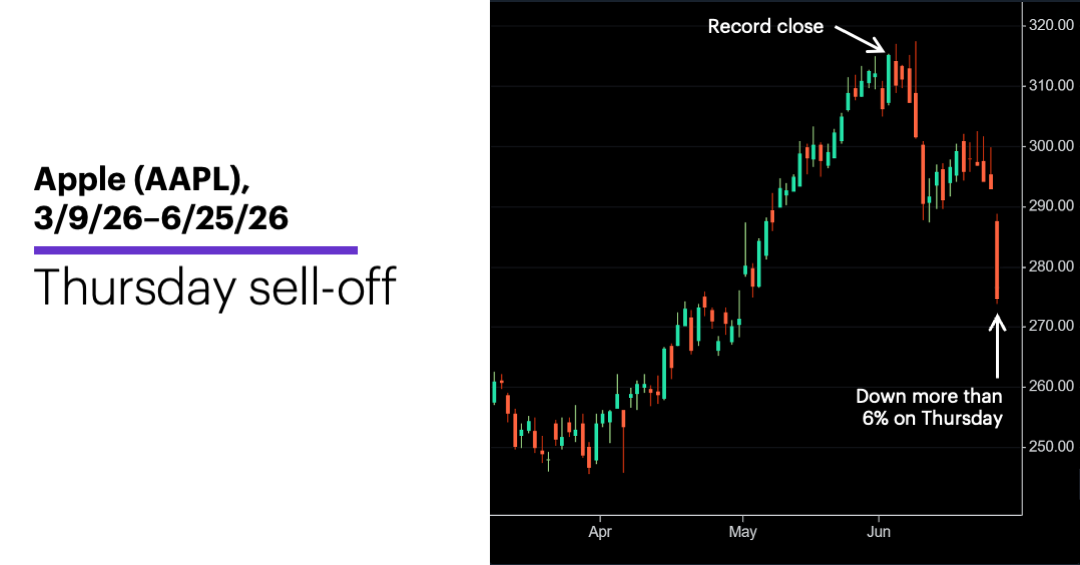
Source: Power E*TRADE. (For illustrative purposes. Not a recommendation.)
Of course, the reference to MU is not random. The memory chip stock rallied more than 1x% on Thursday—the latest of its many record highs this year—after topping earnings estimates and offering bullish forward guidance, citing the strong demand for its products.
Apple’s sell-off represented the other side of that coin. It’s one of the many companies paying more as AI-driven demand has sent memory and storage prices soaring, and it recently announced it was raising prices on some of its flagship products as a result.
History may or may not be a good guide in this arguably unique case, but AAPL has tended to rebound in the short term from its similar sell-offs, although the results were volatile. After the 34 other times the stock fell 5%-10% and closed at its lowest level in at least 30 trading days, shares were higher five trading days later 59% of the time, with an average return of 1.1%. But after 10 days, the stock was higher just 56% of the time, with an average return of 0.1%, suggesting that some of the declines—even though they were less frequent than gains—were relatively large.1
Finally, Daniel Skelly, Head of Morgan Stanley's Wealth Management Market Research & Strategy Team, recently shared the following observations about the swings in tech stocks:
The recent volatility in AI-related names—particularly chip stocks—has been widely described in terms of “technical” exhaustion. But there’s evidence of cracks in the fundamental story, too, including possible AI-model pricing wars and increased sensitivity about spending among AI hyperscalers. We believe this trade will need to roll over in order for the market rally to broaden. For investors, the antidote for “crowded-trade” risk is diversification, including rotation into areas like regional banks, health care, as well as some short-cycle industrial and cyclical names.
Today’s numbers include (all times ET): advance International Trade in Goods (8:30 a.m.), advance retail and wholesale inventories (8:30 a.m.), consumer sentiment (10 a.m.).
Today’s earnings include: Apogee (APOG).
Click here to log on to your account or learn more about E*TRADE's trading platforms, or follow the Company on Twitter, @ETRADE, for useful trading and investing insights.
1 All figures reflect Apple (AAPL) closing prices, 2005-2026. Supporting document available upon request.