The changing exchange story
- Exchange stocks pulled back in May and June
- Tokenization, alternate trade venues pose challenge
- “Evolution” more likely than “extinction”
Although the financial sector has rebounded solidly over the past three months after a rough start to the year, one group of stocks has faced renewed pressure in recent weeks—financial exchanges.
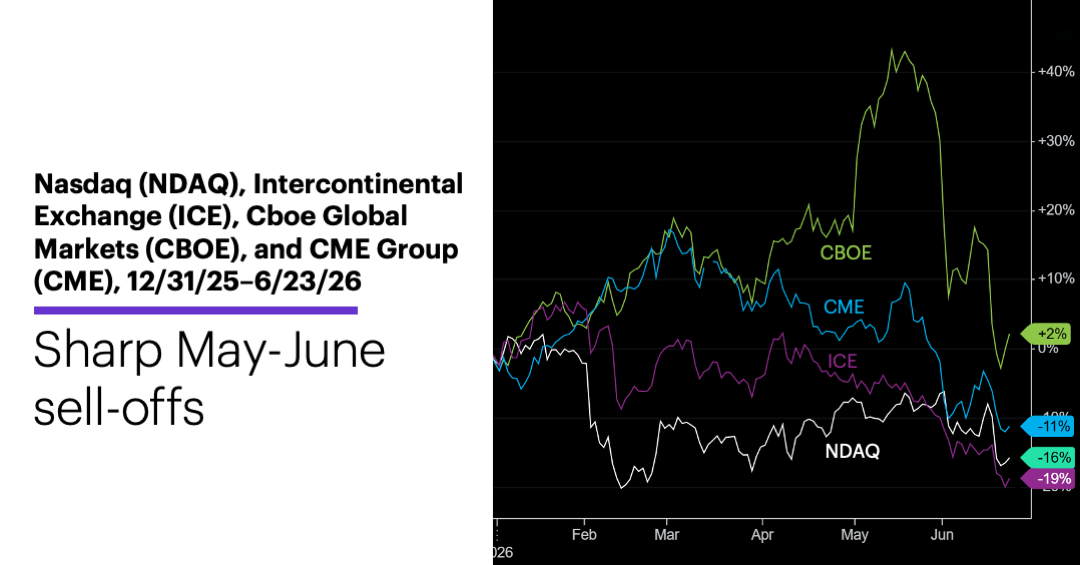
Of the four publicly traded US exchange stocks—Nasdaq (NDAQ), Intercontinental Exchange (ICE), Cboe Global Markets (CBOE), and CME Group (CME)—only one (CBOE) was in positive territory for the year as of Tuesday, and all of them experienced significant sell-offs in May and/or June:
Source: Power E*TRADE. (For illustrative purposes. Not a recommendation.)
Those retracements, which ranged from roughly -11% for NDAQ to -32% for CBOE, unfolded amid growing discussion about the potential disruption posed by alternate trading venues (e.g., crypto exchanges and prediction markets) and technologies (e.g., tokenization). The concern is that an industry long dominated by a handful of players could discover its perceived “moat” isn’t as wide or deep as previously thought.
A new report from Morgan Stanley & Co. discusses these issues, with some emphasis on tokenization, which simply refers to the representation of a real asset, such as a stock, bond, or commodity, as a digital token on a blockchain. Basically, this digitization has the potential to simplify and speed up many of the processes—funding, trade settlement, etc.—that go on behind the scenes at any exchange. As a result, some market watchers think a new wave of “digital native” applications and trading venues are a viable threat to the dominance of the “incumbent exchanges.”
Not necessarily. In the near-term, the analysts argue, tokenization is unlikely to displace the major exchanges. Instead, they believe it represents a potential upgrade of the existing market infrastructure—a reconfiguration of the “plumbing,”—i.e., how cash and collateral move, how asset ownership is recorded, how trade settlement occurs, how corporate actions are processed, and how different financial venues, custodians, clearinghouses, and ledgers interact.1
In other words, the emerging technologies don’t represent an unavoidable “extinction event” for the existing exchanges—although, as is the case in any industry, some players may be better adapted than others to an evolving environment. The incumbent exchanges, the analysts note, have advantages in terms of liquidity, clearing, regulation, and customer trust. That said, parts of the business will likely become more contestable as the new players “compete for distribution, collateral flows, customer relationships, and post-trade activity.”
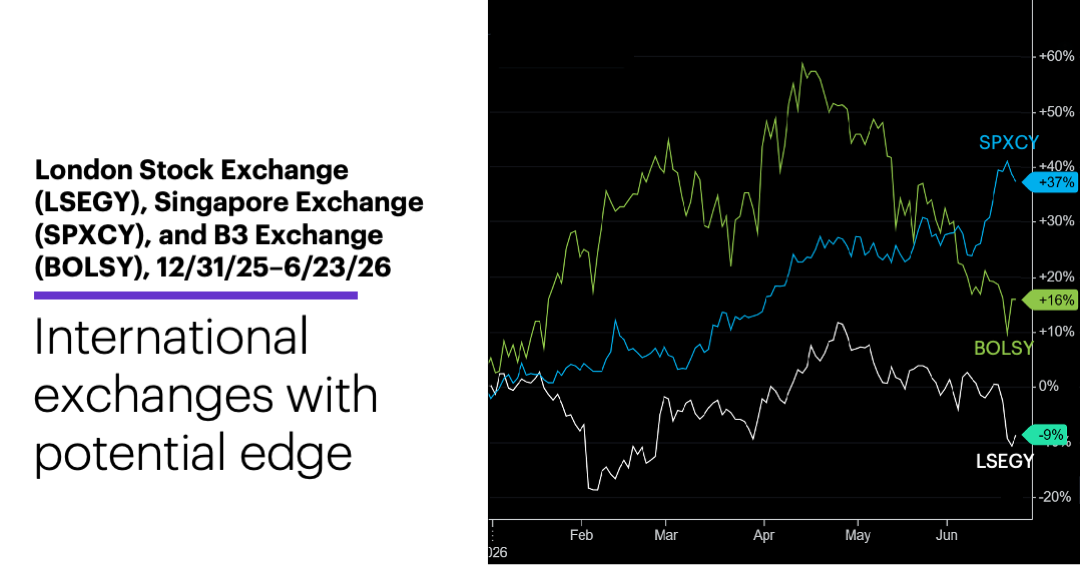
The best-positioned exchanges, the analysts argue, are the ones with exposure to data, technology, collateral, and workflow infrastructure. In addition to NDAQ from the first chart, those criteria pointed to three international exchanges—the London Stock Exchange (LSEGY), Singapore Exchange (SPXCY), and Brazil’s B3 Exchange (BOLSY):2
Source: Power E*TRADE. (For illustrative purposes. Not a recommendation.)
So far this year, these stocks have outperformed their US counterparts from the first chart, except for CBOE.
Perhaps most importantly, the analysts expect adoption of the new technologies to be gradual and evolutionary, with tokenized and traditional market infrastructure coexisting for an extended period. That translates into potential partnerships and increasing M&A as exchanges look to defend existing revenue streams while attempting to capture tokenization, collateral, and digital-market infrastructure opportunities.
Market Mover Update: Micron’s (MU) 13.2% decline on Tuesday led a chip-stock retreat that reverberated throughout the market. The PHLX Semiconductor Index (SOX) fell nearly 8%, while the Nasdaq 100 (NDX) tech index posted the largest decline of the major US stock gauges, falling 3.3%.
Fifteen thousand of the Williams Companies (WMB) $69 puts expiring on July 31 traded Tuesday as the stock bucked the day’s weakness by posting a small gain (see “Upside breakout, heavy puts”).
Today’s numbers include (all times ET): weekly mortgage applications (7 a.m.), current account (8:30 a.m.), new home sales (10 a.m.), EIA Petroleum Status Report (10:30 a.m.).
Today’s earnings include: Micron (MU), Paychex (PAYX), Trip.com (TCOM), Worthington Enterprises (WOR).
Click here to log on to your account or learn more about E*TRADE's trading platforms, or follow the Company on Twitter, @ETRADE, for useful trading and investing insights.
1 MorganStanley.com. Digital Rails, Traditional Trust; Implications of the Next Market Structure Stack. 6/23/26.
2 Although the primary listings for these companies are outside the US, they all trade in the US as the American Depositary Receipts (ADRs) shown in the chart.