Legging into an options spread
- WDC consolidating after correction from record high
- Still-elevated volatility has kept options premiums relatively high
- Staggering spread entries into can sometimes offer benefits
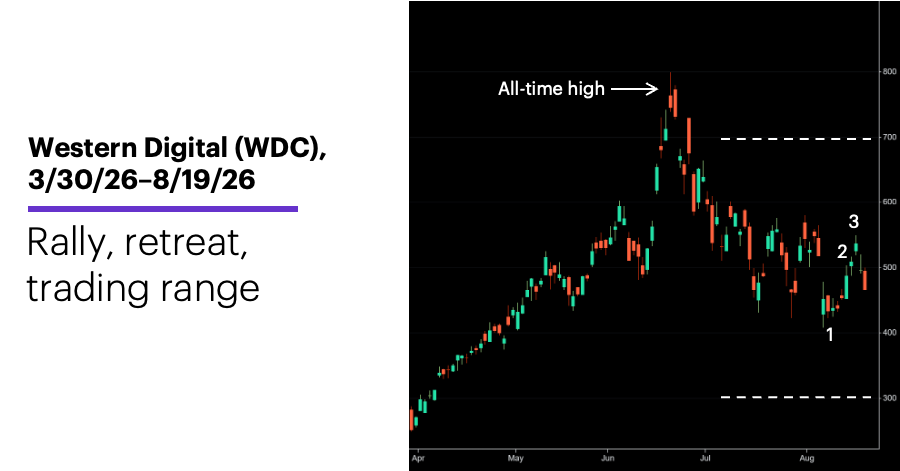
After hitting a record intraday high of nearly $800 in June, memory stock Western Digital (WDC) retreated nearly 29% in less than a month. Since then, it’s spent several weeks in a wide trading range, roughly between $400 and $600.
The chart below flags three days within that consolidation—August 7 (1), August 13 (2), and August 17 (3)—to illustrate how an options trader who thought WDC would continue to trade mostly sideways over the next several weeks might have approached the market.
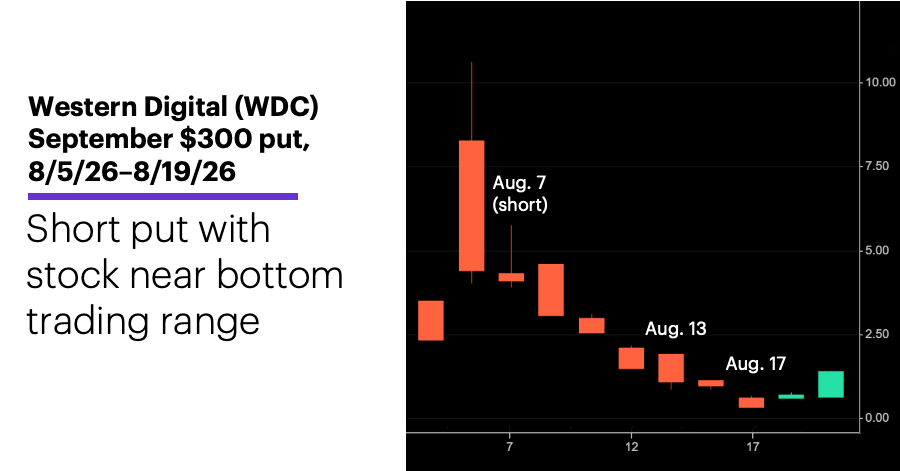
For the sake of argument, let’s say that after WDC fell to a fresh (intraday) range low on August 6, the trader thought the stock’s downside momentum had at least temporarily run its course. The next day, August 7, the trader shorted the relatively deep out-of-the-money September $300 put option (represented by the lower dashed line):
Source: Power E*TRADE. (For illustrative purposes. Not a recommendation.)
If WDC shares remained above $300 until expiration, the trader would get to keep all the premium collected from shorting the options. The chart below shows the $300 put closed at 4.10 ($410) on August 7. Within six trading days (by August 17), the stock was more than 23% higher, and the put had lost more than 91% of its value, closing at 0.35 ($35):
Source: Power E*TRADE Pro. (For illustrative purposes. Not a recommendation.)
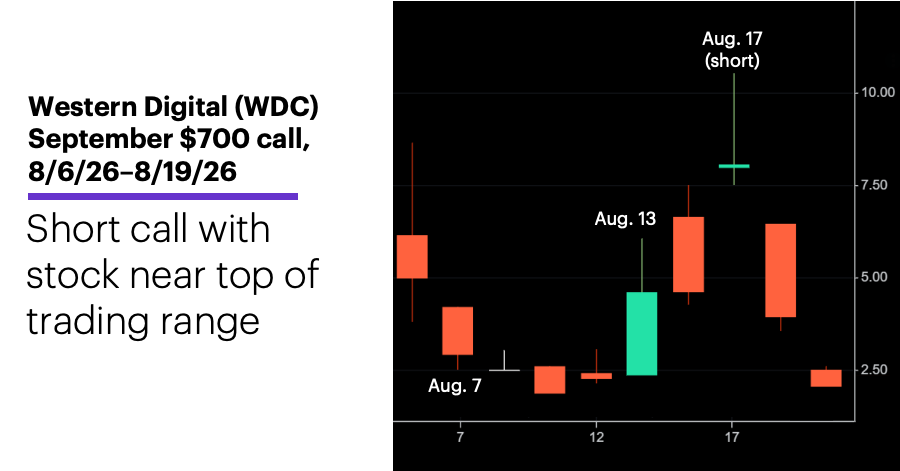
So far, so good. Now with the stock relatively close to its trading range high on August 17, let’s say our trader decides upside momentum will likely fade and, flipping the script from August 7, sells a September $700 call (see the upper dashed line on the WDC price chart), which closed at 8.05 ($805) that day:
Source: Power E*TRADE Pro. (For illustrative purposes. Not a recommendation.)
Now the trader has collected a total of $1,215 in premium ($410 from the short put plus $805 from the short call). If WDC remains between the two strike prices ($300 and $700) until expiration, the trader will keep all of that money. And even if it doesn’t, the combined options position has the potential to generate some profit, as long as the stock doesn’t push above the upper strike price or below the lower strike price by more than the total collected premium.
Experienced options traders will recognize this position as a “short strangle”—the combination of a short out-of-the-money call and a short out-of-the-money put. While the strategy is neutral about the direction of the underlying stock, it’s not neutral about volatility, since it benefits from steady or declining volatility, regardless of whether the stock rises or falls.
But here’s the key point: By “legging” into the position rather than executing both sides simultaneously, our trader appeared to gain an edge. Here’s a comparison of the total premium the strangle would have generated if the trader had instead executed both sides of the trade at the same time on August 7 (near the stock’s range low), August 13 (near the middle of the range), and August 17 (near the range high):1
August 7: $410 for short put + $295 for short call = $705 total premium
August 13: $110 for short put + $461 for short call = $571 total premium
August 17: $35 for short put + $805 for short call = $840 total premium
In other words, the trader would have collected much less premium by executing the strangle as a single trade on any of these days. Selling the put at a relative low point for the stock, then waiting to sell the call at a relative high point for the stock significantly boosted both options’ values.
The message is not that the strangle was the appropriate trade decision in this scenario—there is still time for the trade outlined here to lose money—but that, in the right circumstances, legging into a spread like a strangle may offer an edge over the standard “simultaneous” execution.
Today’s numbers include: Weekly Jobless Claims (8:30 a.m.), Philadelphia Fed Manufacturing Index (8:30 a.m.), Leading Economic Indicators Index (10 a.m.), EIA Natural Gas Report (10:30 a.m.).
Today’s earnings include: Advance Auto Parts (AAP), Autohome (ATHM), The Buckle, (BKE), Deere (DE), Ross Stores (ROST), Ubiquiti (UI), Walmart (WMT).
Click here to log on to your account or learn more about E*TRADE's trading platforms, or follow the Company on X (Twitter), @ETRADE, for useful trading and investing insights.
1 All prices reflect daily closes.