Memory check
- “Attractive” levels for memory stocks after sell-offs?
- Some have posted double-digit gains this week
- Crude oil surge challenges spring highs
On Wednesday, Sandisk (SNDK) did something it’s done only one other time since June 15—posted three up days in a row.
The past month or so has marked quite a shift for the memory and storage chip stock, which ended last week 42% below its June 25 record close of $2,335:
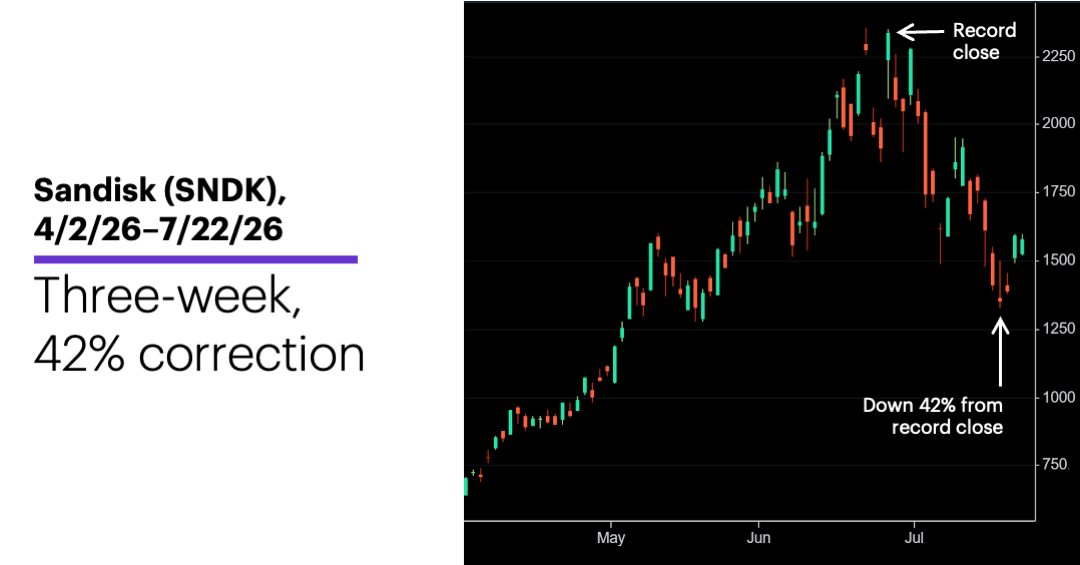
Source: Power E*TRADE. (For illustrative purposes. Not a recommendation.)
Of course, that’s only part of SNDK’s story. The stock preceded the correction with a 308% rally since March 30—a move that was merely the most recent leg of a 1,101% surge off its December low. Even at the July 17 correction low, the stock was still up 471% for the year and, as of Wednesday, the year-to-date gain had increased to more than 580%.
Given the key role semiconductors have recently played in market performance at the index level—the sector has had a noticeable influence on many of the daily and weekly returns of the S&P 500 (SPX) as well as the Nasdaq 100 (NDX) tech index—it’s worthwhile noting the similarities between the price charts of SNDK and the PHLX Semiconductor Index (SOX). In a nutshell, tech has often been the decisive factor the broader market’s short-term momentum, semiconductors have dictated the tech sector’s direction, and memory stocks have recently dominated the semiconductor space.
When the momentum in stocks such as SNDK, Micron (MU), and others was first discussed in this space in January, the AI-driven “memory bottleneck” was still gaining widespread attention as a key market catalyst. The sharp sell-off in these stocks (MU’s reached -30% at the end of last week) may lead some observers to wonder whether the memory rally has run its course.
Earlier this week, Morgan Stanley & Co. analysts argued that is likely not the case, for a very simple reason: The memory bottleneck still exists almost solely because of AI datacenter demand, and that demand shows no signs of abating:
“The underlying premise…is that we have a memory shortage that will last for several years, and rather than the AI business coming to a halt waiting for more memory, we will make do. But that longer-term shortage is the signal.” 1
This “memory cycle,” the analysts believe, is different from those in the past because it is entirely driven by data center demand. Mixed signals regarding demand from the consumer, PC, and smartphone markets that may have fed bearish sentiment during the recent sell-off do not negate data center story.
This doesn’t necessarily mean these stocks will be able to match their previous levels of upside momentum. But as the analysts note, in this unusual environment, “drawdowns seem inevitable—but we are buyers on that weakness.”
Finally, they also noted that in the wider semiconductor space, NVIDIA (NVDA) and Broadcom (AVGO) may offer more compelling opportunities from a reward-risk perspective.
Market Mover Update: As of Wednesday, US crude oil prices had erased well over half of their sell-off from May’s rally highs to the July lows. September WTI crude oil futures (CLU6) hit a high of $88.61 on Wednesday, at which point the market was up more than 9% since July 1:
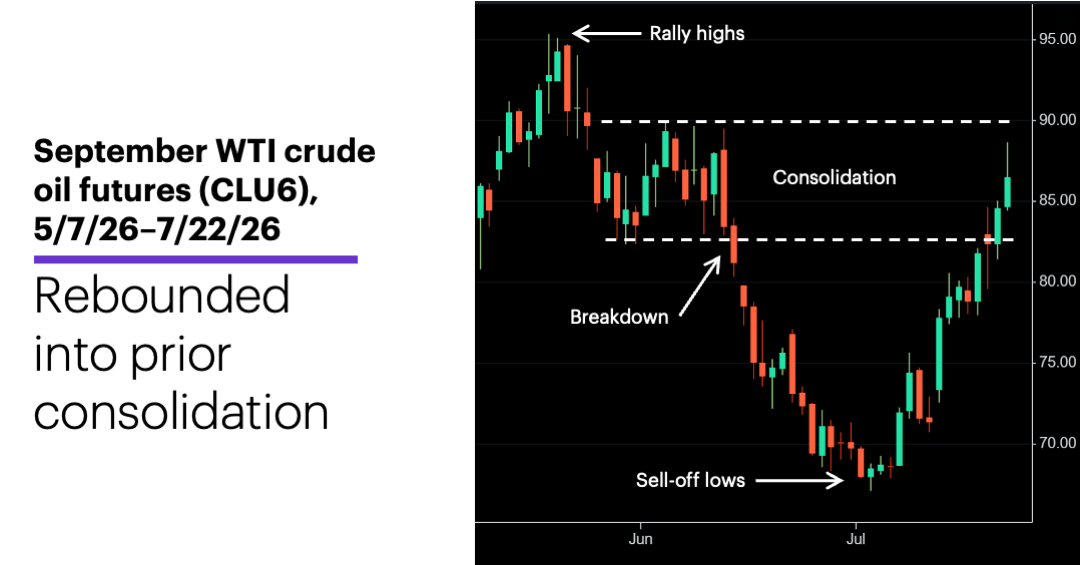
Source: Power E*TRADE Pro. (For illustrative purposes. Not a recommendation.)
The surge pushed prices back within the boundaries of the late-May, early-June consolidation—the breakdown of which was followed by the sharpest portion of the sell-off.
Today’s numbers include: weekly jobless claims (8:30 a.m.), Chicago Fed National Activity Index (8:30 a.m.), EIA Natural Gas Report (10:30 a.m.).
Today’s earnings include: American Airlines (AAL), Freeport McMoRan (FCX), Honeywell (HON), Lockheed Martin (LMT), Newmont (NEM), T-Mobile US (TMUS), Verisign (VRSN).
Click here to log on to your account or learn more about E*TRADE's trading platforms, or follow the Company on X (Twitter), @ETRADE, for useful trading and investing insights.
1 MorganStanley.com. Selloff of US memory stocks creates a compelling entry point. 7/20/26.