Stocks hold the breakout
- Energy sector anchors gains, tech extends bounce
- Inflation cool, retail spending slows
- This week: retail earnings, FOMC minutes
The US stock market appeared to be in vacation mode much of last week, but it did enough to notch a gain amid mostly positive economic data and an absence of negative geopolitical headlines from the Middle East.
Cooler-than-anticipated (but still above-target) inflation readings from the Consumer Price Index (CPI) and Producer Price Index (PPI) were followed by another record high from the S&P 500 (SPX), pushing the index out of a roughly one-week mini consolidation. The SPX slipped on Friday following a bearish higher close from the VIX:
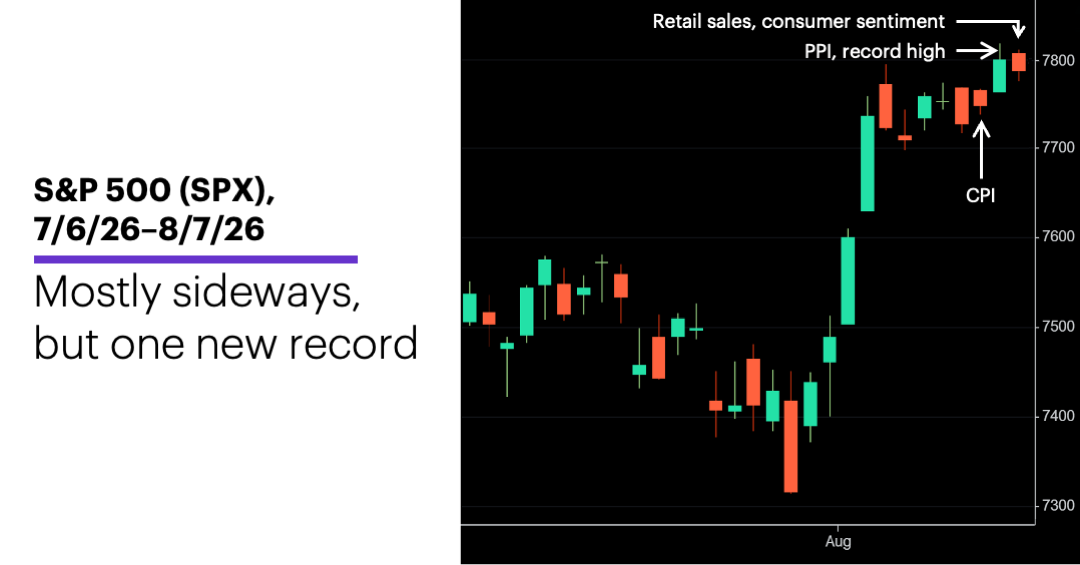
Source: Power E*TRADE. (For illustrative purposes. Not a recommendation. Note: It is not possible to invest in an index.)
The headline: Market focuses on the positives.
The fine print: Overall, last week’s economic data appeared to ease concerns about a September rate hike. On the back of relatively mild CPI and PPI readings, many investors may have welcomed Friday’s soft retail sales report and the weak consumer sentiment data as more nails in the rate-hike coffin, rather than feared them as signs of potentially significant economic weakness.
The number: 3. The SPX logged three straight up weeks for the first time since May.
The scorecard: The Russell 2000 (RUT) small-cap index led the market, while the Dow Jones Industrial Average (DJIA) posted a loss:
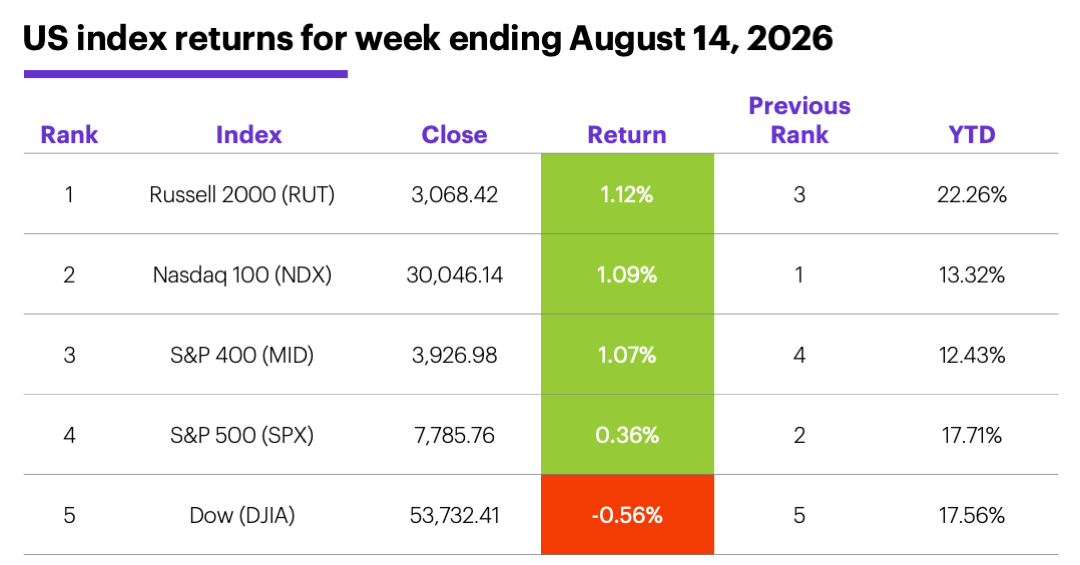
Source (data): Power E*TRADE. (For illustrative purposes. Not a recommendation.)
S&P 500 sector returns: The strongest S&P 500 sectors last week were energy (+8.9%), health care (+5.6%), and tech (+4.5%). The weakest sectors were communication services (-3.4%), utilities (-3.2%), and real estate (+1.9%).
S&P 500 stock movers: Last week’s biggest gains were Sandisk (SNDK) +35% to $1,641.11, Super Micro Computer (SMCI) +28% to $39.84. The biggest losses were Tapestry (TPR) -21% to $128.98 and Coherent (COHR) -14% to $325.83. Other moves: Sionna Therapeutics (SION) -91% to $4.50 on Monday, Quantum (QMCO) +65% to $19.40 on Tuesday.
Yields and the dollar: The 10-year Treasury yield climbed 0.05% at 4.69% last week. The US Dollar Index (DXY) rose 0.13 to 99.66.
Commodity futures: September WTI crude oil (CLU6) rallied $4.22 at $82.40 as the US-Iran stalemate dragged on, while December gold (GCZ6) climbed $37.60 to $4,437.70. Biggest gains: September heating oil (HOU6) +8.9%, September Lithium (LTHU6) +7.3%. Biggest declines: August lean beef trim 50% (BTFQ6) -4.7%, September palladium (PAU6) -3.8%.
Crypto: Bitcoin -2.9% to $62,975.59 last week, Ethereum -2.7% to $1,880.65.
Coming this week
This week’s numbers include:
●Monday: Empire State Manufacturing Index, NAHB Housing Market Index
●Tuesday: Housing Starts and Building Permits, Export Prices, Industrial Production and Capacity Utilization, Pending Home Sales
<●Wednesday: FOMC minutes
●Thursday: Philadelphia Fed Manufacturing Index, Leading Economic Indicators Index
●Friday: S&P Global Manufacturing and Services PMIs (flash)
The retail portion of earnings season gets into gear this week:
●Monday: Fabrinet (FN), XP (XP)
●Tuesday: Dycom (DY), Home Depot (HD), Keysight Technologies, (KEYS), Sony (SONY), Sociedad Quimica Y Minera De Chile (SQM), Toll Brothers (TOL)
●Wednesday: Analog Devices, (ADI), Bill Holdings, (BILL), Estee Lauder (EL), Lowe's (LOW), Target (TGT), TJX (TJX), Wolfspeed (WOLF), Zim Integrated Shipping (ZIM)
●Thursday: Advance Auto Parts (AAP), Autohome (ATHM), The Buckle, (BKE), Deere (DE), Ross Stores (ROST), Ubiquiti (UI), Walmart (WMT)
A weighty AI matter
While some of the Magnificent Seven AI hyperscalers have rebounded in recent weeks, some voices have raised doubts about their continued dominance in light of new challenges—for example, the advent of so-called “open-weight” AI models that publicly share their core components, thus giving end users more direct control over fine-tuning and deployment (similar to, but not quite the same as, open-source software code).
While this paradigm might sound like a potential threat to the economics of the hyperscaler-dominated AI landscape, Morgan Stanley & Co. analysts don’t think that will be the case. The crux of their argument: “Compute” remains the industry’s scarce (and expensive) resource, and the hyperscalers are in a good position to be able to monetize it. At a company level, the analysts note, investors should consider focusing “on the hyperscaler (or owner of compute) that has the lowest cost to serve”—a viewpoint that prompted them to reiterate their Overweight ratings on Amazon (AMZN) and Alphabet (GOOGL).1
Click here to log on to your account or learn more about E*TRADE's trading platforms, or follow the Company on X (Twitter), @ETRADE, for useful trading and investing insights.
1 MorganStanley.com. How Could Open-Weight Models Impact GenAI ROIC? 8/12/26.