A chip in the tech story
- Market falls as AI/chip momentum reverses
- Yields climb, gold falls after jobs report
- This week: inflation (CPI and PPI), SpaceX IPO
There were signs the stock market’s seemingly relentless push to new highs was due for a "reality check," and last week one arrived.
It came in the form of a pullback in the semiconductor sector—the recent linchpin of the AI-momentum trade—but got some accelerant from Friday’s stronger-than-expected jobs report.
The S&P 500 (SPX) lost ground for the week—snapping a run of nine-straight up weeks—despite closing at successive record highs last Monday and Tuesday:
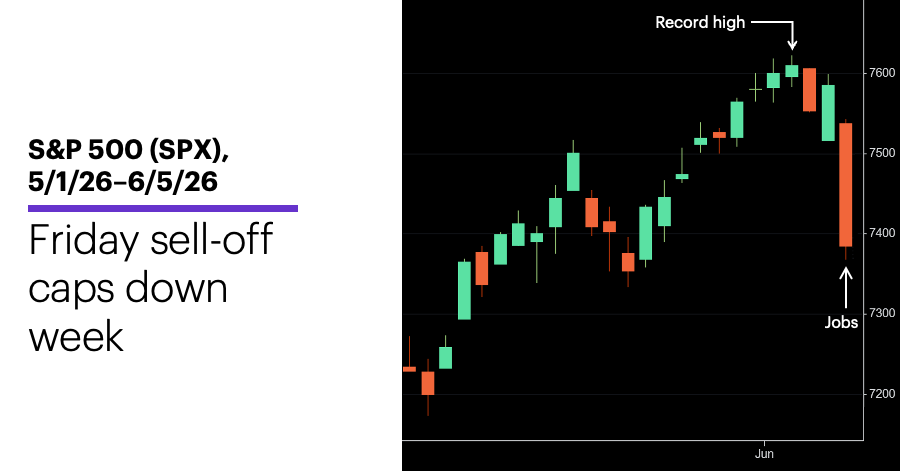
Source: Power E*TRADE. (For illustrative purposes. Not a recommendation. Note: It is not possible to invest in an index.)
The headline: Tech check weighs on market.
The fine print: Although the chip stock retreat—highlighted by Broadcom’s (AVGO) weak forward guidance and 19.5% Thursday-Friday sell-off—dominated the market narrative last week, software stocks fell more, at least within the SPX. Also, consumer discretionary—not tech—was the SPX’s weakest sector.
The move: Amazon (AMZN) fell more than 9% for the week—a major contributor to the consumer discretionary sector’s pullback.
The number: 172,000, the number of new US jobs created in May—more than double the estimate. April’s number was also revised higher, from 115,000 to 179,000. Such numbers will likely keep the markets focused on inflation, since a stronger labor market could contribute to upward price pressures and keep the Fed from cutting interest rates.
The scorecard: All the major indexes lost ground despite hitting record highs at some point during the week. The Nasdaq 100 (NDX) tech index fell the most:
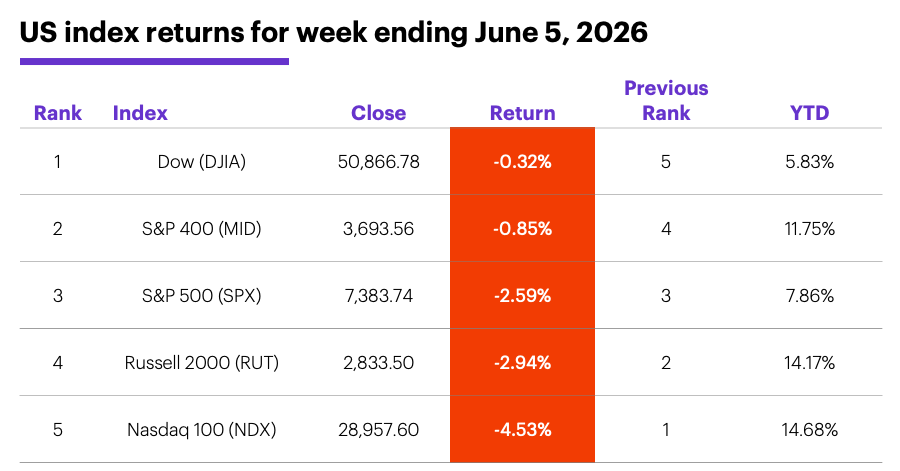
Source (data): Power E*TRADE. (For illustrative purposes. Not a recommendation.)
Sector returns: The strongest S&P 500 sectors last week were energy (+2.5%), health care (+2.3%), and real estate (+1.9%). The weakest sectors were consumer discretionary (-5.9%), tech (-4.8%), and communication services (-4.2%).
S&P 500 stock movers: Last week’s biggest gains were Humana (HUM) +15% to $350.08 and Hewlett Packard Enterprise (HPE) +14% to $49.20. The biggest losses were Coinbase (COIN) -19% to $152.40 and Ciena (CIEN) -16% to $488.21. Other moves: Victoria's Secret (VSXY) +47% to $80.06 on Tuesday, Oculis (OCS) -36% to $14.51 on Monday.
Yields and the dollar: The 10-year US Treasury yield climbed 0.1% to 4.54% last week, mostly because of Friday’s 0.07% jump. The US Dollar Index (DXY) closed Friday at a two-month high of 100.07, up 1.16 for the week.
Commodity futures: July WTI crude oil (CLN6) surged more than $8 last Monday-Wednesday, then pulled back to end the week up just $3.18 at $90.54. August gold (GCQ6) ended the week down $227.70 at $4,365.30—a new low close for the year. Biggest gains: July WTI crude oil (CLN6) +3.6%, July lumber (LBSN6) +3.5%. Biggest declines: July oats (ZON6) -12.9%, July silver (SIN6) -8.9%.
Crypto: Bitcoin fell 17% to $60,922.67 last week (lowest since October 2024), Ethereum dropped 21% to $1,580.86 (lowest since April 2025).
Coming this week
Inflation returns to center stage:
●Monday: New York Fed Consumer Inflation Expectations
●Tuesday: NFIB Business Optimism Index, trade balance, Existing Home Sales, wholesale inventories
●Wednesday: Consumer Price Index (CPI)
●Thursday: Producer Price Index (CPI)
●Friday: consumer sentiment (preliminary)
This week’s earnings include:
●Monday: Core & Main (CNM), Campbell's (CPB), FuelCell Energy (FCEL), Vail Resorts (MTN)
●Tuesday: Casey’ General Stores (CASY), Cracker Barrel (CBRL), Designer Brands (DBI), Oracle (ORCL), J.M. Smucker (SJM), United Natural Foods (UNFI)
●Wednesday: Oxford Industries (OXM), RH (RH)
●Thursday: Adobe (ADBE)
Snap back after streak snap?
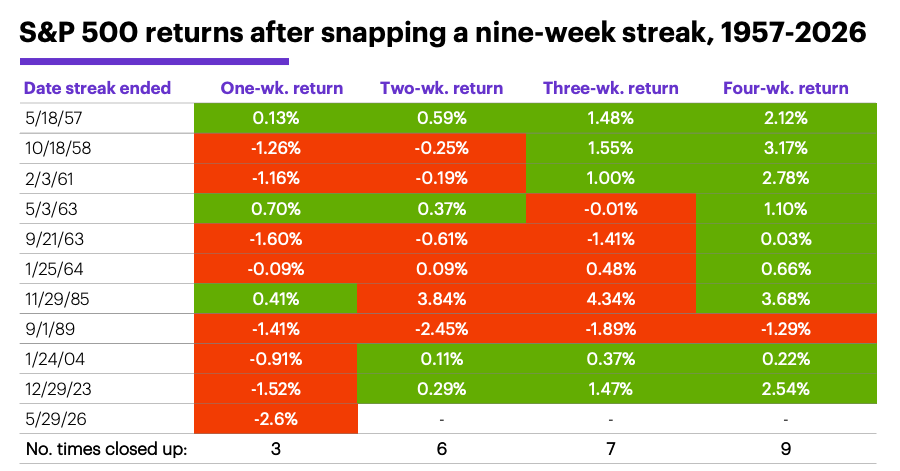
“Stocks extend the streak” noted the SPX closed lower the week after seven of its past 10 nine-week up streaks since 1957.1 Last week made it eight of 11. But the article also noted the SPX was higher after four weeks in nine of 10 cases.
The following table shows the SPX’s net return from one to four weeks after its previous nine-week streaks:
Source (data): Power E*TRADE Pro. (For illustrative purposes. Not a recommendation. Note: It is not possible to invest directly in an index.)
While it’s never advisable to read too much into such a small sample size, it may be worth noting that although the SPX was still in the red after two weeks in four of the 10 cases, it actually lost additional ground in only two of them (1961 and 1989). In other words, the SPX gained ground eight of 10 times the week after it snapped a nine-week win streak.
Click here to log on to your account or learn more about E*TRADE's trading platforms, or follow the Company on X (Twitter), @ETRADE, for useful trading and investing insights.
1 All figures reflect S&P 500 (SPX) weekly closing prices, 1957-2026. “Nine straight up weeks” refers to a lower weekly close followed by nine consecutive higher weekly closes. Supporting document available upon request.