Yielding to rising yields?
- Gold prices tumbled more than 3% on Monday
- Market down more than 23% since January
- Surging yields weighing on precious metals
While rising US Treasury yields have been a headwind for stocks in recent weeks, they haven’t exactly been an anchor. Even with the market falling on Monday as the benchmark 10-year Treasury yield pushed to a fresh 19-year high above 5.2%, the S&P 500 (SPX) was still less than 2% below its August all-time high.
Another market, however, has arguably felt more of an effect from rising yields recently, and certainly appeared to react much more to them on Monday—precious metals. Silver prices slid more than 5% and gold fell more than 4% intraday, with December gold futures (GCZ6) hitting their lowest level since early August:
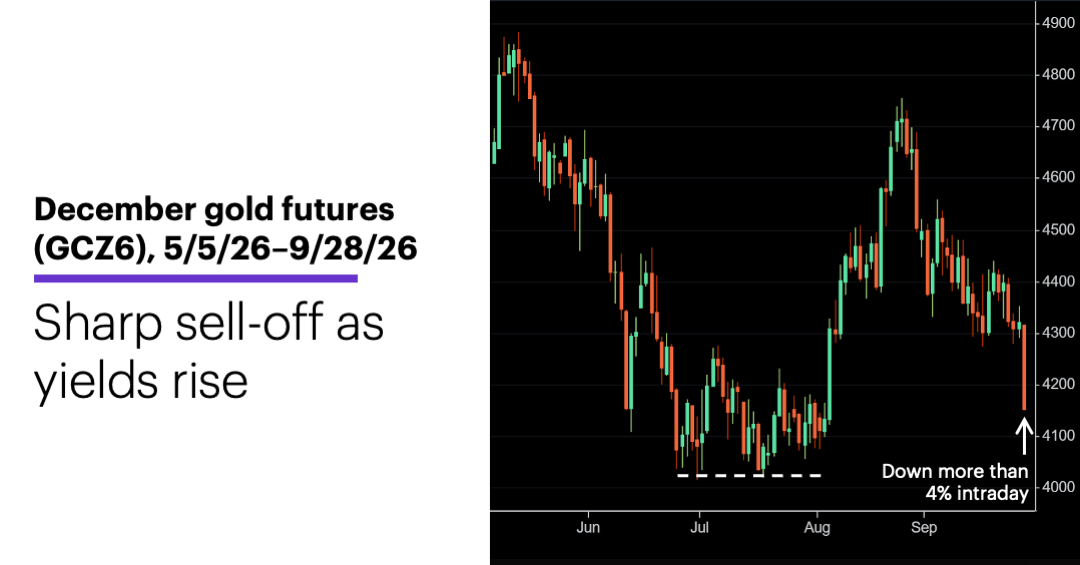
Source: Power E*TRADE. (For illustrative purposes. Not a recommendation.)
At Monday’s lows, spot gold prices were down more than 7% for the month and nearly 24% below their January record closing high above $5,400.
While yields aren’t the gold market’s only driver (they were much lower when gold sold off sharply earlier in the year, for instance), non-yielding assets like precious metals can come under pressure as interest rates climb. And not only has the benchmark 10-year Treasury yield pushed above the psychologically significant 5% threshold, if September had ended on Monday, it would have marked the yield’s biggest one-month increase in nearly two years.
A little more than a month ago when gold was climbing to its highest levels in nearly three months, “Gold regains some shine” noted that Morgan Stanley & Co. analysts saw a path—albeit, a potentially volatile one—to $5,000 gold by early 2027. But the caveat was the Fed outlook, which they saw as a key factor for gold ETF demand. And at the time, recently declining probabilities for Fed rate hikes had increased gold ETF inflows.
That picture changed significantly over the next few weeks as another oil price surge and hotter inflation data set up the Fed’s first rate hike in more than three years, along with the expectation of additional (but limited) increases. Surging longer-term yields only added to a less-friendly shift for precious metals.
That said, Morgan Stanley & Co. analysts expect the 10-year yield to be at 4.8% at the end of 2026 and 4.7% at the end of 2027, although they outline possible scenarios that could result in end-2027 levels ranging from 3.8% and 5.25%.1
Looking past the interest rate factor, gold traders will likely be keeping an eye on the market’s June-July consolidation lows (roughly $4,020-$4,030 in the December futures)—a potential support level that, if decisively broken, could open the door to another momentum sell-off.
Market Mover Update: November WTI crude oil futures (CLX6) jumped more than 4% intraday on Monday, but pulled back to end the day up less than 0.5% at $92.60.
Today’s numbers include (all times ET): S&P Case-Shiller Home Price Index (9 a.m.), FHFA House Price Index (9 a.m.), Job Openings and Labor Turnover Survey (10 a.m.), Consumer Confidence (10 a.m.).
Today’s earnings include: AAR (AIR), Carnival (CCL), CarMax (KMX).
Click here to log on to your account or learn more about E*TRADE's trading platforms, or follow the Company on X (Twitter), @ETRADE, for useful trading and investing insights.
1 MorganStanley.com. New US Treasury Yield Forecasts After New Fed Call. 9/24/26.