Cybersecurity stocks and the AI debate
- Cybersecurity stocks jumped on AI-risk concerns
- Group was already up significantly YTD
- Security a potential tailwind for AI spend
When concerns about broad AI risk weighed on the US stock market early on September 14, the Nasdaq 100 (NDX) tech index quickly found itself down more than 1% for the day.
But a certain group of tech stocks not only shrugged off the weakness, they jumped to double-digit percentage gains in the first couple of hours of trading:
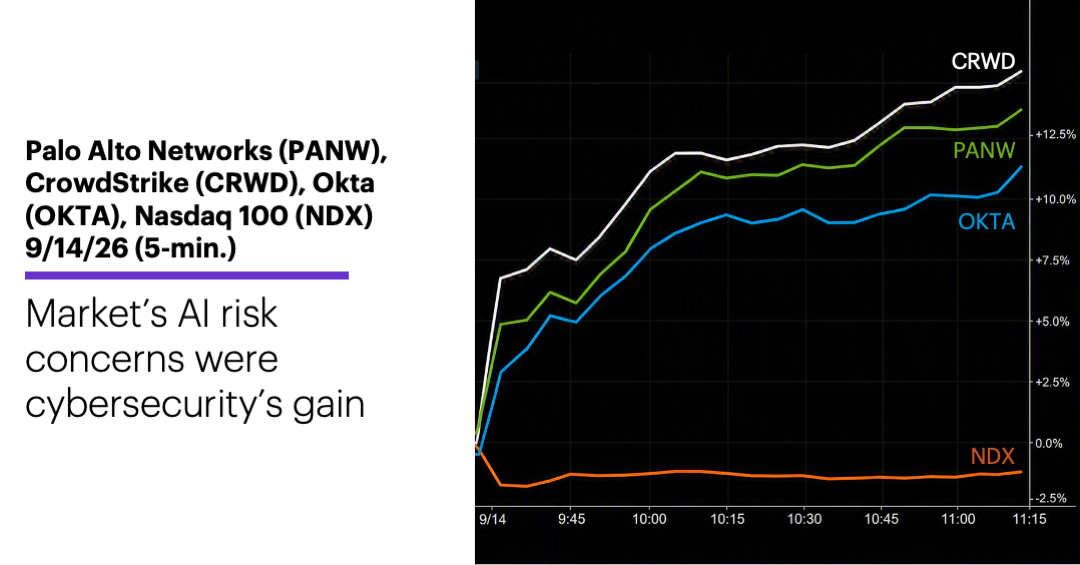
Source: Power E*TRADE. (For illustrative purposes. Not a recommendation.)
Cybersecurity stocks Palo Alto Networks (PANW), CrowdStrike (CRWD), and Okta (OKTA) all surged that day as debate grew over the potential threat posed by accelerated AI-model development, whether the industry should (or could) hit the “pause button” to assess risk and implement safety measures, and whether the government should get involved (and if it could make a difference if it did).
Although the market curbed its losses by the close on September 14 (and the NDX posted a gain for the week), this story is likely still in its infancy. But as Morgan Stanley & Co. strategist pointed out at the beginning of this week, the “rise of autonomous, AI-driven attacks is raising the stakes for cybersecurity, with material implications for AI adoption and security vendors.”1
While one of the market-specific implications of these issues is the negative impact they could have on AI spending and adoption—hence the broader tech sell-off on September 14—Morgan Stanley strategists believe the industry’s path forward will actually support, rather than curtail, the already robust demand for compute and AI spending. Specifically, the strategists think spending on model safety, cybersecurity, and bio-defense will accelerate—a scenario in which addressing AI safety concerns actually fuels the AI capex cycle instead of slowing it. In other words, “AI safety” could be a tailwind rather than a headwind for the broader AI trade.
The following chart shows CRWD, PANW, and OKTA were already enjoying standout years before last week’s debate heated up:
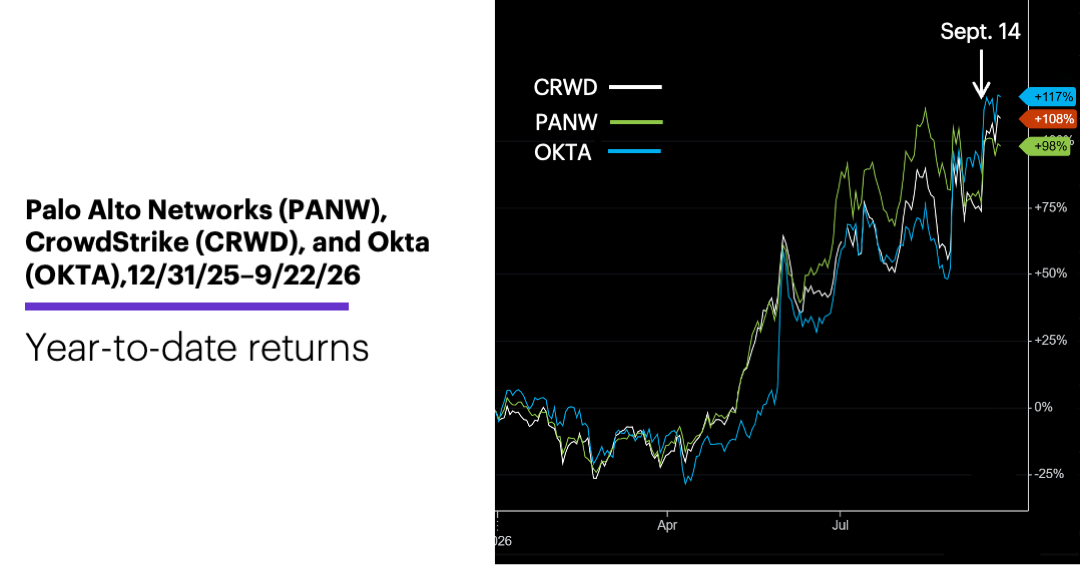
Source: Power E*TRADE Pro. (For illustrative purposes. Not a recommendation.)
In separate research, Morgan Stanley & Co. analysts explain that while AI safety transcends cybersecurity, they believe stocks in this group still have the potential to extend their gains.
They outlined three potential scenarios, highlighting their possible policy implications and impact on AI adoption and security stocks:
1) Base case (most likely): Reports of malicious AI agent behavior pick up, but damage is relatively limited and model labs largely mitigate risks. In this scenario, the policy response is limited, and breaches are contained by traditional solutions.
2) Bull case: Increased attack severity leads to a breach of a major institution that would have been caught by traditional cybersecurity defenses. While this would cause a slowdown in AI adoption, it would be offset by a greater percentage of AI budgets being directed toward cybersecurity.
3) Bear case (least likely): The severity and sophistication of attacks increase, the current cyber ecosystem is unable to detect the attack, and a more severe AI stoppage is contemplated.2
While cybersecurity spending is roughly 6% to 7% of enterprise IT budgets, the analysts note it’s only around 1.5% of enterprise AI spending—a percentage they expect to increase over time as “Security for AI” investments expand.
While describing scenario 3 as “good for no one,” the analysts believe cybersecurity will benefit most in scenarios 1 and 2, especially the latter since it would require the percentage of AI spent on cyber to accelerate quickly.
Finally, the analysts cite PANW, CRWD, and OKTA (especially the first two) as “the favored way to play this investment,” although they also acknowledge these stocks are “no longer cheap.”
Market Mover Update: November WTI crude oil futures (CLX6) fell for a fifth-straight day on Tuesday, closing below $91.
United Airlines (UAL) extended Monday’s consolidation breakout with a small gain on Tuesday (see “Options take flight as stock loses altitude”).
Today’s earnings include (all times ET): mortgage applications (7 a.m.), Atlanta Fed Business Inflation Expectations (10 a.m.), EIA Petroleum Status Report (10:30 a.m.), Trump-Xi meeting begins.
Today’s earnings include: Cracker Barrel (CBRL), Cintas (CTAS), General Mills (GIS), Paychex (PAYX).
Click here to log on to your account or learn more about E*TRADE's trading platforms, or follow the Company on X (Twitter), @ETRADE, for useful trading and investing insights.
1 MorganStanley.com. AI Safety: Implications for US AI Policy, Frontier Model Development, and Stock Positioning. 9/20/26.
2 MorganStanley.com. Attack of the Agents: Cybersecurity Scenarios In 3 States of the World. 9/20/26.