Last-minute earnings play?
- STE had a put-call ratio of 333 on Tuesday
- Stock +13% since mid-Sept., but down for the year
- Options activity a targeted earnings spread?
One advantage of lower-volume, under-the-radar stocks is that “unusual” trading activity is often much easier to spot.
For example, Steris (STE), a stock that trades less than 700,000 share a day, on average, spent most of a seemingly ho-hum Tuesday in mildly negative territory. After erasing a brief opening sell-off, shares hovered around their recent two-month highs above $230—up roughly 13% from their mid-September low and a little below the five-month highs the medical device company hit in early August:
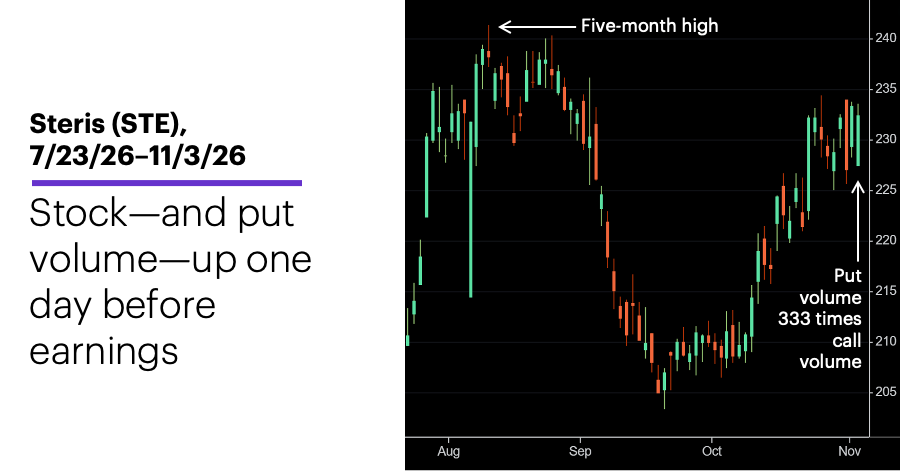
Source: Power E*TRADE. (For illustrative purposes. Not a recommendation.)
Things were a little more eventful on the options side—relatively speaking. Two seemingly modest (500-contract) trades in the November $220 and $200 puts were enough to give STE the day’s highest put-call ratio (333:1) among US stocks. The volume in both contracts was greater than their respective open interest, which suggests these were likely new positions:
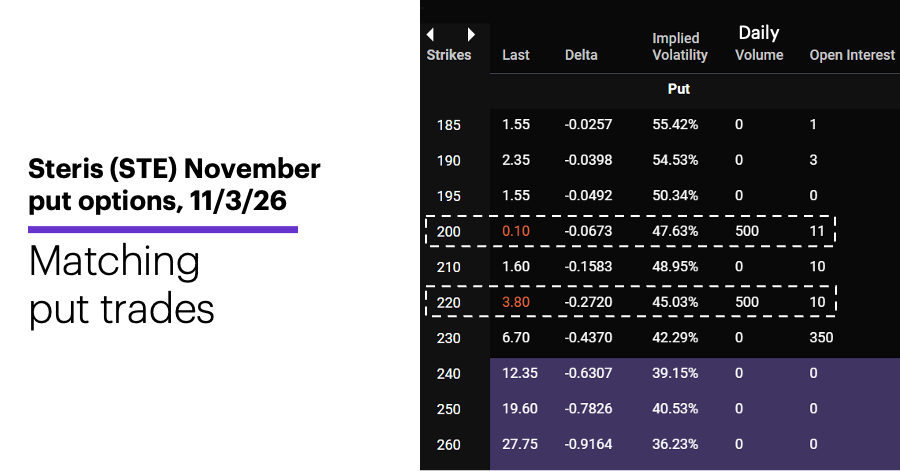
Source: Power E*TRADE Pro. (For illustrative purposes. Not a recommendation.)
Even so, this activity may not have attracted much attention on most days, but Tuesday happened to be the day before STE’s earnings, which are due after today’s closing bell.
The trades could be unrelated, but the fact that both were executed at the same time suggests they could have been part of a single position—specifically, a vertical (bear) put spread combining a long position in the higher-strike put ($220) with a short position in the lower-strike put ($200).
For the sake of argument, let’s assume a trader executed this spread to capitalize on a potential down move in the stock—possibly after earnings. This leads to a simple question: Why not just buy a put? Two reasons come to mind. First, selling a lower-strike put allows the trader to collect some premium, which makes the position cheaper than a simple long put. Second, the short option benefits from time decay, offsetting the negative effects of time on the long option.
The following risk profile for a vertical put spread shows the trade-off for these potential advantages. Because the short put’s losses offset the long put’s gains if the stock continues to fall below the lower strike price, a vertical spread caps reward as well as risk:
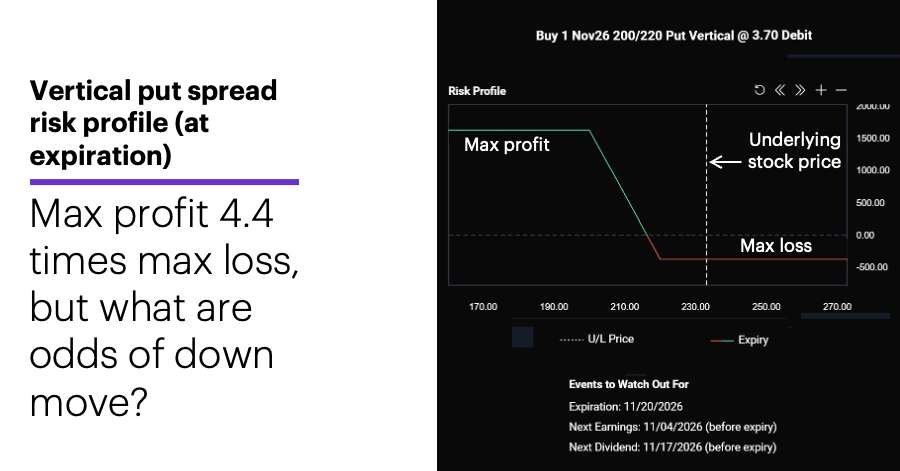
Source: Power E*TRADE Pro. (For illustrative purposes. Not a recommendation.)
A long vertical put can be profitable (at expiration) if the stock is somewhere between the two strike prices, with the maximum profit occurring if it closes at or below the lower strike price. The spread’s maximum potential reward is the difference between the strike prices (in this case, $20) minus the cost of the spread (in this case, $3.70), or 16.30 ($1,630) per spread. The maximum loss—no matter how much the stock rallies—is the cost of the spread, which means the trade’s reward-risk ratio is more than 4:1.
While that’s a favorable balance, the “catch” is not knowing whether the stock will rally or fall, or by how much. (The stock has been evenly split between earnings-day gains and losses after its past 12 announcements.1) That’s a reminder that a large trader may have instead shorted the spread—selling the higher-strike put and buying the lower-strike put—expecting the stock to maintain its current level or rally. Either way, there were traders on both sides of yesterday’s positions, so it’s fair to assume there are varying opinions about the stock’s near-term path.
As of Tuesday, STE would have needed to fall below $216.30 (by expiration) for the put spread to begin to profit—roughly 6.8% below the stock’s closing price on Tuesday, and a bit more than the +/-5.9% move implied by the options market.
Market Mover Update: Morgan Stanley & Co. released a new report identifying stocks that are most and least likely to deliver earnings surprises in November, which includes Analog Devices (ADI), Deere (DE), and Snowflake (SNOW).2
Today’s numbers include (all times ET): mortgage applications (7 a.m.), ADP Private Employment (8:15 a.m.), International Trade in Goods and Services (8:30 a.m.), PMI Composite (9:45 a.m.), ISM Services Index (10 a.m.), EIA Petroleum Status Report (10:30 a.m.).
Today’s earnings include: Applovin’ (APP), Arm Holdings (ARM), Circle Internet (CRCL), E.L.F. Beauty (ELF), Hut 8 (HUT), Kraft Heinz (KHC), McDonald's (MCD), MercadoLibre (MELI), Murphy Oil (MUR), Novo Nordisk (NVO), Revolution Medicines (RVMD), Uber (UBER), Wayfair (W).
Click here to log on to your account or learn more about E*TRADE's trading platforms, or follow the Company on X (Twitter), @ETRADE, for useful trading and investing insights.
1 “Earnings day move” refers to the price change the day after the numbers are released, since STE announces after the closing bell.
2 MorganStanley.com. Quant Driven Earnings Ideas—Stocks Poised for Earnings Surprises in November 2026. 11/4/26.