Gold’s overlooked catalysts
- Gold prices near lowest levels of year
- Most recent downswing tracked yield surge
- Macro headwinds masking bullish factors?
For a while now, gold has seemed to be a one-story market, and the plot has revolved around interest rates: In a rising-yield environment, non-yielding assets like gold tend to suffer.
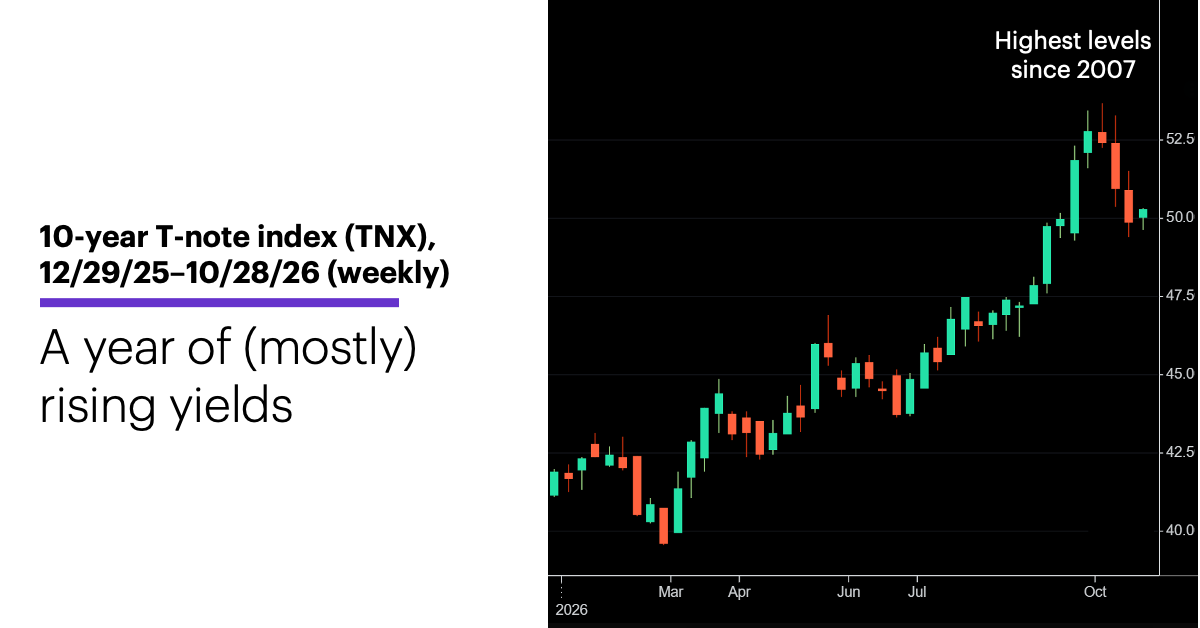
This year has certainly qualified as a rising-yield environment. Even after a significant three-week pullback this month, the benchmark 10-year Treasury yield was a little above 5% on Wednesday, and up 86 basis points (0.86%) for the year:
Source: Power E*TRADE. (For illustrative purposes. Not a recommendation.)
Meanwhile, spot gold prices—which soared 66% in 2025—were down more than 6% for the year, and off nearly 28% from their January 2026 record high close.
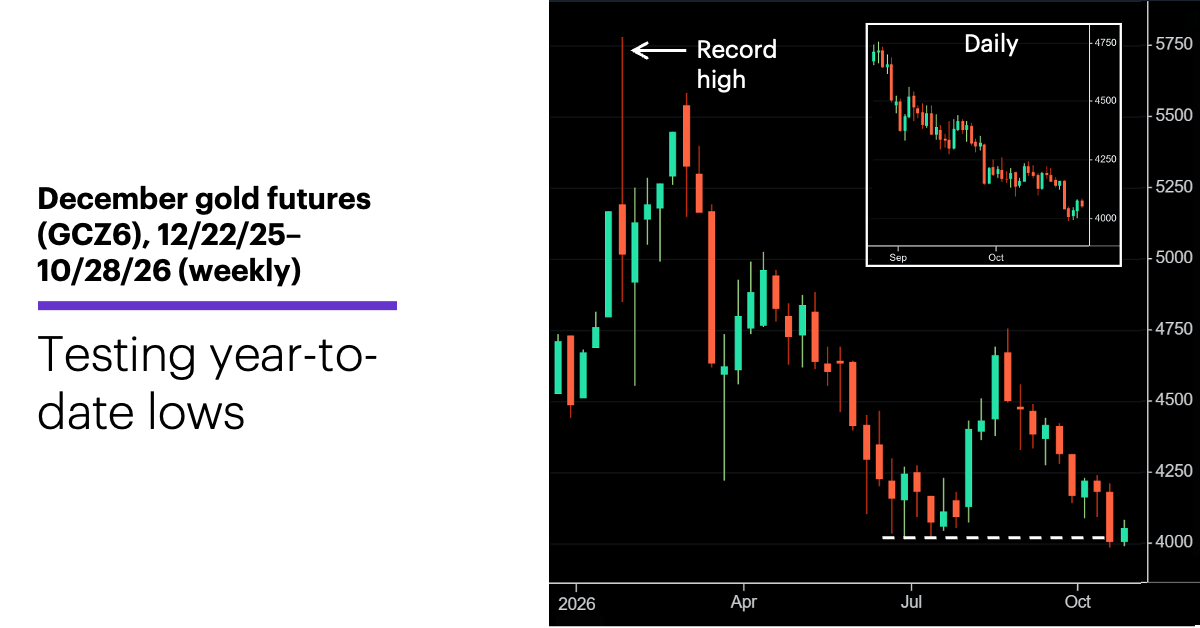
The following chart of December gold futures (GCZ6) shows the market’s latest downswing—since late August, when the yield rally accelerated—dropped prices to their summer lows:
Source: Power E*TRADE Pro. (For illustrative purposes. Not a recommendation.)
While a roughly 15% decline between August 25 and October 23 (the high and low closes in the daily chart inset) may not smack of “resilience” in the face of rising rates, Morgan Stanley & Co. analysts argued in mid-October that gold was actually outperforming its macro backdrop: The March-July relationship with real yields, they explain, implied a gold price below $3,000, which was roughly 28% lower than its level at the time.1 (Note: Spot gold prices are still slightly above their June-July lows.)
They also make the case that gold isn’t strictly a “yields” story. Structural demand for gold, they note—strong central bank purchases and gold ETF inflows—is increasingly offsetting the market’s macro headwinds. Although they acknowledge that easing yields and/or oil prices would likely drive gold gains, they believe prices may still prove resilient even if yields rise because of fiscal concerns or rising oil triggers stagflation fears.
In a separate report, the analysts note that while gold hasn’t diversified stock risk since 2020, it has “blunted” the worst bond sell-offs, which they describe as “increasingly valuable as fiscal and inflation concerns rise.” Yes, Fed rate tightening and a stronger dollar are risks, but given the real potential for lower yields (the market is currently pricing in more rate hikes than Morgan Stanley & Co. strategists expect), they describe gold as a “top metals pick,” with a price target of $5,000 for the second quarter of 2027.2
Today’s numbers include (all times ET): Q3 GDP, initial estimate (8:30 a.m.), Jobless Claims (8:30 a.m.), Personal Income and Outlays (8:30 a.m.), PCE Price Index (8:30 a.m.), EIA Natural Gas Report (10:30 a.m.).
Today’s earnings include: Amazon (AMZN), Baxter (BAX), Bristol Myers Squibb (BMY), Anheuser-Busch InBev (BUD), Caterpillar (CAT), Coinbase (COIN), Hershey (HSY), Intel (INTC), Eli Lilly (LLY), Mastercard (MA), Merck (MRK), Roblox (RBLX), Sandisk (SNDK), ExxonMobil (XOM).
Click here to log on to your account or learn more about E*TRADE's trading platforms, or follow the Company on X (Twitter), @ETRADE, for useful trading and investing insights.
1 MorganStanley.com. Gold: More Than a Rates Trade. 10/13/26.
2 MorganStanley.com. Gold: Same Haven, Different Storm. 10/26/26.