Stocks navigate tech obstacles
- Stocks pivot from midterm sell-off despite NVDA volatility
- Inflation mixed but moderate, yields and dollar climb
- This week: NVDA earnings, retail sales
All market roads continued to lead to tech last week—and this week looks to be more of the same.
US stocks rebounded from the previous week’s post-midterm sell-off, despite AI chip bellwether NVIDIA (NVDA) suffering its biggest weekly drop in more than a year amid CEO Jensen Huang’s unexpected departure.
That news overshadowed the release of moderate-but-sticky inflation data from the Consumer Price Index (CPI) and Producer Price Index (PPI) that appeared to solidify expectations for a December rate hike. The S&P 500 (SPX) posted its biggest weekly return since early August, although Friday’s tech-led pullback ended the week on a soft note:
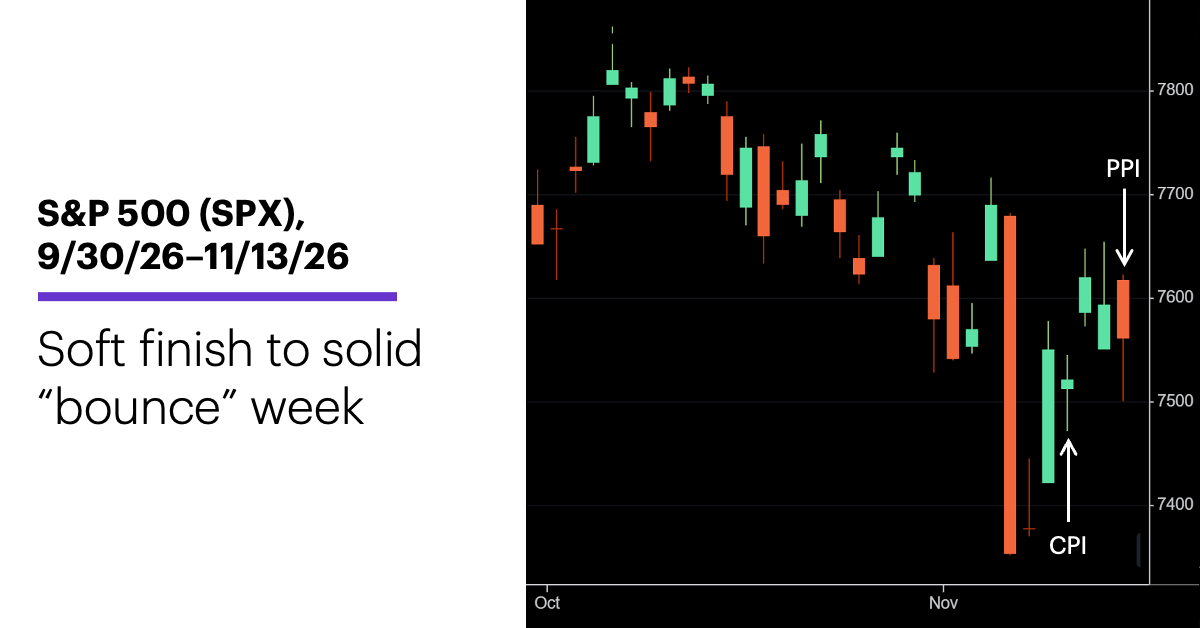
Source: Power E*TRADE. (For illustrative purposes. Not a recommendation. Note: It is not possible to invest in an index.)
The headline: Stocks snap four-week losing streak.
The fine print: Sentiment around the AI trade had already been challenged before last week’s NVDA story emerged. But CoreWeave’s (CRWV) earnings beat-and-raise (and stock rally) last Wednesday appeared to ease some of those concerns.
The number: 0.3%, the core CPI inflation reading (for October) reported last Tuesday. While that was higher than the 0.2% estimate, it was unchanged from a month earlier. Friday’s PPI report was slightly cooler than expected.
The scorecard: The Nasdaq 100 (NDX) tech index led the market last week:
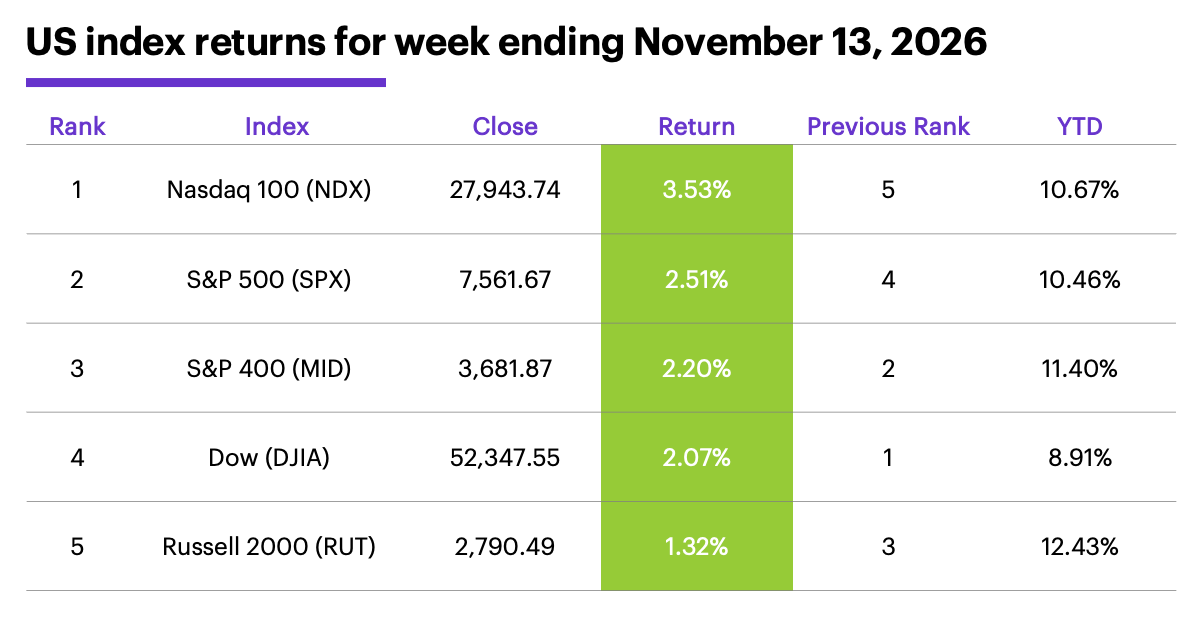
Source (data): Power E*TRADE. (For illustrative purposes. Not a recommendation.)
S&P 500 sector returns: The strongest S&P 500 sectors last week were energy (+5.1%), industrials (+3.7%), and communication services (+3.5%). The weakest sectors were materials (+0.3%), real estate (+0.9%), and utilities (+1.9%).
S&P 500 stock moves: Last week’s biggest gains were Advanced Micro Devices (AMD) +19% to $534.06, Broadcom (AVGO) +18% to $347.01, and Charter Communications (CHTR) +17% to $138.39. The biggest losses were First Solar (FSLR) -15% to $171.39, NVIDIA (NVDA) -13% to $162.85, and Moderna (MRNA) -12% to $223.37.
Yields and the dollar: The benchmark 10-year US Treasury yield rose 30 basis points (0.3%) to a three-week high of 5.16% last week. The US Dollar Index (DXY) climbed 1.11 to 103.41, its highest level since April 2025.
Commodity futures: WTI crude oil futures (CLZ6) declined $2.27 to $88.56 last week. December gold (GCZ6) fell $188.60 to $3,886.30. Biggest gains: December natural gas (NGZ6) +7.7%, December oats (ZOZ6) +7.7%. Biggest declines: December silver (SIZ6) -5.4%, January RBOB gasoline (RBF7) -5.1%.
Crypto: Bitcoin -9.9% to $68,249.27 last week, Ether -13.8% to $1,927.59, Solana -13.3% to $78.10.
Coming this week
This week’s numbers include:
●Monday: Empire State Manufacturing Index
●Tuesday: Retail Sales, Import and Export Prices, Industrial Production and Capacity Utilization, NAHB Housing Market Index
●Wednesday: Housing Starts and Building Permits, FOMC minutes
Thursday: Philadelphia Fed Manufacturing Index, Leading Economic Indicators Index
●Friday: Consumer Sentiment
Retail earnings take center stage on the earnings calendar—or would, if NVIDIA (NVDA) wasn’t also releasing its numbers:
●Monday: Medtronic (MDT), Powell Industries (POWL), Tyson Foods (TSN), Viking Holdings (VIK)
●Tuesday: Disney (DIS), Dycom (DY), Home Depot (HD), NVIDIA (NVDA), Palo Alto Networks (PANW), Williams Sonoma (WSM)
●Wednesday: Copart (CPRT), The Gap (GAP), Lowe’s (LOW), Ross Stores (ROST), Target (TGT), TJX (TJX)
●Thursday: Intuit (INTU), Keysight Technologies (KEYS), Walmart (WMT)
●Friday: Warner Music (WMG), Zim Integrated Shipping (ZIM)
AI beyond NVDA
Before the NVDA story dominated headlines, the markets were still digesting the midterm elections—specifically, their potential ramifications for data centers and the AI trade.
In describing the post-election market weakness as “unwarranted,” Morgan Stanley & Co. analysts noted their total AI capex projections for the next few years are unchanged, although they expect some data center builds to be delayed.
For example, they believe the blue sweep of statewide offices in Texas—a key data center state—likely won’t impact 2027 data center construction, although a new review process could shift roughly 20% of US projects from 2028 to 2029. Overall, they see US data center builds remaining more or less flat from 2027 to 2028, with roughly 40% growth in 2029. They also think AI labs putting an even greater emphasis on exponential “compute efficiencies” will enable tech diffusion across the economy.1
Meanwhile, Morgan Stanley & Co. quant researchers, who note the “the global AI correction has been driven by multiple compression amid concerns over future earnings,” favor selectivity over broad dip-buying. They suggest diversifying into resilient adopters, prioritizing “valuation cushions,” and monitoring earnings-revision trends closely. AI multiples have reset, they note, “but investors may be pricing future earnings risks not yet reflected in consensus revisions.”2
Their report also points out that while AI adopters had outperformed enablers by approximately 26 percentage points from the end of September to November 8, “AI enablers continued to show stronger earnings revisions, suggesting the rotation in share-price performance has yet to translate into a rotation in earnings fundamentals.”2
Click here to log on to your account or learn more about E*TRADE's trading platforms, or follow the Company on X (Twitter), @ETRADE, for useful trading and investing insights.
1 MorganStanley.com. Buy the Drop: AI Investment Opportunities Post the US Midterms. 10/8/26.
2 Morgan Stanley. AI Correction: Multiples Reset, Estimates Hold. 11/8/26.