Market absorbs latest punches
- Stocks swing amid oil surge, earnings, tech volatility
- Treasury yields push to 18-month highs
- This week: Mag-7 earnings, Fed meeting, inflation, GDP
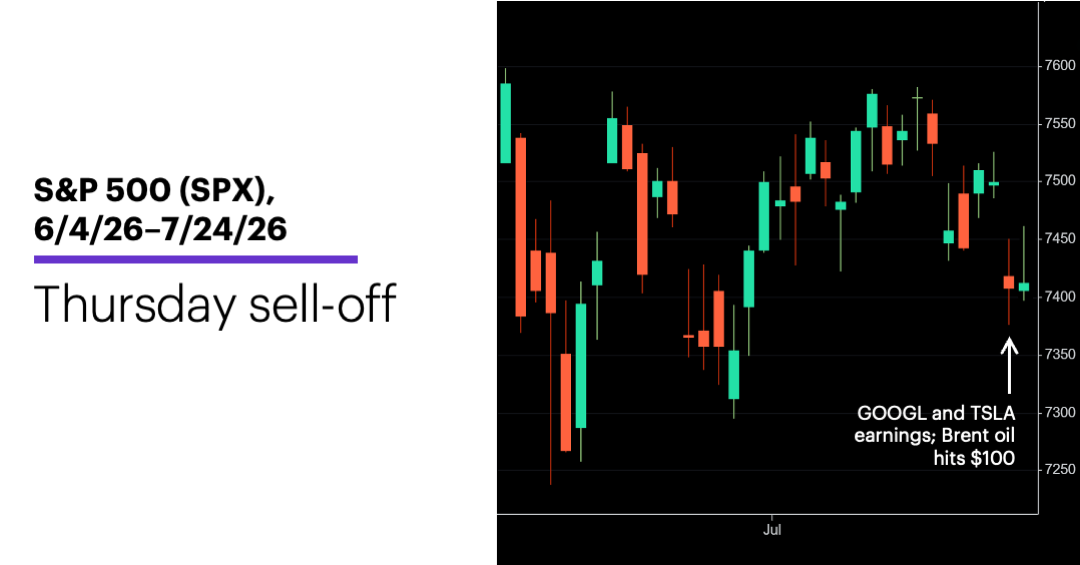
first time since March, as geopolitics and some high-profile earnings sell-offs exacerbated volatility in a market already reckoning with a semiconductor correction.
At last Wednesday’s close the SPX was up 0.6% for the week and flat for the month. But the index fell 1.2% on Thursday as escalating hostilities in the Middle East pushed global Brent crude oil prices back above $100, and Alphabet (GOOGL) and Tesla (TSLA) dropped after releasing earnings. Retreating oil gave the market an early boost on Friday, but the SPX still struggled as chip stocks turned lower again:
Source: Power E*TRADE. (For illustrative purposes. Not a recommendation. Note: It is not possible to invest in an index.)
The headline: Geopolitics and oil return as stock-market catalysts.
The fine print: The initial negative reception to GOOGL’s earnings announcement bears watching, since three more of the key AI hyperscalers—Amazon (AMZN), Meta (META), and Microsoft (MSFT)—are scheduled to release their numbers this week. GOOGL beat its earnings and revenue numbers, but it also raised its estimate for AI capex this year, reviving concerns about the major AI players’ ability to turn their unprecedented AI spending into a proportional economic benefit.
The number: 8. So far in this up-and-down July, the S&P 500 (SPX) has closed in positive territory for the month on eight days and negative territory on the other eight.
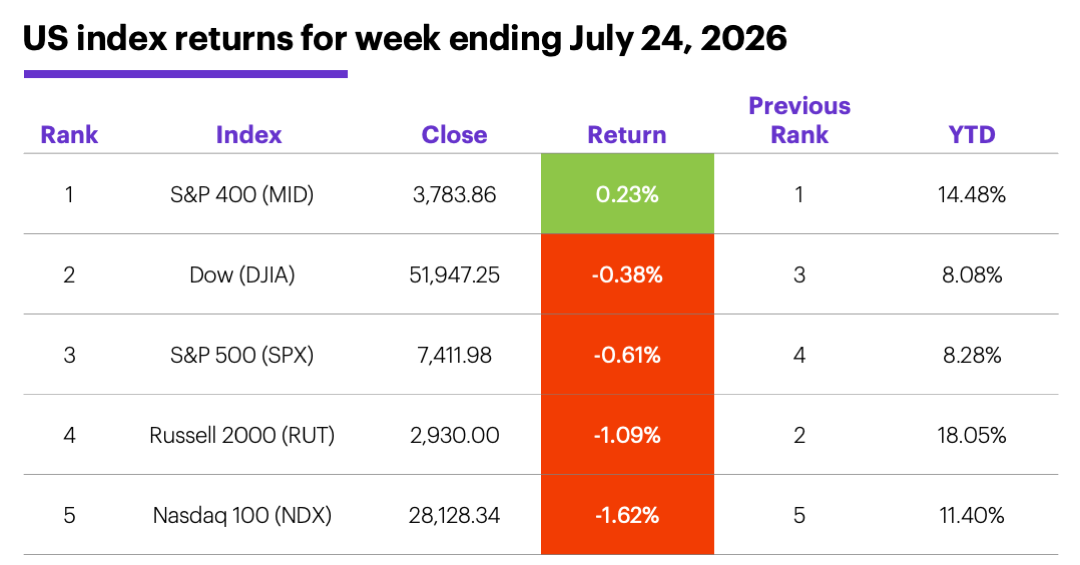
The scorecard: The S&P 400 (MID) mid-cap index led the US market last week:
Source (data): Power E*TRADE. (For illustrative purposes. Not a recommendation.)
S&P 500 sector returns: The strongest S&P 500 sectors last week were energy (+3.7%), utilities (+2.5%), and industrials (+1.7%). The weakest sectors were consumer discretionary (-6.2%), communication services (-5.9%), and consumer staples (-1.4%).
S&P 500 stock movers: Last week’s biggest gains were Super Micro Computer (SMCI) +24% to $30.10, and Wabtec (WAB) +15% to $302.50. The biggest losses were Tesla (TSLA) -18% to $313.03, and Rollins (ROL) -15% to $38.56. Other moves: Liberty Energy (LBRT) -22% to $19.62 on Thursday, Safety Insurance Group (SAFT) +41% to $103.20 on Friday.
Yields and the dollar: The 10-year US Treasury yield hit 4.7% last Thursday—its highest level since January 2025—and ended the week up 0.13% at 4.67%. The US Dollar Index (DXY) climbed 0.70 to 101.47.
Commodity futures: Despite pulling back 2% on Friday, September WTI crude oil (CLU6) ended the week up $7.59 at $89.37. August gold (GCQ6) rose $39.10 to $4,057.90 for the week. Biggest gains: September WTI crude oil (CLU6) +9.3%, December soybean meal (ZMZ6) +5.2%. Biggest declines: November Lithium (LTHX6) -6.2%, August milk (DLQ6) -3.5%.
Crypto: Bitcoin +0.4% to $64,143.48 last week, Ethereum +1.1% to $1,861.08.
Coming this week
Four of the Magnificent Seven are on this week’s earnings calendar—along with more than a thousand other companies. The following list merely scratches the surface:
●Monday: Agilysys (AGYS), Electronic Arts (EA), F5 (FFIV), Logitech (LOGI), Navitas Semiconductor (NVTS), Penumbra (PEN), PayPal (PYPL), Rambus (RMBS), Southern Copper (SCCO), Whirlpool (WHR)
●Tuesday: Boeing (BA), eBay (EBAY), Enphase (ENPH), Ford (F), Corning (GLW), Coca Cola (KO), NXP Semiconductors (NXPI), Qorvo (QRVO), Repligen (RGEN), Sherwin-Williams (SHW), Seagate (STX), Teradyne (TER), United Parcel Service (UPS), Visa (V)
●Wednesday: Carvana (CVNA), Chipotle (CMG), General Dynamics (GD), Eagle Materials (EXP), Lam Research (LRCX), Meta (META), Microsoft (MSFT), O'Reilly Automotive (ORLY), Procter & Gamble (PG), Qualcomm (QCOM), Starbucks (SBUX), Verisk Analytics (VRSK), Vulcan Materials (VMC)
●Thursday: Apple (AAPL), Amazon (AMZN), Baxter (BAX), Bristol Myers Squibb (BMY), Hyatt (H), Hershey (HSY), Roblox (RBLX), Regeneron (REGN), Tower Semiconductor (TSEM), ExxonMobil (XOM), XPO (XPO)
●Friday: AbbVie (ABBV), AutoNation Inc (AN), Colgate Palmolive (CL), Chevron (CVX), Moderna (MRNA)
A big week of data includes a Fed interest rate announcement, Fed inflation (PCE price index), and GDP:
●Monday: Durable Goods Orders
●Tuesday: Trade Balance in Goods (advance), retail and wholesale inventories (advance), S&P Case-Shiller Home Price Index, NAHB House Price Index, Consumer Confidence
●Wednesday: Fed interest rate decision
●Thursday: PCE Price Index, Q2 GDP (initial estimate), Personal Income and Spending
●Friday: Employment Cost Index, Chicago PMI, Consumer Sentiment (final)
SOX bear markets
As of Friday, the PHLX Semiconductor Index (SOX) may have looked like it exited the bear market it entered on July 17 almost as soon as it began, rallying x.x% last week.
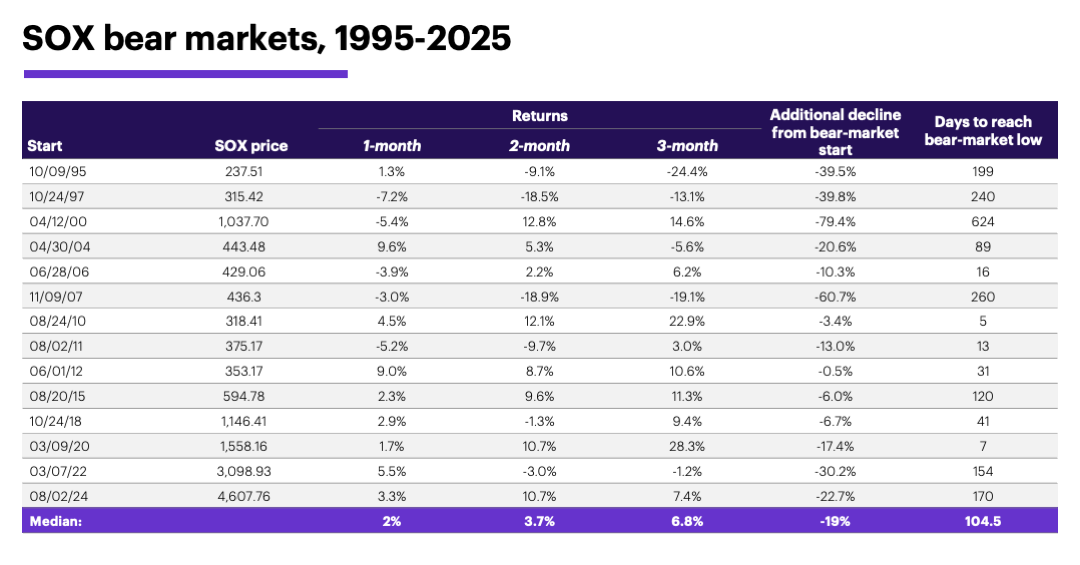
If July 17 did mark the simultaneous beginning and end of this SOX bear market, it would be somewhat unusual, given the index’s performance after the other times it fell 20% below a prior high. The table below shows what happened after 14 other times the SOX first closed in bear-market territory (after rallying at least 40% off a prior low):
Data source: Power E*TRADE Pro. (For illustrative purposes. Not a recommendation. Note: It is not possible to invest directly in an index.)
The “Returns” columns show how much the index gained or lost one, two, and three months after it first fell into a bear market. One takeaway is that, more often than not, the SOX was higher one, two, and three months after it first entered a bear market.
But that doesn’t mean SOX bear markets tended to be short-lived affairs. The final two columns show how much further the index fell before the bear move ultimately ended, and how long it took to reach that low.1
In each instance the SOX fell further after starting the bear market, although in one case the additional decline was only -0.5%. The final column shows that it took the SOX anywhere from five to 624 trading days to reach the low point of the bear market. There wasn’t a single case of the SOX starting and finishing a bear market on the same day.
Finally, while the belief that “this time is different” is usually the enemy of sound trading and investing, Morgan Stanley & Co. analysts noted last week that the memory segment of the semiconductor space—which was largely responsible for the wider chip sector’s big gains in previous months, and its sharp retreat in recent weeks—may, in fact, be experiencing something unique. The current memory cycle, the analysts say, is different from others because it’s driven almost exclusively by data center demand, and the memory shortage looks like it could persist for several years.2
Click here to log on to your account or learn more about E*TRADE's trading platforms, or follow the Company on X (Twitter), @ETRADE, for useful trading and investing insights.
1 All figures reflect PHLX Semiconductor Index (SOX) daily prices, 1994-2026. Note: The start of a bear market was defined as a daily closing price at least 20% below a prior closing price, but only if that prior closing price was at least 40% above a previous closing price. One-month, two-month, and three-month returns represent 21, 42, and 63 trading days, respectively. Supporting document available upon request.
2 MorganStanley.com. Selloff of US memory stocks creates a compelling entry point. 7/20/26.