The long-term opportunity in AI infrastructure stocks
Summary: As investors continue to debate the scale, pace and returns of AI spending, Morgan Stanley Research revisits the long-term bull case for AI infrastructure and where opportunities may emerge across the ecosystem.

Key takeaways
- AI infrastructure stocks have experienced periods of volatility as investors question unprecedented AI spending and potential returns.
- Despite concerns, demand for AI compute is likely to exceed supply for years, supporting continued investment across the AI ecosystem.
- More efficient AI models, including advances from Chinese developers, may lower costs and drive greater overall demand.
- Power availability, labor shortages and data center permitting could slow deployment but not derail AI infrastructure expansion.
- Morgan Stanley Research sees long-term opportunities across AI infrastructure bottlenecks, compute manufacturing, energy security, leading Chinese AI companies and hyperscalers.
Shares of companies involved in the infrastructure for artificial intelligence—from semiconductor manufacturers to large language model developers—have been volatile as investors weigh the magnitude of AI capital spending against the timing and scale of potential returns.
That debate is likely to remain a central feature of the market for months to come. Still, Morgan Stanley Research believes the more important question for investors is whether the long-term demand for AI compute can continue to outstrip supply—and what that means for companies positioned across the AI value chain.
Recent weakness in parts of the AI infrastructure trade are likely due more to short-term investor positioning than to deteriorating fundamentals. And over the longer term, demand for AI compute is likely to significantly outpace supply for years to come. AI capabilities should continue improving at a non-linear pace, increasing the long-term value of the infrastructure supporting the technology.
"AI infrastructure will, over time, become an 'intelligence superhighway' that provides significant net benefits to economies around the world," says Stephen Byrd, Morgan Stanley's Global Head of Thematic and Sustainability Research. "Bottom line: we're bullish on the 'intelligence superhighway,' but see key speed bumps ahead."
Investor concerns center on AI economics
One key concern among investors is that companies could begin limiting AI token usage per employee to control costs, reducing revenue opportunities for LLM developers. Such policies would aim to discourage "tokenmaxxing"—the practice of maximizing AI token consumption to create the appearance of higher productivity without delivering meaningful business results.
Since we are fundamentally bullish on the rate of improvement in AI capabilities, the benefits of AI adoption and associated capex—and given the recent market pullback affecting a range of AI Infrastructure stocks—this point in time represents an unusually attractive buying opportunity.
Those concerns are overstated, according to Morgan Stanley Research.
"The data suggests that average token consumption per employee is actually quite low, with the potential to increase significantly in the coming months and years," Byrd says.
Another concern is growing competition from Chinese open-weight AI models. Some small Chinese startups have introduced models that rival comparable U.S. offerings at significantly lower development costs.
While a legitimate competitive threat, efficient model development can also reinforce Jevon’s Paradox, in which efficiency gains lower costs and ultimately increase overall demand.
"This single-minded pursuit of efficiency by both Chinese and American LLM developers reinforces our fundamental view that demand for compute is likely to vastly exceed supply," Byrd says.
Investors are also watching whether the industry can build AI infrastructure quickly enough. Data center development faces challenges, including shortages of skilled labor, constraints on electricity availability and growing political opposition in some U.S. states.
"We view this broadly as a valid concern, though we see this as more of a speed bump rather than a brick wall," Byrd says.
Reasons to remain optimistic
Morgan Stanley Research expects AI capabilities to potentially accelerate with the use of recursive self-improvement by major LLMs labs. RSI would allow frontier models to help improve future generations of AI systems. Such advances could enable AI capabilities to improve at machine speed rather than being limited by the pace of human development, while requiring little or no additional compute capacity.
“Large technology companies, or hyperscalers, continue to invest aggressively because they are confident that their unprecedented spending on AI will pay off,” Byrd says.
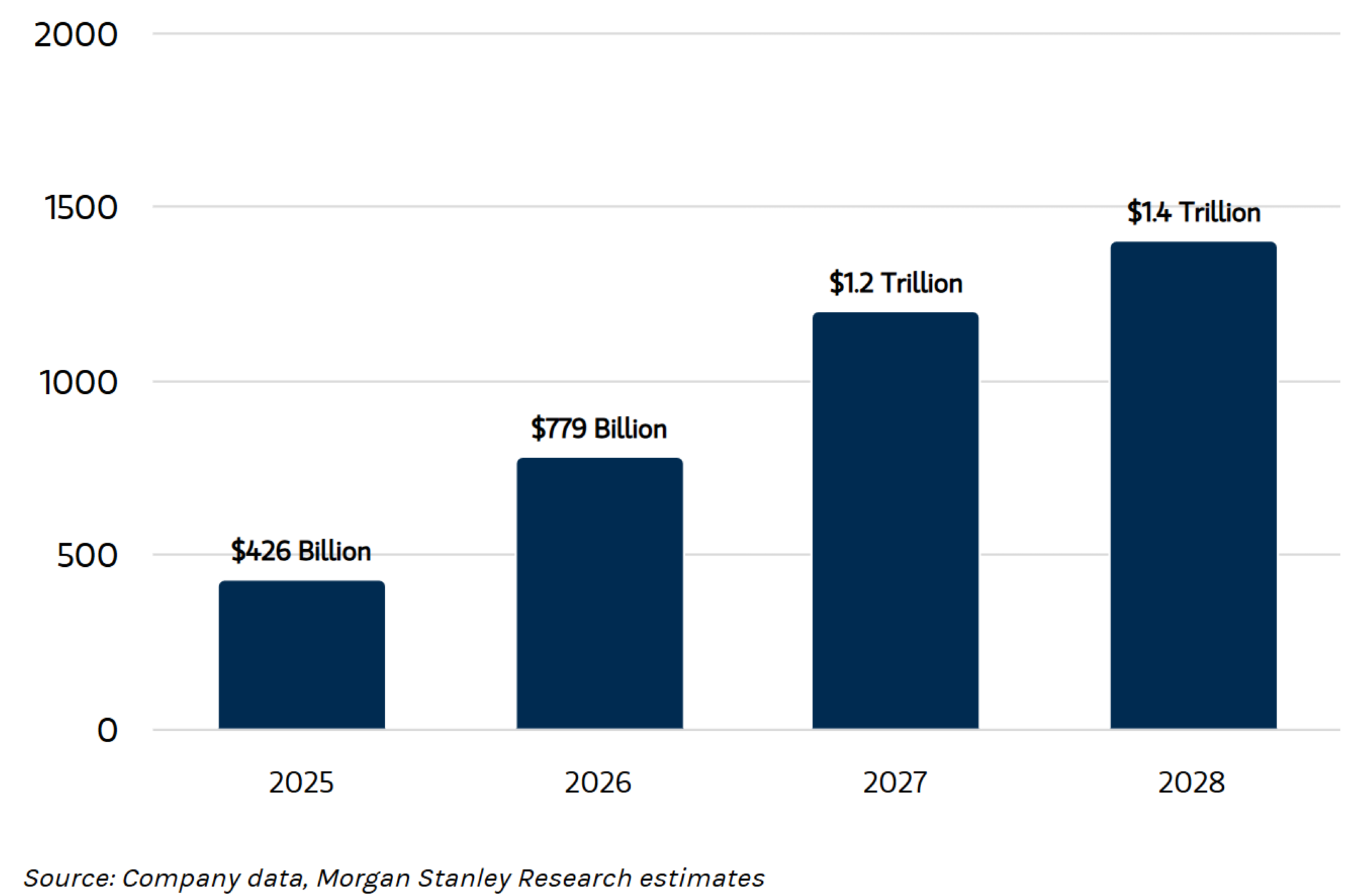
Capital expenditures by the five largest U.S. technology companies alone will increase from nearly $800 billion this year to approximately $1.2 trillion in 2027 and $1.4 trillion in 2028, according to Morgan Stanley Research.
Several areas may be poised to benefit as investment in AI infrastructure continues:
- AI infrastructure bottlenecks: Companies that help address labor shortages, shorten time to power and expand electricity availability stand to benefit, including fuel cell providers, Bitcoin operators transitioning into powered data center infrastructure providers, turbine manufacturers, energy storage companies, power developers and data center REITs with strong growth prospects.
- Compute manufacturing ecosystem: Businesses that are positioned to benefit from growing demand for AI compute, such as semiconductor producers, as the value of intelligence rises and supply remains constrained.
- Leading Chinese AI solution providers: These companies have AI capabilities and cost competitiveness that may not yet be fully reflected in their valuations.
- Energy security assets: Businesses that support reliable energy supply and storage are critical to AI infrastructure development.
- Hyperscalers: Large technology companies have the scale to generate attractive returns on AI capital expenditures and accelerate AI adoption.
CRC# 5847737 08/2026
How can E*TRADE from Morgan Stanley help?
Artificial intelligence
Find investing opportunities in this growing field of technology.
Brokerage account
Investing and trading account
Buy and sell stocks, ETFs, mutual funds, options, bonds, and more.
Prepare to participate
E*TRADE from Morgan Stanley offers eligible clients access to IPOs and other new issue offerings.
Thematic Investing
Find ETFs that align with your values or with social, economic, and technology trends.