Back to the Mag future?
- Mag-7 has lagged the market this year
- Evidence of late-June momentum shift?
- Some hyperscalers may have strategic advantage
After a weak June, the Magnificent 7 stocks found themselves, as a group, in a somewhat surprising position—underperforming the S&P 500 (SPX) for the year. While the Mag 7 was an early beneficiary of AI bullishness, they have been eclipsed by rallies in other groups representing different sections of the “AI stack”—most notably (and recently), semiconductors.
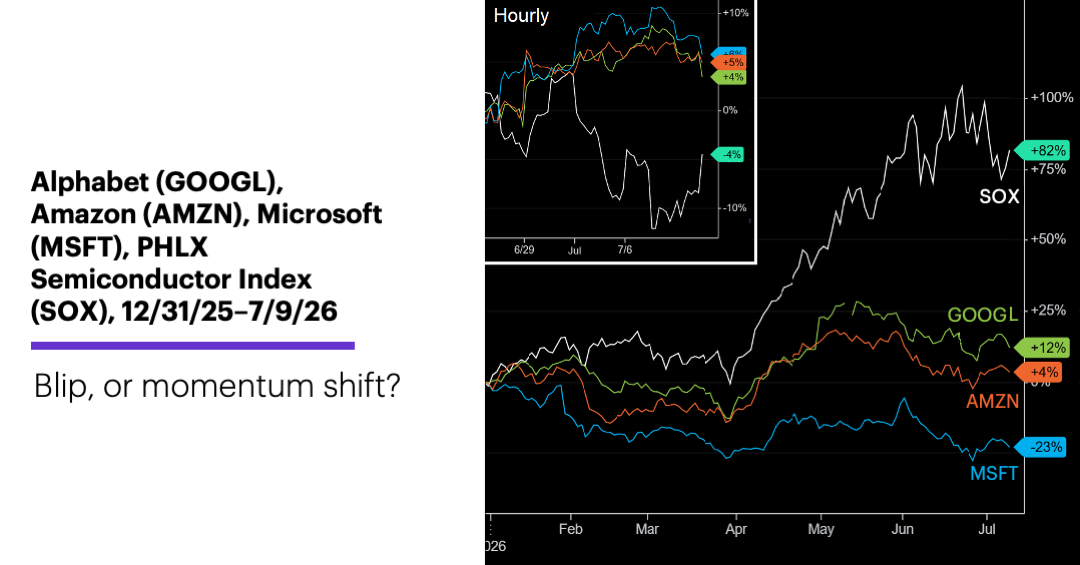
The following chart highlights this underperformance by comparing the returns of three Mag-7 stocks—Alphabet (GOOGL), Amazon (AMZN), and Microsoft (MSFT)—to the PHLX Semiconductor Index (SOX). The main chart shows year-to-date performance through Thursday morning, while the hourly inset at the upper left zooms in on the past 10 trading days (since June 25):
Source: Power E*TRADE. (For illustrative purposes. Not a recommendation.)
While the strongest of these Mag-7 stocks, GOOGL, still trailed the SOX by 70 percentage points on Thursday morning—despite the chip index’s rebound off a key support level—the inset highlights a role reversal that has occurred over the past couple of weeks.
It’s too early to say whether this shift signals a more durable changing of the guard, but there are valid reasons to consider the possibility. Earlier this week Morgan Stanley Wealth Management strategists noted that one of the more significant rotations of the four-year AI bull market played out in Q2: While semiconductor stocks soared, the AI hyperscalers—a group that includes GOOGL, MSFT, and AMZN—lagged the SPX more than they have at any time since 2022.1
Certain Mag 7 hyperscalers may be worth another look, especially given their valuations relative to an arguably overbought chip sector.
The strategists concede that this revaluation of hyperscalers in light of their accelerated AI spending and seemingly (so far) limited return on investment made sense—especially given the extreme pricing power enjoyed by semiconductor makers. The question now, they note, is whether that dynamic has, or soon will, run its course. While noting that not all hyperscalers are created equal, they think certain Mag 7 names are worth another look, especially given their relative valuations vs. the chip sector, which they describe as “meaningfully overbought.”
They also explain that signs point to an evolution in AI-stack design enabling increased implementation of hybrid designs—specifically, those that “blend use of open-source large language models (LLMs) with frontier models and feature more application-specific integrated circuits (ASICs) and AI accelerators in lieu of graphics processing units (GPUs).” Hyperscalers like GOOGL, AMZN, and MSFT, they note, have increasingly adopted this approach—which, by linking to their own proprietary cloud-services businesses, offers greater potential for monetization.
Market Mover Update: Solstice Advanced Material (SOLS) posted its first up day of the month on Thursday, although it reversed intraday to close near the bottom of its daily range (see “Deal chemistry”).
Today’s earnings include: Delta Air Lines (DAL).
Click here to log on to your account or learn more about E*TRADE's trading platforms, or follow the Company on X (Twitter), @ETRADE, for useful trading and investing insights.
1 MorganStanley.com. The GIC Weekly: Revisiting the Mag 7. 7/7/26.