From tokens to GPUs: AI terminology to know
E*TRADE from Morgan Stanley
11/16/26Summary: Want to follow the AI conversation more easily? Start here with 15 key terms, explained without the jargon.

Key takeaways:
- Generative AI creates new content, like text, images, and code, based on patterns learned from large amounts of data.
- Large language models (LLMs) are the technology behind many AI chatbots and writing tools.
- Training is how AI models learn from data; inference is how they apply that learning to answer your prompts.
- AI often runs on specialized chips called GPUs, typically housed in data centers and accessed through cloud-computing services.
- Knowing key AI terms can help you follow the news, but for investors, it's a starting point, not a substitute for research.
Tokens. Hallucinations. Hyperscalers. AI has a language of its own. And increasingly, these terms are part of the investing conversation.
These terms are showing up everywhere from earnings calls and company filings to news headlines. Understanding them can help you better follow the companies, technologies, industries, and infrastructure shaping the AI economy.
Here are 15 AI terms1 that can help you follow along and ask better questions.
What AI is
- Artificial intelligence (AI): The theory and development of computer systems able to perform tasks that traditionally have required human intelligence.
- Machine learning: A branch of AI in which a system learns from applicable data sets without being explicitly programmed by humans.
- Generative AI: A machine learning technique that uses existing content, such as text, images, or code, to generate realistic outputs by analyzing training data and learning its patterns and distribution.
- Large language model (LLM): A type of AI model trained on large volumes of text and other data to process and generate language. LLMs are used as foundation models in many chatbots, writing assistants, and other generative AI applications.
How AI works
- Training: The process of using data to adjust a model so it can identify patterns and perform specified tasks. Training large AI models can require substantial time and computing resources.
- Inference: The process in which a trained model uses new input to produce an output, such as an answer, prediction, classification, or summary.
- Prompt: An input, such as a question or an instruction, that guides a generative AI model’s output. The content and wording of a prompt can affect the response.
- Token: A unit of information processed by a language model. A text token may be a word, part of a word, a number, or punctuation.
- Hallucination: AI-generated information that is incorrect, unsupported, misattributed, or inconsistent with the available source material, even though it may sound plausible.
What AI needs
- Compute: The processing resources used to train and operate AI models.
- GPU (graphics processing unit): A processor designed to perform many calculations in parallel, making it well suited to training and running many AI models. Many modern AI systems rely on GPUs and other processors, often housed in data centers or accessed through cloud-computing services.
- Data center: A facility that houses servers, processors, storage, and networking equipment used to store data and operate digital services, including many AI systems.
- Hyperscaler: A large technology company that operates cloud-computing infrastructure and data centers at significant scale and provides computing, storage, networking, or related services to customers.
Where AI is going
- AI agent: A software, system, or tool that operates with a degree of autonomy, including taking select actions with defined permissions and controls. The human user remains accountable for the agent’s AI output and actions.
- Artificial general intelligence (AGI): A theoretical form of AI that could perform a wide range of tasks at or above human level. It's a concept rather than a product, and experts define it differently.
How it all fits together
These terms often show up together because AI is an ecosystem, and each part depends on the others: AI models learn from data and need powerful chips to train and run. Those chips sit in data centers that often deliver their computing power through the cloud. And the chatbots, AI agents, and other products people use rely on all of it. Some companies focus on one part of the ecosystem; others operate across several.
Understanding how the pieces connect can help provide context for the different companies and technologies operating across the AI ecosystem.
AI is bigger than the model
The technology depends on an ecosystem spanning data, compute, chips, infrastructure, cloud providers, and the products built on top.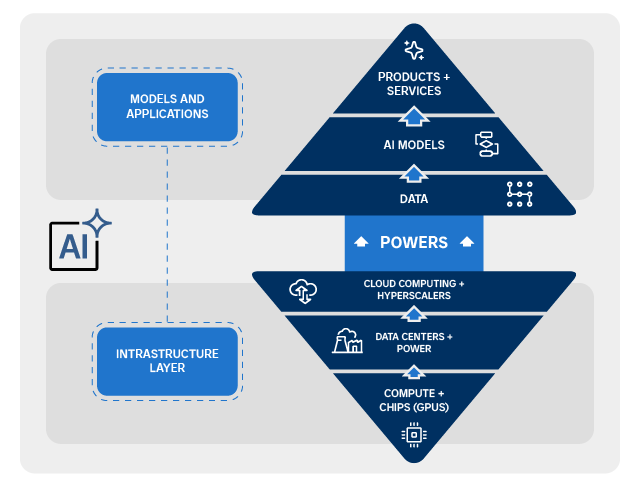
For investor consideration
AI terms are a starting point, not a substitute for research. Like all investments, AI-related investments involve risk, including the possible loss of principal. Before investing in any AI-related company or fund, consider your goals, time horizon, and risk tolerance, and read the disclosure documents available, such as a prospectus.
Article Footnotes
1 Certain definitions are based on guidance from regulatory agencies and bodies.
CRC# 6114148 (11/2026)