Diversifying beyond Bitcoin: Where Ether and Solana may fit
Morgan Stanley Wealth Management
08/18/26Summary: Thinking beyond BTC? Explore how cryptocurrencies ETH and SOL have historically moved with BTC, stocks and the dollar—and what that may mean for diversification.

Key takeaways:
- Investors shouldn’t count on ETH, alone, to diversify a BTC-heavy crypto allocation, because historically the two have tended to move together.
- Although SOL is somewhat less correlated with BTC than ETH, it has also been meaningfully more volatile, with larger drawdowns.
- Before adding crypto, identify its purpose for you and consider funding it by trimming the portfolio exposure it most closely resembles.
- Re-check your diversification assumptions over time, because crypto correlations can shift as the asset class evolves and becomes more widely held.
With the 2024 launch of spot exchange-traded products for ETH, investors gained an accessible way to invest in the second-largest cryptocurrency by market capitalization. More recently, spot exchange-traded products for SOL, the native cryptocurrency of the fast-growing SOL blockchain, began trading in October 2025. Whether you already hold BTC or are looking to add crypto to your portfolio for the first time, it’s important to know how ETH and SOL may impact diversification.
Understanding crypto “correlations”
When considering the impact that BTC, ETH, or SOL could have on your portfolio, it helps to understand how they “correlate,” or tends to move in relation to, other asset classes. This understanding is key for investors aiming to achieve diversification, the practice of spreading investments across different assets to help reduce the risk of outsize swings in a portfolio’s value. If two different investments tend to move together, adding either to your portfolio may simply increase this risk, rather than mitigate it.
It’s also key to note that “altcoins” like ETH and SOL are generally less liquid and more volatile than BTC. Whether that volatility improves portfolio diversification depends on correlations: A volatile asset moving in the same direction as the rest of the portfolio may reduce diversification, while one moving in a different direction may enhance it.
Morgan Stanley Wealth Management strategists have identified three main takeaways for investors about correlations between different cryptocurrencies and other assets:
- Diversification may be limited: Historically, BTC and ETH have been highly correlated, so owning both has provided limited incremental diversification. By comparison, SOL has been somewhat less correlated with BTC than ETH and has also exhibited slightly lower correlations with equities—factors that historically have been associated with greater diversification benefits—albeit with higher volatility and larger drawdown risk
- Low crypto-stock correlations: While cryptocurrencies sometimes seem to move up or down with stocks, over longer, four-year periods, they have historically had fairly low correlation to stocks.
- Relationships can shift: That said, correlations shift: As cryptocurrencies have become more popular, they have had increasing correlations with other assets like stocks.
Over a roughly four-year BTC market cycle, BTC has at times moved most closely with gold and at times with equities and has often been inversely related to the U.S. dollar.
How has BTC tended to move relative to other cryptocurrencies?
Over the four years through April 2026, BTC’s correlation with ETH was 0.78, meaning that the two assets have tended to move in the same direction most of the time, although not always at the same pace. BTC’s correlation with SOL was slightly lower, at 0.72.
However, since December 31, 2019, SOL has been approximately 86% more volatile than BTC, whereas ETH has been about 33% more volatile than BTC.
BTC, ETH, and SOL have become less volatile, but ETH and SOL remain more volatile than BTC.
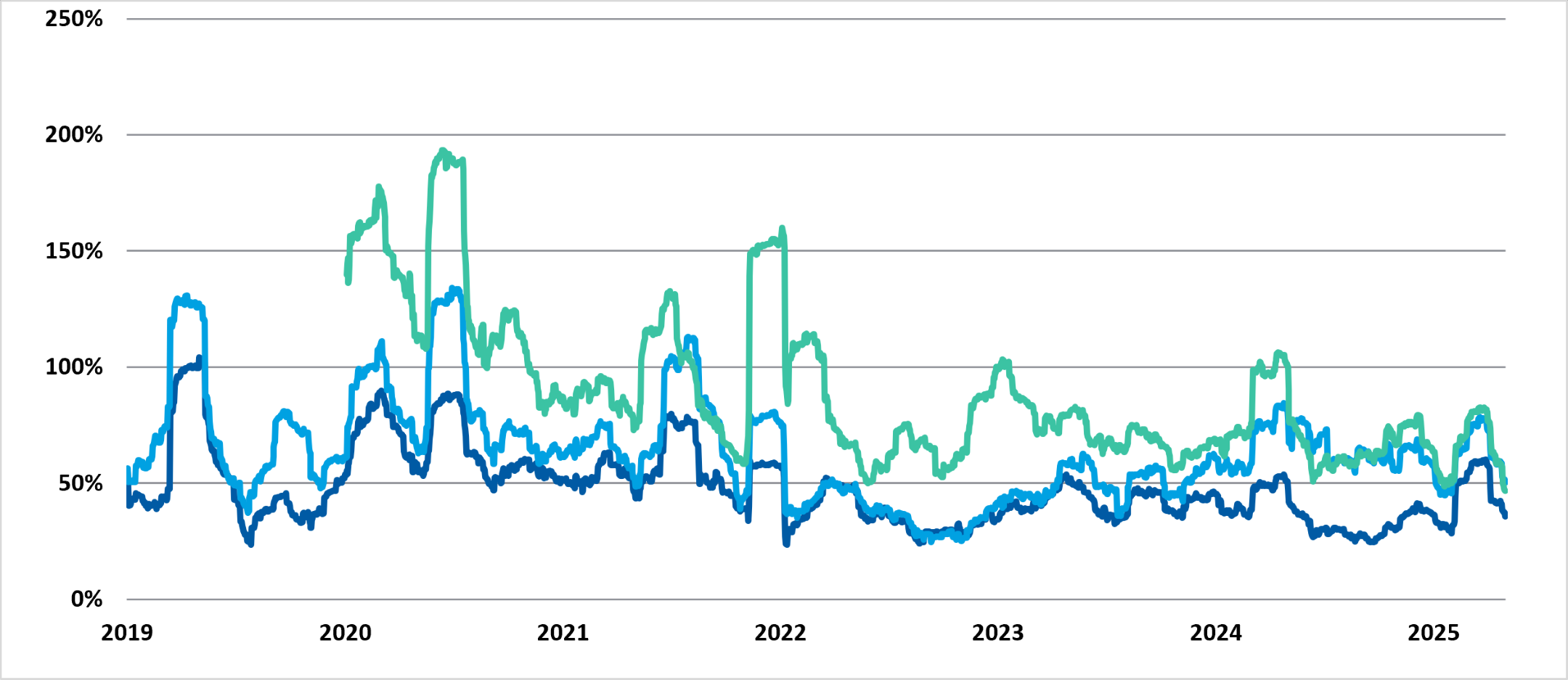
Source: Bloomberg, Coinmarketcap, Morgan Stanley Wealth Management Global Investment Office as of April 30, 2026
What role can ETH or SOL play in a portfolio?
The answer depends on why you’re interested in cryptocurrency in the first place. It can be helpful to think of crypto investors in three general categories:
1. “Digital gold” investors
Many investors see crypto as a hedge against inflation and a weakening U.S. dollar, similar to holding gold. Most investors looking for “digital gold” are satisfied with BTC, as ETH and SOL have historically been more volatile than BTC and less correlated with gold. That said, investors who are particularly worried about the dollar’s value may find ETH’s lower correlation with the greenback appealing.
2. Disruptive tech believers
Investors who view crypto as “disruptive tech” are drawn to the idea that blockchain networks could reshape parts of the financial system over time. For these investors, some may prefer ETH because the ETH network remains the largest smart-contract ecosystem and, historically, has tended to behave somewhat more like a technology-adjacent risk asset than BTC. Others may favor SOL based on the view that the Solana network’s faster and lower-cost transactions could help it gain share in certain use cases—or they may hold both to avoid making a single bet in a competitive and fast-moving landscape.
3. Crypto portfolio diversifiers
Investors who are attracted to crypto because it may serve as a portfolio diversifier might consider either a BTC-only portfolio or a portfolio combining BTC and SOL.
Based on our historical analysis, adding ETH to a BTC allocation has tended to reduce diversification benefits because it has been highly correlated with BTC and somewhat more correlated with equities and other traditional assets. On the other hand, SOL historically has been more volatile than BTC and ETH, but it also has shown slightly lower correlations with stocks, bonds, and gold, which are often components of traditional portfolios. This positions SOL as a potentially stronger portfolio diversifier.
That said, past correlations and volatility are not reliable predictors of future results, and crypto-asset relationships can change quickly.
Morgan Stanley Wealth Management takes no position on whether investors should buy, sell, or hold BTC, ETH or SOL. That said, cryptocurrency is a new asset class that many investors want to better understand in the context of its potential role in a portfolio.
What about staking?
One additional consideration with ETH and SOL is staking—depositing crypto to help support the network in exchange for potential rewards, typically paid in newly created crypto and transaction fees. Morgan Stanley Wealth Management’s historical analysis found that staked ETH and staked SOL proxies generally behaved similarly to their unstaked counterparts in returns and correlations, so staking did not meaningfully change the diversification picture; however, liquid-staking products may introduce risks related to liquidity, pricing, and redemptions.
Which assets can crypto replace in a portfolio?
If you’re thinking about allocating a portion of your portfolio to cryptocurrency, it can be helpful to consider what assets it would replace. Your answer will depend on your reason for holding crypto in the first place:
- If you’re a “digital gold” investor, you might reduce your gold allocation or short-U.S. dollar investments.
- If you’re a “disruptive tech believer,” you might consider reducing your exposure to tech stocks or venture capital investments.
- If you’re seeking overall portfolio diversification, you might fund your position by reducing the rest of your portfolio evenly.
The key to remember is that there is no one “right” answer. How you diversify your portfolio—whether with ETH, BTC, SOL, or other assets—depends on your current portfolio mix, investment goals, and crypto outlook.
The bottom line
Like so many questions about investments, the definitive answer about whether or not to add ETH or SOL to your portfolio is: It depends.
Many investors may find it easier to think of ETH as a way to pursue investment strategies that take advantage of blockchain’s utility, as opposed to a way to diversify their crypto holdings. For investors focused specifically on diversifying within crypto, historical data suggests SOL may have offered somewhat greater portfolio diversification benefits than ETH, but with meaningfully higher volatility. That said, cryptocurrencies are still relatively new investments, and how they ultimately correlate with other assets can change over time.
This article is based on the AlphaCurrents report, “To ETH or Not to ETH—Is SOL the Better Diversifier?” published June 9, 2026.
CRC# 5788214 (08/2026)
How can E*TRADE from Morgan Stanley help?
Bitcoin Exchange-Traded Products (ETPs)
Spot bitcoin ETPs and futures-based bitcoin exchange-traded funds (ETFs) make it simple to invest in bitcoin without the trouble of owning the cryptocurrency itself.
Cryptocurrency
Explore how you can gain indirect exposure to popular cryptocurrencies via securities and futures at E*TRADE.
E*TRADE’s Security Center
Your account security is important to us. In addition to the ways your assets are protected, the E*TRADE Customer Protection Guarantee means you’re not liable for unauthorized third-party use of your account through no fault of your own, and we’ll never sell your personal information.d1