Certificate of Deposit maturity: Your options when a CD matures
E*TRADE from Morgan Stanley
08/17/26Summary: When a Certificate of Deposit reaches maturity, you have a brief window to decide what happens next. Here’s how to compare your options.

A Certificate of Deposit (CD) is an easy way to earn more on your savings. To get started, choose the CD term that matches how long you want to lock in your rate. Once you open and fund your CD account, you’ll begin to earn a fixed interest rate for the term until the CD reaches the end of its term, also known as maturity.
Once the CD matures, it’s up to you to decide what to do with your money next. Here’s how CD maturity works and how to choose the right option for you.
What is CD maturity?
Every CD has a term that can last anywhere from a few months to several years. During this term, your original deposit will continue to earn interest until the date when your CD term ends, also known as CD maturity.
At that point, you can then access your deposit and any interest earned without paying a penalty. For example, if you opened and funded a 6-month CD, the maturity date is six months from the date you funded the CD. At that time, you then enter a grace period, where you can then decide what to do with your deposit and the interest you earned.
What and how long is the CD grace period?
A CD grace period is the window of time you have after your CD matures to make changes to your plan, without paying an early withdrawal penalty. Grace periods vary by financial institution, but they often last about 7 to 10 days.
During this time, you can review your options, compare current rates, and decide what to do with your money next. Depending on your goals and cash needs, the grace period is your chance to decide how to best make your savings work for you after your CD matures.
Keep in mind: If you decide to make changes to your CD after the grace period expires, you may be subject to early withdrawal penalties for the new CD.
What to do when your CD matures
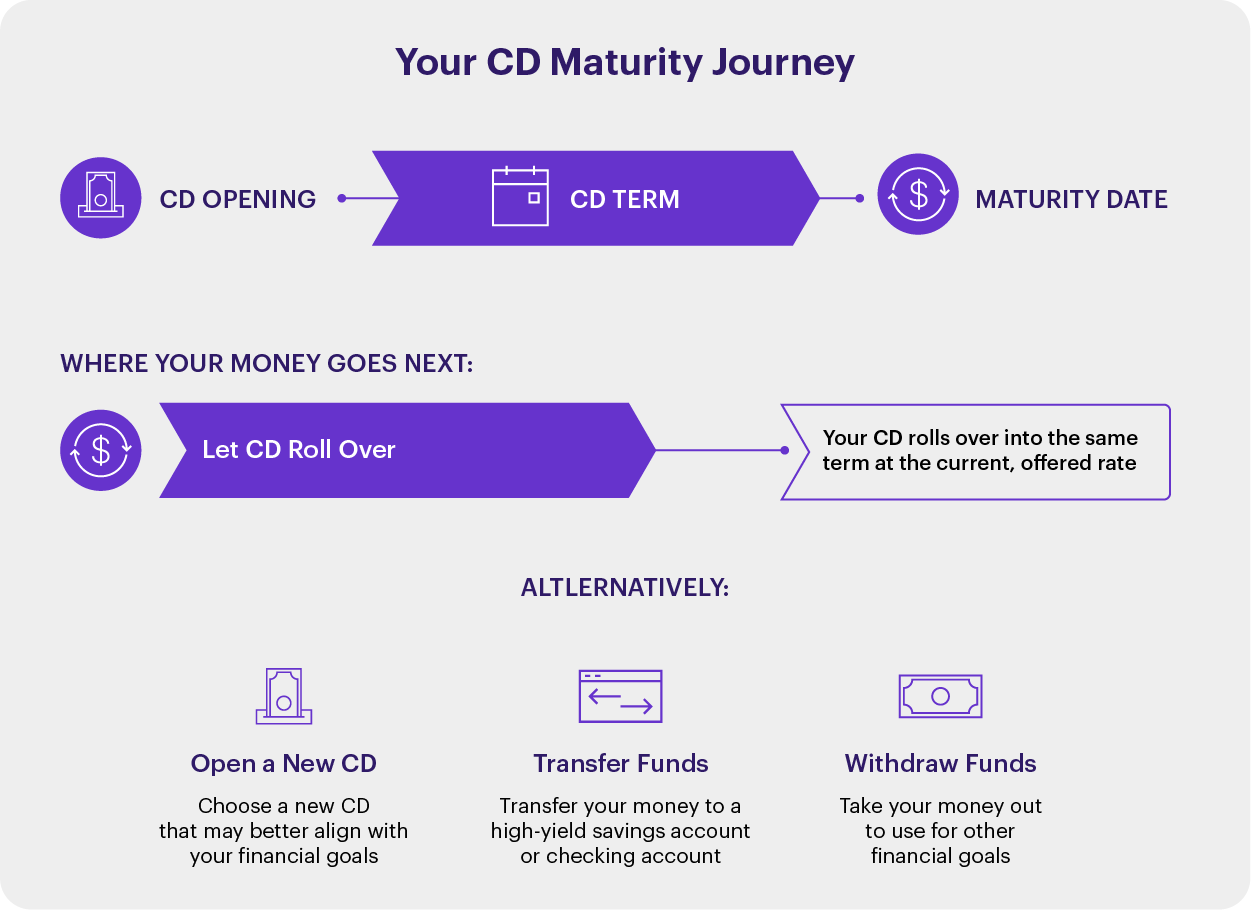
Once your CD term is up, you have four different choices you can make.
1. Let your CD automatically renew
If you want to keep earning interest and don’t need your money soon, the simplest choice is to let your CD automatically renew. In most cases, your money will roll over into a new CD with the same term length, at the effective rate at the time. This rate may be higher or lower than the rate you had before.
Your CD balance, including your deposit and interest earned, will then roll over into the new CD. By rolling over, you benefit from compounding interest, which helps you grow your savings faster over time. Depending on the financial institution, you also may be able to deposit additional funds into your CD during this grace period.
Keep in mind: The CD will renew for the same term, but at the current Annual Percentage Yield (APY). These rates fluctuate and may be higher or lower than your previous CD.
2. Adjust your CD strategy
Your CD maturity date is the perfect time to review your timeline. If you think you’ll need the money sooner, you can choose a shorter-term CD. If you are saving for a longer-term goal, you can instead switch to a longer-term CD that might offer a higher yield.
This is also a good time to check the latest interest rates. Based on your liquidity needs, the interest rate environment, and the available rates at the time of maturity, you may prefer to reinvest your money in a shorter- or longer-term CD tenor.
Keep in mind: Depending on the financial institution, you may be required to open a new CD and roll over the balances if you would like to change or add a different CD term to your strategy. Click here to check the current Bank CD rates on etrade.com.
3. Move your money to a high-yield savings account
If you want to keep earning interest but want more flexibility, a high-yield savings account lets you keep your cash growing in a FDIC-insured deposit account without waiting for a maturity date.
Because cash is easier to access in high-yield savings accounts without penalties, it’s best used for emergency savings, upcoming expenses, or money you may want to keep available while you decide what to do next.
Keep in mind that savings account rates, unlike CDs, are variable, which means the rate can change over time. As a result, you won’t be able to predict the exact return you’ll get on your cash in the same way that you can with a CD.
4. Withdraw the funds for another goal
Finally, you can also withdraw your funds during the grace period without paying a penalty when your CD matures. If you know you might need the money soon, this is a good time to withdraw the money into a checking account for your everyday expenses. Alternatively, you can also use this opportunity to shift the money to a brokerage account to be able to invest in the markets.
Additional CD strategies to consider
As part of your savings strategy, consider building a CD ladder. With this strategy, you divide your money across multiple CDs with staggered maturity dates. As each CD matures, you can decide whether to withdraw the money or renew it into a new CD and keep earning compounding interest. This approach can help you balance earning interest with more flexible access to part of your cash.
What’s the right choice for you?
Here are a few things to keep in mind when deciding what to do when your CD matures:
- When will you need the money? Can you wait until a new CD expires?
- Is this money part of an emergency fund, a near-term goal, or longer-term savings?
- What is the current APY for a new CD?
- How do current CD rates compare with your other cash options?
- Would a CD ladder help you balance interest and access?
CRC# 5775897 (08/2026)
How can E*TRADE from Morgan Stanley help?
Certificates of Deposit (CD)
Lock in a competitive fixed rate up to Annual Percentage Yield1,2 with a Bank CD account
Available terms from to . Plus, no minimums or monthly account fees3
Morgan Stanley Private Bank, Member FDIC.
Premium Savings Account
Boost your savings with a guaranteed 4.25% Annual Percentage Yield for 6 months4
With rates 11X the national averaged2 and FDIC-insured up to $500,000;6 certain conditions must be satisfied.
Morgan Stanley Private Bank, Member FDIC.
Max-Rate Checking
A fee-free checking account, built to do more
Seamless money movement, up to Annual Percentage Yield,7 and ATM fee refunds worldwide.8,d3
Morgan Stanley Private Bank, Member FDIC.
Brokerage account
Investing and trading account
Buy and sell stocks, ETFs, mutual funds, options, bonds, and more.